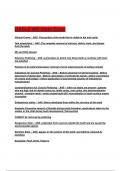
Incident Safety Officer Exam Questions With 100% Correct Answers
Incident Safety Officer Exam Questions With 100% Correct Answers - The ____ collects U.S. firefighter injury and fatality statistics associated with line-of-duty activities, including incident response, training, station, and apparatus activities, and other nonemergency activities, while performing official department-related tasks. - answerNational Fire Protection Association (NFPA) The ____ collects similar data but classifies line-of-duty deaths (LODDs) differently. The ___ includes what are known as "hometown hero" LODDs—that is, firefighters who have suffered a fatal heart attack within 24 hours of an incident response or physically stressful duty-related activity. (The NFPA omits the majority of these LODDs when collecting data.). - answerU.S. Fire Administration (USFA) _____ conducts LODD examinations of specific incidents to assist fire departments and the fire service in developing processes and procedures to prevent further LODD or injury occurrences. - answerNational Institute for Occupational Safety and Health (NIOSH) The____ collects and reports on injury and fatality data from its members, which may include those outside the United States. - answerInternational Association of Fire Fighters (IAFF) The percentage of firefighter LODDs due to noncardiac, on-scene causes (e.g., thermal insult, trauma, asphyxiation) is trending upward. The myriad reasons for this problem are being studied, although some fire service leaders believe that it boils down to the following dynamics: - answer■ Society has changed the building (lightweight construction). ■ Society has changed the fire (fuels with rapid, high-heat-release rates). ■ The fire service has been slow to adapt to societal changes A quick, low-cost solution to the statistical trend of LODDs due to noncardiac events at fires includes the more frequent use of a ___ - answertrained, persuasive ISO. In many ways, the ISO is the hazard "MEDIC" for an incident because this individual must - answerM = Monitor the incident environment and activities E = Evaluate hazard potentials D = Develop preventive measures I = Intervene when a threat exists C = Communicate urgent and advisory safety messages Ultimately responsible for the safety of all members operating at an incident. Serves as the "safety officer" when no one has been delegated the task. - answerIncident commander. Delegated the "hazard MEDIC" responsibility. - answerIncident safety officer Responsible for accomplishing tactical directives in a safe manner and ensuring that the firefighters assigned to them operate as a team using appropriate PPE. - answerCompany officers and group or division supervisors. Responsible for using appropriate PPE, performing directed tasks as trained, and maintaining team discipline. - answerIndividual firefighters. Uncommon sense can be described as the ability of the ISO to ask and ponder two questions: - answer1. What is the worst that can happen here? 2. What is the probability of it happening? Creating a safe operational environment is dependent on three (3) components (the triad): - answer· Procedures · Equipment · Personnel The word ____ is used in a very generic form here to describe all sorts of formal (written) and informal processes that are in place in a fire department. - answer"procedure" A ___ is defined in writing and can take on many forms: standard operating procedures (SOPs), standard operating guidelines (SOGs), departmental directives, temporary memorandums, and the like. In some departments, formal processes are derived from standard evolutions or lesson plans. - answerformal process _____ are strict directives that must be followed with little or no flexibility. - answerProcedures ____ are adaptable templates that allow flexibility in application. - answerGuidelines An ____ is a process or operation that is part of a department's routine but that is not written. Because they are not written, informal processes are typically learned through: · New member training · On-the-job training, and · Day-to-day routine - answerinformal process The first step in developing a formal SOP is - answerestablishing an administrative process to create, edit, alter, or delete established processes. Once the process is in place, a general format for SOP appearance and indexing is necessary. There are three (3) factors that must be addressed as part of the personnel leg of the safety triad: - answer· Training · Health, and · Attitude The safety culture of a department - answerThe department's safety culture is made up of the ideas, skills, and customs that are passed from one "generation" to another. The firefighter death or injury history of a given department - answerThe department's firefighter death or injury history is a factor in the attitude of its firefighters. A firefighter's line- of-duty death often shocks a department's members into an attitude change. Risk managers in most industries use a five-step process called classic risk management. An understanding of this process can help the ISO make a difference. (IEPCM) - answerHazard Identification Hazard Evaluation Hazard Prioritization Hazard Control Hazard Monitoring ________ is the primary function of an ISO. - answerIdentifying hazards In this step, a value is established for a hazard in terms of frequency and severity. - answerHazard Evaluation One method to simplify this matrix and priority system is to divide the matrix into three hazard classes—priorities 1, 2, and 3. - answerHazard Prioritization Once a hazard has been prioritized, efforts can be made to minimize exposure to the hazard or to correct the hazard. The overall strategy of hazard control is called mitigation. - answerHazard Control The fire service mitigation hierarchy refers to a preferred order of hazard control strategies: - answer■ Elimination ■ Reduction ■ Adaptation ■ Transfer
Written for
- Institution
- Incident Safety Officer
- Course
- Incident Safety Officer
Document information
- Uploaded on
- April 6, 2024
- Number of pages
- 14
- Written in
- 2023/2024
- Type
- Exam (elaborations)
- Contains
- Questions & answers
Subjects
-
incident safety officer exam questions with 100 c

Document also available in package deal