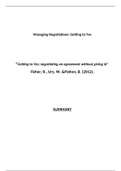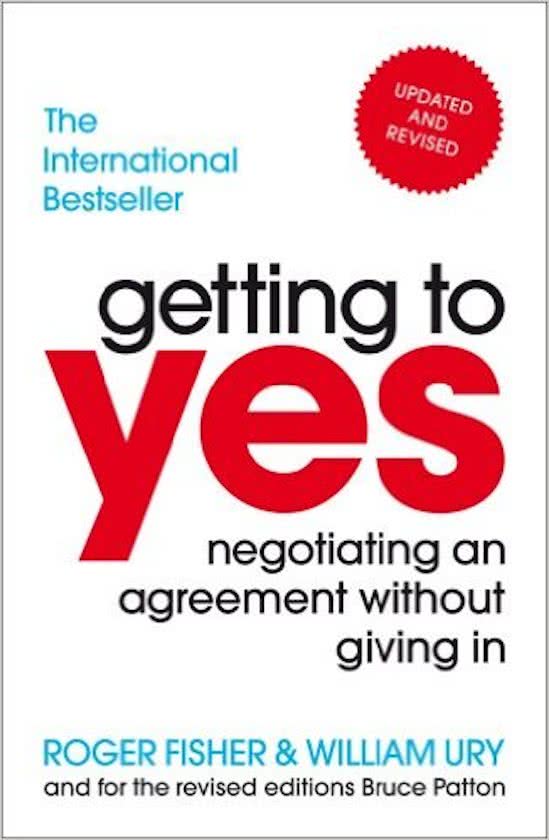
Managing Negotatono: Getng go oeo
“Getting to Yes; n negoatang tn tgeeenent withtuomt githnithng ithn”vi
Fioher, R., Ury, W. &Paton, . (2012).
SUMMARo
, ⁃ Positional bargaining - why is it bad?
⁃ Arguing over positions produces unwise outcomes - the more
you clarify your position, the more you defend it against attack, the more
committed you become to it. Furthermore, the more you try to convince he
other side of the impossibility or changing your opening position, the more
difficult it actually becomes to do so. Your ego becomes identieed with your
position and you now have a new interest in “saving face”.
⁃ Arguing over positions is inefcient - bargaining over positions
creates j incentives that stall settlement. The more you hold to your position,
the smaller will be the concessions and the more time and efort it will take
to discover whether an agreement is possible.
⁃ Arguing over positions endangers an ongoing relationship
⁃ When there are many parties, positional bargaining is even
worse - almost every negotiation involves more than two parties - the more
people involved in a negotiation, the more serious the drawbacks to
positional bargaining. When many parties are involved, positional bargaining
leads to the formation of coalitions among parties whose shared interests are
often more symbolic than substantive. eg. United Nations - such coalitions
often produce negotiations between the “north” and the “south”.
⁃ Being nice is no answer - there is a risk of producing a sloppy
agreement. Pursuing a soft and friendly form of positional bargaining makes
you vulnerable to someone who plays a hard game of positional bargaining.
In positional bargaining, a hard game dominates a soft one.
Difference between softt and hard negotiation:
“Getting to Yes; n negoatang tn tgeeenent withtuomt githnithng ithn”vi
Fioher, R., Ury, W. &Paton, . (2012).
SUMMARo
, ⁃ Positional bargaining - why is it bad?
⁃ Arguing over positions produces unwise outcomes - the more
you clarify your position, the more you defend it against attack, the more
committed you become to it. Furthermore, the more you try to convince he
other side of the impossibility or changing your opening position, the more
difficult it actually becomes to do so. Your ego becomes identieed with your
position and you now have a new interest in “saving face”.
⁃ Arguing over positions is inefcient - bargaining over positions
creates j incentives that stall settlement. The more you hold to your position,
the smaller will be the concessions and the more time and efort it will take
to discover whether an agreement is possible.
⁃ Arguing over positions endangers an ongoing relationship
⁃ When there are many parties, positional bargaining is even
worse - almost every negotiation involves more than two parties - the more
people involved in a negotiation, the more serious the drawbacks to
positional bargaining. When many parties are involved, positional bargaining
leads to the formation of coalitions among parties whose shared interests are
often more symbolic than substantive. eg. United Nations - such coalitions
often produce negotiations between the “north” and the “south”.
⁃ Being nice is no answer - there is a risk of producing a sloppy
agreement. Pursuing a soft and friendly form of positional bargaining makes
you vulnerable to someone who plays a hard game of positional bargaining.
In positional bargaining, a hard game dominates a soft one.
Difference between softt and hard negotiation: