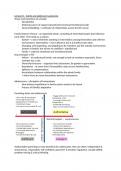
Lecture 8 – family and adolescent autonomy
Three main functions of a family:
- Socialization
- Enduring source of support (practical/economical/emotional/social)
- Social embedding = continuity of relationships across the life course
Family Systems Theory = an organized whole, consisting of interrelated parts that influence
each other. The family as a system.
- System = a set of elements standing in interrelation among themselves and with the
environment. Interrelation = not A affects B, but A & B affect each other.
- Changing, self-organizing, and adapting to its members and the outside environment.
System is flexible, but strives for stability (= equilibrium)
- Family = cohesive emotional unit (emotional bond)
Key principles in FST
- Holism – to understand family, not enough to look at members separately. Every
member has a role.
- Hierarchy/structure – organized into subsystems. By gender or generation.
- Boundaries – at every level. Permeability varies across families/time.
Spillover vs compensations
Associations between relationships within the whole family
= when there are loose boundaries between subsystems
Adolescence = disruption of homeostasis
- New balance/equilibrium in family system needs to be found
- Process of (family) adaptation
Parenting styles and adolescents
Authoritative parenting is most beneficial for adolescents, they are often: independent &
autonomous, responsible, self-confident, good self- & emotion regulation, socially skilled,
problem solving & critical thinking.
, What is the worst parents can do? Authoritarian parenting. Adolescents become dependent
& obedient, low self-confidence, low social competence, passivity & lack of school interest,
rebellious adolescents. Or Indifferent parenting. Adolescents become impulsive, delinquent
early experimentations with sex, drugs, and alcohol, mature earlier, academic
underachievement.
Indulgent parenting styles & adolescent functioning -> less mature & responsible,
conforming to peers, self-confident but misbehavior, impulsive. But: could be emotionally
secure & independent. Can be ok.
What do parents and adolescent fight about? Autonomy-related issues (= control issues)
Emotional autonomy = independence in close interpersonal relationships (especially
parents)
Behavioral autonomy = capacity to make independent decisions and follow through
Cognitive autonomy = independent values, opinions, and beliefs
Autonomy = making independent choices and decisions, having independent thoughts and
feelings (-> increased need for privacy)
Increase in parent-adolescent conflict: why?
- Psychoanalytic/biological perspective
Puberty (hormonal changes -> sexual partner + physical appearance) -> the family
needs to adjust to this.
- Maturational perspective
Cognitive development (question parental legitimacy of control + weighing options)
- Expectancy violation-realignment theory
Discrepancies in autonomy/independence expectations initially, particularly timing
autonomy <-> self-regulation. This creates tension.
- Social domain theory
Discrepancies in personal vs others domain issues
Assumption ‘shared environment’ = within each family, the same processes are at play for all
parent-child dyads. But: family systems theory, all connections differ!
Parental differential treatment (PDT). Parent-adolescent relationship as unshared
environment.
Conflict frequency with parents in families with 2+ children.
Why learning from experience? Better coping skills and new conflict resolution strategies.
Areas of disagreement already resolved for 2nd-born. All motivated to avoid the stress of
conflict with 1st-born. So, the conflict with the first born is the worst.
Spill over is also possible, so the conflict takes place between all children at the same time.
Three main functions of a family:
- Socialization
- Enduring source of support (practical/economical/emotional/social)
- Social embedding = continuity of relationships across the life course
Family Systems Theory = an organized whole, consisting of interrelated parts that influence
each other. The family as a system.
- System = a set of elements standing in interrelation among themselves and with the
environment. Interrelation = not A affects B, but A & B affect each other.
- Changing, self-organizing, and adapting to its members and the outside environment.
System is flexible, but strives for stability (= equilibrium)
- Family = cohesive emotional unit (emotional bond)
Key principles in FST
- Holism – to understand family, not enough to look at members separately. Every
member has a role.
- Hierarchy/structure – organized into subsystems. By gender or generation.
- Boundaries – at every level. Permeability varies across families/time.
Spillover vs compensations
Associations between relationships within the whole family
= when there are loose boundaries between subsystems
Adolescence = disruption of homeostasis
- New balance/equilibrium in family system needs to be found
- Process of (family) adaptation
Parenting styles and adolescents
Authoritative parenting is most beneficial for adolescents, they are often: independent &
autonomous, responsible, self-confident, good self- & emotion regulation, socially skilled,
problem solving & critical thinking.
, What is the worst parents can do? Authoritarian parenting. Adolescents become dependent
& obedient, low self-confidence, low social competence, passivity & lack of school interest,
rebellious adolescents. Or Indifferent parenting. Adolescents become impulsive, delinquent
early experimentations with sex, drugs, and alcohol, mature earlier, academic
underachievement.
Indulgent parenting styles & adolescent functioning -> less mature & responsible,
conforming to peers, self-confident but misbehavior, impulsive. But: could be emotionally
secure & independent. Can be ok.
What do parents and adolescent fight about? Autonomy-related issues (= control issues)
Emotional autonomy = independence in close interpersonal relationships (especially
parents)
Behavioral autonomy = capacity to make independent decisions and follow through
Cognitive autonomy = independent values, opinions, and beliefs
Autonomy = making independent choices and decisions, having independent thoughts and
feelings (-> increased need for privacy)
Increase in parent-adolescent conflict: why?
- Psychoanalytic/biological perspective
Puberty (hormonal changes -> sexual partner + physical appearance) -> the family
needs to adjust to this.
- Maturational perspective
Cognitive development (question parental legitimacy of control + weighing options)
- Expectancy violation-realignment theory
Discrepancies in autonomy/independence expectations initially, particularly timing
autonomy <-> self-regulation. This creates tension.
- Social domain theory
Discrepancies in personal vs others domain issues
Assumption ‘shared environment’ = within each family, the same processes are at play for all
parent-child dyads. But: family systems theory, all connections differ!
Parental differential treatment (PDT). Parent-adolescent relationship as unshared
environment.
Conflict frequency with parents in families with 2+ children.
Why learning from experience? Better coping skills and new conflict resolution strategies.
Areas of disagreement already resolved for 2nd-born. All motivated to avoid the stress of
conflict with 1st-born. So, the conflict with the first born is the worst.
Spill over is also possible, so the conflict takes place between all children at the same time.