ATS Exam 1 Questions With Correct Answers
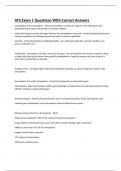
composition of the atmosphere - Answer atmosphere consists of a mixture of invisible gases and suspended microscopic solid particles and water droplets molecules of gases can be exchanged between the atmosphere and earth's surface by physical processes (volcanic eruptions) and biological processes (plant & animal respiration) aerosols - small solid particles and liquid droplets - (ex: wind-generated dust, volcanic ejections, sea spray, combustion etc.) steady state - atmosphere acts like a reservoir for gases. Gas concentration will remain constant as long as input rate (rate of gas moves from ground to atmosphere) is equal to output rate (rate of gas as it moves from atmosphere to ground). Residence time - average length of time that individual molecules of a given substance remain in the atmosphere. Homosphere: the entire atmosphere - chemical homogeneity of permanent gases heterosphere: above homosphere, lighter gases (hydrogen & helium) become dominant with increasing altitude. Contains no permanent gases. Permanent gases - Answer permanent gases: form a constant proportion of the atmospheric mass variable gases: distribution in the atmosphere varies in both time and space. Nitrogen (most common in atmosphere) - 28.02 stable gas accounting for 78% of the volume of all permanent gases. Long residence time because processes that add or remove nitrogen take a long time. Makes up more than 75% of the atmosphere oxygen (second most common) 21% volume of atmosphere 5000 years residence time nitrogen and oxygen make up 99% of the atmosphere argon make up 1% of permanent gases Nitrogen, oxygen, and argon → all permanent gases atmosphere consists of gases, liquids, and solids (memorize this list for test) Gases (permanent): 78% nitrogen 21% oxygen 0.93% argon Trace amounts of: .04% CO2 O3 (ozone) .01% water vapor (H2O) 1-4% Trace gases - Answer water vapor - most abundant of all variable gases (short residence time) exists as individual gas molecules - molecules not bonded together ¼ of 1% of total volume of atmosphere source comes from evaporation from earth's surface; concentration decreases rapidly with altitude most water vapor in lowest 5 km (3 mi) of atmosphere readily changes phase into liquid and solid forms hydrologic cycle: water constantly being cycled between planet and the atmosphere → evaporation, condensation, and precipitation. Carbon dioxide - supplied by plant and animal respiration, decay of organic material, volcanic eruptions, natural and anthropogenic (human-produced) combustion. Removed from atmosphere by photosynthesis - process when plants convert light energy to chemical energy - oxygen released as by-product. Carbon cycle and ocean acidification - Answer carbon cycle: photosynthesis converts solar energy, water, and carbon dioxide into simple carbohydrates, starches, and proteins - supplying plants with material for their own growth. Plants provide basic nutrients for grazing animals respiration - exchange of gases through leaves of plants - plants obtain oxygen needed to perform metabolic processes, "fixing" carbon into their cells in order to grow.
Written for
- Institution
- ATS
- Course
- ATS
Document information
- Uploaded on
- March 21, 2024
- Number of pages
- 10
- Written in
- 2023/2024
- Type
- Exam (elaborations)
- Contains
- Questions & answers
Subjects
-
ats stuvia
-
ats exam 1 questions with correct answers
-
composition of the atmosphere atmosphere consists
-
permanent gases permanent gases form a constant p

Document also available in package deal