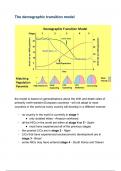
The demographic transition model
the model is based on generalisations about the birth and death rates of
primarily north-western European countries - will not adapt to most
countries in the world as every country will develop in a different manner.
- no country in the world is currently in stage 1
● only isolated tribes - Amazon rainforest
- all the HICs in the world are either at stage 4 or 5 - Spain
● most have experienced all of the previous stages
- the poorest LICs are in stage 2 - Niger
- LICs that have experienced socioeconomic development are in
stage 3 - Brazil
- some NICs may have entered stage 4 - South Korea and Taiwan
, The high fluctuating stage - stage 1
- crude birth rate is high and stable
- crude death rate is high and fluctuating due to sporadic famine,
disease and war
- population growth is very slow and there may be periods of decline
- infant mortality rate is high
- life expectancy is low
- high proportion of young dependants
- pre-industrial society
● most live in rural areas, dependent on subsistence farming
Early expanding stage
- death rates decline significantly
- birth rate remains at its previous level - fertility changes slowly
- gap between these 2 widens ---> rate of natural change increases
to a peak
- infant mortality rate falls
- life expectancy increases
- proportion of population under 15 increases
- better nutrition, improved healthcare, improved water supply, more
efficient sewage systems
- However, many LICs have not followed this stage in recent times
as urbanisation has not always been accompanied by
industralisation
- considerable rural-to-urban migration
Late expanding stage - stage 3
- adjustment of social norms ---> decreasing birth rates to match
death rates
the model is based on generalisations about the birth and death rates of
primarily north-western European countries - will not adapt to most
countries in the world as every country will develop in a different manner.
- no country in the world is currently in stage 1
● only isolated tribes - Amazon rainforest
- all the HICs in the world are either at stage 4 or 5 - Spain
● most have experienced all of the previous stages
- the poorest LICs are in stage 2 - Niger
- LICs that have experienced socioeconomic development are in
stage 3 - Brazil
- some NICs may have entered stage 4 - South Korea and Taiwan
, The high fluctuating stage - stage 1
- crude birth rate is high and stable
- crude death rate is high and fluctuating due to sporadic famine,
disease and war
- population growth is very slow and there may be periods of decline
- infant mortality rate is high
- life expectancy is low
- high proportion of young dependants
- pre-industrial society
● most live in rural areas, dependent on subsistence farming
Early expanding stage
- death rates decline significantly
- birth rate remains at its previous level - fertility changes slowly
- gap between these 2 widens ---> rate of natural change increases
to a peak
- infant mortality rate falls
- life expectancy increases
- proportion of population under 15 increases
- better nutrition, improved healthcare, improved water supply, more
efficient sewage systems
- However, many LICs have not followed this stage in recent times
as urbanisation has not always been accompanied by
industralisation
- considerable rural-to-urban migration
Late expanding stage - stage 3
- adjustment of social norms ---> decreasing birth rates to match
death rates