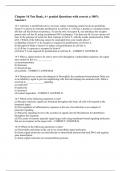
Chapter 16 Test Bank, A+ graded Questions with correct a 100% Answers
16-1 Cell lines A and B both survive in tissue culture containing serum but do not proliferate. Factor F is known to stimulate proliferation in cell line A. Cell line A produces a receptor protein (R) that cell line B does not produce. To test the role of receptor R, you introduce this receptor protein into cell line B, using recombinant DNA techniques. You then test all of your various cell lines in the presence of serum for their response to factor F, with the results summarized in Table Q16-1.Which of the following cannot be concluded from your results above? (a) Binding of factor F to its receptor is required for proliferation of cell line A. (b) Receptor R binds to factor F to induce cell proliferation in cell line A. (c) Cell line A expresses a receptor for factor F. (d) Factor F is not required for proliferation in cell line B. - CORRECT ANSWER-B 16-5 When a signal needs to be sent to most cells throughout a multicellular organism, the signal most suited for this is a ___________. (a) neurotransmitter. (b) hormone. (c) dissolved gas. (d) scaffold. - CORRECT ANSWER-B 16-6 During nervous-system development in Drosophila, the membrane-bound protein Delta acts as an inhibitory signal to prevent neighboring cells from developing into neuronal cells. Delta is involved in ______________ signaling. (a) endocrine (b) paracrine (c) neuronal (d) contact-dependent - CORRECT ANSWER-D 16-7 Which of the following statements is true? (a) Because endocrine signals are broadcast throughout the body, all cells will respond to the hormonal signal. (b) The regulation of inflammatory responses at the site of an infection is an example of paracrine signaling. (c) Paracrine signaling involves the secretion of signals into the bloodstream for distribution throughout the organism. (d) The axons of neurons typically signal target cells using membrane-bound signaling molecules that act on receptors in the target cells. - CORRECT ANSWER-B 16-10 Which of the following statements is false? (a) Nucleotides and amino acids can act as extracellular signal molecules. (b) Some signal molecules can bind directly to intracellular proteins that bind DNA and regulate gene transcription. (c) Some signal molecules are transmembrane proteins. (d) Dissolved gases such as nitric oxide (NO) can act as signal molecules, but because they cannot interact with proteins they must act by affecting membrane lipids. - CORRECT ANSWER-D 16-11 All members of the steroid hormone receptor family __________________. (a) are cell-surface receptors. (b) do not undergo conformational changes. (c) are found only in the cytoplasm. (d) interact with signal molecules that diffuse through the plasma membrane. - CORRECT ANSWER-D 16-13 The lab you work in has discovered a previously unidentified extracellular signal molecule called QGF, a 75,000-dalton protein. You add purified QGF to different types of cells to determine its effect on these cells. When you add QGF to heart muscle cells, you observe an increase in cell contraction. When you add it to fibroblasts, they undergo cell division. When you add it to nerve cells, they die. When you add it to glial cells, you do not see any effect on cell division or survival. Given these observations, which of the following statements is most likely to be true? (a) Because it acts on so many diverse cell types, QGF probably diffuses across the plasma membrane into the cytoplasm of these cells. (b) Glial cells do not have a receptor for QGF. (c) QGF activates different intracellular signaling pathways in heart muscle cells, fibroblasts, and nerve cells to produce the different responses observed. (d) - CORRECT ANSWER-C 16-15 Acetylcholine is a signaling molecule that elicits responses from heart muscle cells, salivary gland cells, and skeletal muscle cells. Which of the following statements is false? (a) Heart muscle cells decrease their rate and force of contraction when they receive acetylcholine, whereas skeletal muscle cells contract. (b) Heart muscle cells, salivary gland cells, and skeletal muscle cells all express an acetylcholine receptor that belongs to the transmitter-gated ion channel family. (c) Active acetylcholine receptors on salivary gland cells and heart muscle cells activate different intracellular signaling pathways. (d) Heart muscle cells, salivary gland cells, and skeletal muscle cells all respond to acetylcholine within minutes of receiving the signal. - CORRECT ANSWER-B 16-17 The local mediator nitric oxide stimulates the intracellular enzyme guanylyl cyclase by ________________. (a) activating a G protein. (b) activating a receptor tyrosine kinase. (c) diffusing into cells and stimulating the cyclase directly. (d) activating an intracellular protein kinase. - CORRECT ANSWER-C
Written for
- Institution
- Molecular Cell Biology,
- Course
- Molecular Cell Biology,
Document information
- Uploaded on
- February 12, 2024
- Number of pages
- 8
- Written in
- 2023/2024
- Type
- Exam (elaborations)
- Contains
- Questions & answers
Subjects
-
chapter 16 test bank a graded questions with cor

Document also available in package deal