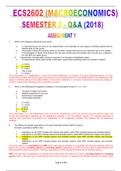
1. Which of the following statements are correct?
a. In macroeconomics we focus on the determination of the demand for and supply of individual goods and the
determination of their prices.
b. The impact of fiscal and monetary policy on the level of output and income is an important topic in this module.
c. If the population of South Africa grows at 5% per year and the economic growth rate is 3% per year, a decline in
the real GDP per capita occurs.
d. Expansionary monetary policy during a recession is an example of stabilisation policy.
e. An expansionary fiscal policy implies a decrease in government spending and/or an increase in taxation.
1. a, b and c
2. b, c and d
3. b, d and e
4. Only b and c
5. b, c and e
The correct option is 2. Statements b, c and d are correct. Statement a is incorrect. The focus in Macroeconomics is on the
current level of output and income, given the structure of the economy and not on the determination of the demand for and
supply of individual goods and the determination of their prices. Statement e is incorrect. Expansionary fiscal policy implies an
increase in government spending and/or a decrease in taxation.
2. Which of the following are exogenous variables in the consumption function C = c 0 + cYD?
a. The level of output and income.
b. Marginal propensity to consume.
c. Autonomous consumption.
d. Consumption spending.
1. a, b and c
2. b, c and d
3. a and d
4. b and c
5. Only b
The correct option is 4. Only statements b and c are correct. Statements a and d are incorrect since the level of output and
income and consumption spending are the endogenous variables in the consumption function. The marginal propensity to
consume and autonomous consumption are independent of the endogenous variables and therefore are the exogenous
variables.
3. The difference between expenditure on the gross domestic product (GDP) and gross
domestic expenditure (GDE) is that …
1. expenditure on the GDP includes both imports and exports, while GDE includes exports and excludes imports.
2. expenditure on the GDP includes exports and excludes imports, while GDE includes both imports and exports.
3. expenditure on the GDP includes exports and excludes imports, while GDE includes imports and excludes
exports.
4. expenditure on the GDP includes imports and excludes exports, while GDE includes exports and excludes
imports.
The correct option is 3. Expenditure on GDP is the total value of spending on final goods and services produced within the
borders of a country, including exports but excluding imports. Expenditure on GDP is the total value of spending on South
African produced goods and services. Therefore, expenditure on GDP represents the demand for domestic goods. 4
GDE is the total value of spending on final goods and services within the borders of a country, including imports but excluding
exports. GDE is the total value of spending in South Africa; therefore, it represents the domestic demand for goods. Study
Page 1 of 15
a. In macroeconomics we focus on the determination of the demand for and supply of individual goods and the
determination of their prices.
b. The impact of fiscal and monetary policy on the level of output and income is an important topic in this module.
c. If the population of South Africa grows at 5% per year and the economic growth rate is 3% per year, a decline in
the real GDP per capita occurs.
d. Expansionary monetary policy during a recession is an example of stabilisation policy.
e. An expansionary fiscal policy implies a decrease in government spending and/or an increase in taxation.
1. a, b and c
2. b, c and d
3. b, d and e
4. Only b and c
5. b, c and e
The correct option is 2. Statements b, c and d are correct. Statement a is incorrect. The focus in Macroeconomics is on the
current level of output and income, given the structure of the economy and not on the determination of the demand for and
supply of individual goods and the determination of their prices. Statement e is incorrect. Expansionary fiscal policy implies an
increase in government spending and/or a decrease in taxation.
2. Which of the following are exogenous variables in the consumption function C = c 0 + cYD?
a. The level of output and income.
b. Marginal propensity to consume.
c. Autonomous consumption.
d. Consumption spending.
1. a, b and c
2. b, c and d
3. a and d
4. b and c
5. Only b
The correct option is 4. Only statements b and c are correct. Statements a and d are incorrect since the level of output and
income and consumption spending are the endogenous variables in the consumption function. The marginal propensity to
consume and autonomous consumption are independent of the endogenous variables and therefore are the exogenous
variables.
3. The difference between expenditure on the gross domestic product (GDP) and gross
domestic expenditure (GDE) is that …
1. expenditure on the GDP includes both imports and exports, while GDE includes exports and excludes imports.
2. expenditure on the GDP includes exports and excludes imports, while GDE includes both imports and exports.
3. expenditure on the GDP includes exports and excludes imports, while GDE includes imports and excludes
exports.
4. expenditure on the GDP includes imports and excludes exports, while GDE includes exports and excludes
imports.
The correct option is 3. Expenditure on GDP is the total value of spending on final goods and services produced within the
borders of a country, including exports but excluding imports. Expenditure on GDP is the total value of spending on South
African produced goods and services. Therefore, expenditure on GDP represents the demand for domestic goods. 4
GDE is the total value of spending on final goods and services within the borders of a country, including imports but excluding
exports. GDE is the total value of spending in South Africa; therefore, it represents the domestic demand for goods. Study
Page 1 of 15