Brooks Biodiversity Unit 3 Exam 2024 with complete solution
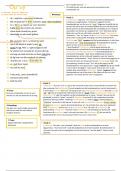
Plants Architecture - Plant needs
i. collection & conversion of solar energy -> leaves
ii. positioning & support of leaves -> stems iii. anchorage & absorption -> roots
iv. transport -> vascular system
Leaf Structure - Epidermis, Mesophyll, and Vein (Vascular Bundle)
Epidermis contains what? - - Cuticle
- Guard cells with Stomata
Epidermis - outermost cell layer of a plant body
cutin: (wax) excreted by epidermis
Cuticle - Waxy waterproof covering of a plant.
Produced by the epidermis and has wax to resist desiccation.
Guard Cells - Responsible for opening and closing stomata.
Works together with stomata to regulate gas exchange.
Prevents movement of water ACROSS surface
Stomata - Small openings on the underside of a leaf through which oxygen and carbon dioxide can move.
Mostly on lower surfaces, sometimes on upper surfaces. Found on both surfaces. Allows for gas exchange. 2 aspects of Photosynthesis - light dependent reactions
light independent reactions
Mesophyll contains what? - - Parenchyma - Dicots have Palisade & Spongy Layers
Mesophyll - Middle leaf structures photosynthetic layer.
Parenchyma - Ground tissue that forms the bulk of the mesophyll
Can be modified into collenchyma and sclerenchyma
Thin and flexible cells
Most common and versatile ground tissue
Used for metabolic functions and storage of organic products
Palisade & Spongy layers - Palisade layer: where light dependent reactions occur, near the surface. Top part of the mesophyll in dicot plants. Spongy mesophyll or spongy parenchyma: soft lower layer. Has access to CO2 through stomata. Kelvin Cycle: where carbon fixation occurs, converting nonorganic CO2 into sugars.
Vein (Vascular bundle) - Transports materials throughout the leaf and contains the xylem and phloem.
Separating the VB = damage.
Stem Structure - Epidermis, Cortex, Collenchyma, Sclerenchyma, Vascular Tissues
Xylem - (Xylem Up)
Distributes water from roots throughout Aimed towards stem Red
Tells age of tree
Contains: tracheids & vessel members
Tracheids - Thin, hollow, narrow tube, dead cells with perforated, tapered ends.
Vestigial structure
First kind of tube made
Present in early vascular plants and present in angiosperms and gymnosperms (slow flow)
Vessel Members - Thick, hollow, wide tube, dead cells with large holes on end.
Clearly visible
Phloem - (Phloem Down)
Distributes the products of photosynthesis (sugary water) to plants tissues. Blue
Contains: Sieve tube members (element) & Companion cells
Sieve Tube Members - hollow, living cells with perforated cells
Companion Cells - living cells that help keep sieve tube member cells alive. Production of sugars in Kelvin Cycle require transportation done by companion cells into phloem
Which 4 cell types is most active metabolically when fully functional? - companion cells
Epidermis in Trees - is replaced by bark or cork. Produced by the cork cambium (tissues that produce other tissues). Cork (dead) = phloem (alive)
Cork cambium produces cork. Trees grow wider cause xylem will get clogged
Plants Architecture - Plant needs
i. collection & conversion of solar energy -> leaves
ii. positioning & support of leaves -> stems iii. anchorage & absorption -> roots
iv. transport -> vascular system
Leaf Structure - Epidermis, Mesophyll, and Vein (Vascular Bundle)
Epidermis contains what? - - Cuticle
- Guard cells with Stomata
Epidermis - outermost cell layer of a plant body
cutin: (wax) excreted by epidermis
Cuticle - Waxy waterproof covering of a plant.
Produced by the epidermis and has wax to resist desiccation.
Guard Cells - Responsible for opening and closing stomata.
Works together with stomata to regulate gas exchange.
Prevents movement of water ACROSS surface
Stomata - Small openings on the underside of a leaf through which oxygen and carbon dioxide can move.
Mostly on lower surfaces, sometimes on upper surfaces. Found on both surfaces. Allows for gas exchange. 2 aspects of Photosynthesis - light dependent reactions
light independent reactions
Mesophyll contains what? - - Parenchyma - Dicots have Palisade & Spongy Layers
Mesophyll - Middle leaf structures photosynthetic layer.
Parenchyma - Ground tissue that forms the bulk of the mesophyll
Can be modified into collenchyma and sclerenchyma
Thin and flexible cells
Most common and versatile ground tissue
Used for metabolic functions and storage of organic products
Palisade & Spongy layers - Palisade layer: where light dependent reactions occur, near the surface. Top part of the mesophyll in dicot plants. Spongy mesophyll or spongy parenchyma: soft lower layer. Has access to CO2 through stomata. Kelvin Cycle: where carbon fixation occurs, converting nonorganic CO2 into sugars.
Vein (Vascular bundle) - Transports materials throughout the leaf and contains the xylem and phloem.
Separating the VB = damage.
Stem Structure - Epidermis, Cortex, Collenchyma, Sclerenchyma, Vascular Tissues
Xylem - (Xylem Up)
Distributes water from roots throughout Aimed towards stem Red
Tells age of tree
Contains: tracheids & vessel members
Tracheids - Thin, hollow, narrow tube, dead cells with perforated, tapered ends.
Vestigial structure
First kind of tube made
Present in early vascular plants and present in angiosperms and gymnosperms (slow flow)
Vessel Members - Thick, hollow, wide tube, dead cells with large holes on end.
Clearly visible
Phloem - (Phloem Down)
Distributes the products of photosynthesis (sugary water) to plants tissues. Blue
Contains: Sieve tube members (element) & Companion cells
Sieve Tube Members - hollow, living cells with perforated cells
Companion Cells - living cells that help keep sieve tube member cells alive. Production of sugars in Kelvin Cycle require transportation done by companion cells into phloem
Which 4 cell types is most active metabolically when fully functional? - companion cells
Epidermis in Trees - is replaced by bark or cork. Produced by the cork cambium (tissues that produce other tissues). Cork (dead) = phloem (alive)
Cork cambium produces cork. Trees grow wider cause xylem will get clogged