IF Summary – Lecture 1
Learning Goals
1. Define economic (financial) globalization.
2. Describe the key trends and developments of the global economy and financial
market.
3. Review the historic narrative of the international financial architecture. Identify the
institutional features of major periods in the evolution of global economy
4. Clarify the reasons for increase in globalization
Learning Goal 1: Define economic (financial) globalization:
Globalization: development of an increasingly integrated global economy marked especially
by free trade, free flow of capital, and the tapping of cheaper foreign labor markets
- In short: Globalization is an increase in international flows of…
1. Goods & Services,
2. Capital,
3. Information/Ideas
4. People (Migration)
International Finance: Part of the general international economics discipline.
International economics is about how nations interact through trade of goods and services,
flows of money, and investment. ➔ Important because nations are more closely linked than
ever
Learning Goal 2: Describe the key trends and developments of the global economy and
financial market
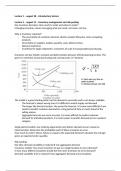
Globalization was not even – it came in waves
- 1st Wave: 19th century to 1913 (up until 1st WW)
- 2nd Wave: 2nd Half of the 20th century, after WW2
- Financial globalization followed a similar long-run trends
1. Wave: Second Industrial Revolution (1850-1913)
2. Wave: Globalization: After WW2, financial globalization grew exponentially
➔ However, strong regional differences! Financial globalization mainly
happened between advanced economies.
- Globalization caused large trade imbalances: Some countries accumulated large
debts (US, Spain, UK) while others accumulated trade surpluses (Germany, China,
Russia)
- Labor is increasingly mobile
Learning Goal 3: Review the historic narrative of the international financial architecture.
Identify the institutional features of major periods in the evolution of global economy
Review the historic narrative of the international financial architecture
- Why? Tracing evolution of international financial architecture over the last 100 (or
more) years helps to understand the reasons for observed trends in globalization!
Learning Goals
1. Define economic (financial) globalization.
2. Describe the key trends and developments of the global economy and financial
market.
3. Review the historic narrative of the international financial architecture. Identify the
institutional features of major periods in the evolution of global economy
4. Clarify the reasons for increase in globalization
Learning Goal 1: Define economic (financial) globalization:
Globalization: development of an increasingly integrated global economy marked especially
by free trade, free flow of capital, and the tapping of cheaper foreign labor markets
- In short: Globalization is an increase in international flows of…
1. Goods & Services,
2. Capital,
3. Information/Ideas
4. People (Migration)
International Finance: Part of the general international economics discipline.
International economics is about how nations interact through trade of goods and services,
flows of money, and investment. ➔ Important because nations are more closely linked than
ever
Learning Goal 2: Describe the key trends and developments of the global economy and
financial market
Globalization was not even – it came in waves
- 1st Wave: 19th century to 1913 (up until 1st WW)
- 2nd Wave: 2nd Half of the 20th century, after WW2
- Financial globalization followed a similar long-run trends
1. Wave: Second Industrial Revolution (1850-1913)
2. Wave: Globalization: After WW2, financial globalization grew exponentially
➔ However, strong regional differences! Financial globalization mainly
happened between advanced economies.
- Globalization caused large trade imbalances: Some countries accumulated large
debts (US, Spain, UK) while others accumulated trade surpluses (Germany, China,
Russia)
- Labor is increasingly mobile
Learning Goal 3: Review the historic narrative of the international financial architecture.
Identify the institutional features of major periods in the evolution of global economy
Review the historic narrative of the international financial architecture
- Why? Tracing evolution of international financial architecture over the last 100 (or
more) years helps to understand the reasons for observed trends in globalization!