aPHR Study Kit Questions and Answers
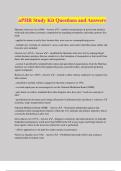
aPHR Study Kit Questions and Answers Sherman Anti-trust Act (1890) - Answer ️️ ---curbed concentrations of power that interfere with trade and reduce economic competition by regulating monopolies and trade; protects free trade --applied to unions in early days because they were seen as a monopolizing power --forbade any "restraint of commerce" across state lines, and courts ruled that union strikes and boycotts were included Clayton Act (1914) - Answer ️️ ---modified the Sherman Anti-trust Act by making illegal certain business practices that are conducive to the formation of monopolies or that result from them, like anticompetitive mergers and acquisitions. --section 6 specifically exempted labor union and agricultural organizations from the Sherman Antitrust Act which effectively legalized boycotts, peaceful strikes, and peaceful picketing against companies Railway Labor Act (1926) - Answer ️️ ---created to allow railway employees to organize into labor unions --amended to include Airlines engaged in interstate commerce in 1936. --covered employees are encouraged to use the National Mediation Board (NMB) --puts limits on strikes; mandated that when disputes arise they must "work now and grieve later". --presidential involvement and cooling off periods if arbitration fails and there is a threat to US economy, trade, transportation needs National Mediation Board (NMB) - Answer ️️ ---Permanent independent agency that coordinates labor-management relations within the U.S. railroads and airlines industries (those covered by the Railway Labor Act) Davis-Bacon Act (1931) - Answer ️️ ---Requires contractors and subcontractors on federally funded/assisted projects worth more than $2000 in the US to pay wages and fringe benefits at least equal to those in the local area where the work is performed --Allows apprentices to be paid less under certain circumstances Norris-La Guardia Act (1932) - Answer ️️ ---Prohibited and made yellow-dog contracts unenforceable in federal court. --Also prohibited federal courts from issuing injunctions of any kind against peaceful strikes, boycotts, or picketing when used by a union in connection with a labor dispute which forces employer to openly and fairly discuss any disputes yellow-dog contracts - Answer ️️ ---any contract where a worker had to agree not to be a member of the union before they could be hired labor dispute - Answer ️️ ---any disagreement about working conditions National Industrial Recovery Act, NIRA (1933) - Answer ️️ ---declared unconstitutional by the Supreme Court in 1935 because it was too far-reaching (Schecter Poultry Case) --replaced by the National Labor Relations Act NLRA in the same year which is still in effect. --Proposed the creation of "codes of fair competition" for each of several different industries. Required every business to identify with and belong to a trade association and would then be federally licensed. Anti-trust laws would be superseded in favor of the code. If a business refused to participate in the code, its license could be suspended, that business would end all operations immediately. --established that employees could not be required as a condition of employment to join or refrain from joining a union Wagner-Peyser Act (1933) - Answer ️️ ---created a nationwide system of employment offices, known as Employment Service Offices, run by the US Department of Labor's Employment and Training Administration (ETA). --offices provide jobseekers with assistance in their job search, assistance in searching jobs for unemployment insurance recipients, and recruitment services for employers --amended by the Workforce Investment Act (1988) Securities and Exchange Act (1934) - Answer ️️ ---provides for governance in the secondary market, which is all trading after the initial public offering --created the Securities and Exchange Commission Securities Exchange Commission (SEC) - Answer ️️ ---created by the Securities and Exchange Act --has oversight authority for the trading of stocks in America --extends the disclosure doctrine of investigative protection to securities listed and registered for public trading on any of the US exchanges Copeland Anti-Kickback Act (1934) - Answer ️️ ---precludes federal contractors or subcontractors from inducing an employee to giving up any part of their wages to the employer for the benefit of having or keeping the job National Labor Relations Act, NLRA (1935)*** - Answer ️️ --- aka "The Wagner Act" --grants and protects employees' right to organize, join unions, and engage in collective bargaining and other "concerted activities" --Also protects against any unfair labor practices by employers aimed at employees --Key Provisions: 1. Right of workers to organize into unions for collective bargaining 2. Requirement of employers to bargain in good faith when employees have voted in favor of a union to represent them. 3. Requirement that unions represent all members equally without showing favoritism 4. Covering non management employees in private industry who are not already covered by the Railway Labor Act --Established the NLRB concerted activities - Answer ️️ ---anytime two or more employees co
Written for
- Institution
- APHR - Associate Professional in Human Resources
- Course
- APHR - Associate Professional in Human Resources
Document information
- Uploaded on
- January 24, 2024
- Number of pages
- 62
- Written in
- 2023/2024
- Type
- Exam (elaborations)
- Contains
- Questions & answers
Subjects
-
aphr study kit questions and answers

Document also available in package deal