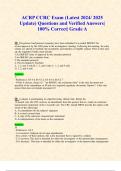
ACRP CCRC Exam (Latest 2024/ 2025 Update) Questions and Verified Answers| 100% Correct| Grade A
ACRP CCRC Exam (Latest 2024/ 2025 Update) Questions and Verified Answers| 100% Correct| Grade A Q: The protocol and protocol summary have been submitted to a central IRB/IEC for review/approval by the CRO prior to the investigators' meeting. Following the meeting, the entry criteria are altered to facilitate the recruitment and retention of eligible subject. Prior to trial start-up, the regulatory binder must include: 1.An IRB/IEC letter of approval for the amended protocol 2.An IRB/IEC site evaluation form 2.The amended protocol 4. The investigator's brochure A. 1, 2, and 3 only B. 1, 2, and 4 only C. 1, 3, and 4 only D. 2, 3, and 4 only Answer: C - References: E6 4.4; E6 4.5.2; E6 4.9.4; E6 8.2.7 - Of the 4 choices, choice #2 - "an IRB/IEC site evaluation form" is the only document not specified to the amendment or IP and not a required regulatory document. Option C is the only answer that does not include document #2 Q: A subject is participating in a lipid-lowering clinical trial. Before his 12-month visit, the CRC receives an amendment from the sponsor that in- cludes an outcomes measurement instrument at the 12-month visit. The CRC should FIRST provide the subject with which of the following? A. An amendment for the subject's signature B. A revised consent form C. A copy of the outcomes measurement instrument D. An interpretation of the items on the instrument Answer: B - References: 4.8.2 - A is incorrect: Subjects do not sign amendments - B is correct: Of these options, this is the document that is signed by a subject - C is incorrect This item is intended for either the investigator or the sponsor/data management - D is incorrect: This item is intended for either the investigator or the sponsor/data management Q: Which of the following scenarios are considered SAEs? 1.Infection following surgery prolonging hospital stay 2.Pregnancy resulting in normal delivery of twins 2.Boating accident with overnight hospitalization 4. Use of illicit drugs during the trial A. 1 and 3 only B. 1 and 4 only C. 2 and 3 only D. 2 and 4 only Answer: A - References: E6 1.50, E2A IIB - Note: per ICH guidelines E6 1.50 Serious Adverse Event (SAE) or Serious Adverse Drug Reaction (Serious ADR) is defined as any untoward medical occurrence that at any dose results in death, is life-threatening, requires inpatient hospitalization or prolongation of existing hospitalization (scenarios #1 and #3), results in persistent or significant disability/incapacity, or is a congenital anomaly/birth defect - 1 is correct - prolongation of existing hospitalization - 2 is incorrect - pregnancy is not an SAE - 3 is correct - inpatient hospitalization - 4 is incorrect - not an SAE - A is correct since it is the only option that contains both 1 and 3 Q: A subject in a Phase I oncology trial experiences nausea with vomiting after IP infusion which results in an inpatient hospitalization. Nausea with vomiting does not appear in the investigator's Brochure. The investigator should rate this event as: A. Expected and serious B. Expected and not serious C. Unexpected and serious D. Unexpected and not serious Answer: C - References: E2A II.A.3; E2A IIB; E2A III.A.1 - Since, as stated in the stem of the question, nausea with vomiting does not appear in the Investigators' Brochure, it meets the criteria of "unexpected." The event is also considered "serious" as inpatient hospitalization meets the definition of a Serious Adverse Event per ICH guideline E6 1.50 - A is incorrect: this event is unexpected - B is incorrect: this event is unexpected and serious - C is correct: this event is unexpected and serious - D is incorrect: this event is serious Q: During a respiratory trial, a subject called the CRC 1 week before his next scheduled trial visit and reports upper respiratory symptoms and a pea-sized lump in his neck. Which of the following should the CRC do FIRST? A. Inform the sponsor's medical monitor or the situation B. Instruct the subject to contact his primary care physician C. Have the subject come to the site for an interim assessment D. Cancel the scheduled follow-up visit until symptoms resolve Answer: C - References: E6 4.3.2 - A is incorrect: the subject needs to be assessed before the sponsor is contacted - B is incorrect: the investigator, not the primary care physician, should ensure that adequate medical care is provided to the subject for and adverse event - C is correct: in the given scenario, the subject needs to be evaluated by the investigator so that adequate medical care can be provided and relatedness of the AEs to the clinical trial can be assessed - D is incorrect: the subject needs to be evaluated as subject's safety should always be the primary concern in clinical care, particularly in the context of a clinical trial Q: Which of the following is a liver function test? A. TSH B. LDH C. BUN D. Hct Answer: B - A is incorrect: Thyroid Stimulating Hormone - test used to assess the function of the thyroid gland - B is correct: Lactate Dehydrogenase - test used to check for damage to the tissue of the heart, liver, kidney, muscles, brain, blood cells, and lungs - C is incorrect: Blood Urea Nitrogen - kidney function test - D is incorrect: Hematocrit - blood test measuring the percentage of the volume of whole blood that is made up of red blood cells. - NOTE: to be certified, candidates are expected to have a general knowledge of laboratory terminology, tests, and procedures Q: At the month-3 visit of a Phase III double-blind trial, the subject informs the CRC that he was seen in the emergency department for an anaphylactic reaction. The subject states, "The doctor told me I was very lucky, I might have died." Having received this information, the MOST appropriate sequence of action is to inform the: A. PI, sponsor, and IRB/IEC B. Sponsor, PI, and IRB/IEC C. Sponsor, IRB/IEC, and PI D. PI, IRB/IEC, and sponsor Answer: A - References: E6 4.11.1 - A is correct: The study PI should be notified first ash they are responsible for the subject's wellbeing while on the clinical trial and should ensure that adequate medical care is provided to the subject for all adverse events. Per ICH guidelines, all SAEs should be reported immediately to the sponsor and to the IRB/IEC per applicable regulatory requirements. - B is incorrect: it would not be appropriate to notify the sponsor before making the PI aware of subject reported safety information - C is incorrect: it would not be appropriate to notify the sponsor before making the PI aware of subject reported safety information - D is incorrect: per ICH guidelines, all SAEs should be reported immediately to the study sponsor and to the IRB/IEC per applicable regulatory requirements Q: A subject is being screened for an allergic rhinitis trial. At the screening visit, the CRC obtains a BP of 200/100 mm Hg. The subject states she has not had a problem with hypertension and does not take hypertension medication. The CRC checks the inclusion and exclusion section of the protocol and does not find hypertension to be an exclusion criterion. What should be the next step for the CRC? A. Call the sponsor B. Document this as an AE C. Discontinue the subject D. Recheck the blood pressure Answer: D - References: E6 4.5.1 - A is incorrect: this situation does not warrant a call to the sponsor - B is incorrect: this is the NEXT step the CRC would take - C is incorrect: hypertension is not exclusionary - D is correct: blood pressure reading of 200/100 is clinically concerning for a subject with no history of hypertension. The blood pressure should be rechecked to verify the reading's accuracy before going any further Q: A subject is admitted to the hospital for chest pain and suspected myocardial infarction. This subject gave informed consent for a trial of a new antihistamine 1 week before the onset of any chest pain. The subject took the first dose of test article 2 days ago. The PI determines that the event is probably related to the IP. Which of the following is the BEST course of action for the CRC to take? A. Reconsent the subject prior to administering further IP doses B. Notify the sponsor that the PI believes the
Written for
- Institution
- ACRP CCRC
- Course
- ACRP CCRC
Document information
- Uploaded on
- January 24, 2024
- Number of pages
- 34
- Written in
- 2023/2024
- Type
- Exam (elaborations)
- Contains
- Questions & answers
Subjects
-
acrp ccrcce
-
acrp ccrc exam latest update question
-
a subject is admitted to the hospital for chest pa
-
the protocol and protocol summary have been submit
-
acrpccrccertified clinical research coordinator

Document also available in package deal