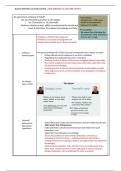
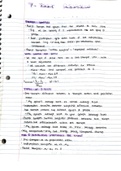
BLACK WRITING IS SLIDE NOTES | RED WRITING IS LECTURE NOTES
o Unique
Do apes have ato • children
theory of mind? : display a very early
humans? understanding of others’
- The two theoretical positions in the debate
psychological states
o Yes (Tomasello) vs. No (Povinelli)
• what about our closest relatives?
- Evidence relating to apes’ ability to understand the mental states of others with respect to:
• mental similarity real or apparent?
o Goals & intentions, Perception & knowledge and False belief
See Povinelli & Vonk (2003)
Question is whether their apparent
similarity to us clouds our judgement on
whether they actually have a theory of mind?
o Evidence – Premack and Woodruff (1978): Does the chimpanzee have a theory of mind?
seminal paper • Chimp offered correct solutions to an actor’s problems
• Suggesting she could infer the actor’s intentions
• Showing a series of videos of the human struggling doing certain tasks
• The correct solutions from the chimp shows that they could infer what
the human was intending
• Could argue that all she has done is associate certain objects go with
other objects but even so there would be a low lying piece of evidence
of inference
o Do chimps
have a ToM?
o Povinelli
behavioural - Understand only surface-level of behaviour and form behavioural rules
abstraction - ‘BAH’ posits that chimpanzees:
hypothesis - make predictions about future behaviours that follow from past
behaviours, and
- adjust their own behaviour accordingly.
- They notice patterns in other chimps behaviours and pick up
behavioural rules from these – making predictions about future
(anticipate how they’re going to behave and adjust their own behaviour
accordingly)
- Abstract these behaviour rules and don’t have to continuously learn
these rules, instead can learn it once and apply it various scenarios
(danger behaviours can be attributed to many scenarios)
, BLACK WRITING IS SLIDE NOTES | RED WRITING IS LECTURE NOTES
o Real world
example of - Mentalistic explanation – learnt that you go into the living room when
behavioural on the stairs
rule without - Povinelli states – he’s learnt overtime that most of the time stepping on
mental state stairs you go to the living room as so is inferring this behavioural rule
attribution
o Tomasello’s - Chimps highly social animals – need to anticipate what others do
beyond - Observing previous behaviour and deriving set of behavioural rules
behavioural enables behavioural prediction
rules - BUT: Inferring states not only in previously observed situations,
but also in novel situations
- Need to anticipate actions based on goals and intentions
o Understanding - Goal = what person is trying to do or achieve
goals and - Intention = the action plan chosen for pursuing this goal.
intentions: - 6 chimps imitated E’s novel action when he seemed to do it
Example 1 intentionally but NOT when this was due to a physical constraint
- chimps understand other’s goals and intentions
- Are they going to copy the human’s abstract behaviour?
- Human in phase a has restricted hands however not in phase b but he
still uses the foot suggesting the intention was to use the foot to light
up the panel
- Question is whether the chimps would be rational and selectively
imitate when the apes saw the hands full, but in the other case it was
not intention in the second phase. And so they did the first.
o Altruistic - Altruistic Helping requires:
helping - Cognition = understanding of another’s goals
- altruistic motivation = no benefit/costly
- Study 1: 18mos infants (N=24)
Study 2: 36-54mos chimps (N=3)
- Procedure:
10 situations, 4 categories
- (1) Out-of-reach
- (2) Access thwarted by physical object
- (3) Achieving wrong result
- (4) Using wrong means
- 3 ‘request’ phases
(10s focus only, 10s alternate gaze, 10s verbalise)
- Altruistic – have to infer what they’re trying to do
- At what point would the infants and the apes intervene and help? Does
this differ?
o Unique
Do apes have ato • children
theory of mind? : display a very early
humans? understanding of others’
- The two theoretical positions in the debate
psychological states
o Yes (Tomasello) vs. No (Povinelli)
• what about our closest relatives?
- Evidence relating to apes’ ability to understand the mental states of others with respect to:
• mental similarity real or apparent?
o Goals & intentions, Perception & knowledge and False belief
See Povinelli & Vonk (2003)
Question is whether their apparent
similarity to us clouds our judgement on
whether they actually have a theory of mind?
o Evidence – Premack and Woodruff (1978): Does the chimpanzee have a theory of mind?
seminal paper • Chimp offered correct solutions to an actor’s problems
• Suggesting she could infer the actor’s intentions
• Showing a series of videos of the human struggling doing certain tasks
• The correct solutions from the chimp shows that they could infer what
the human was intending
• Could argue that all she has done is associate certain objects go with
other objects but even so there would be a low lying piece of evidence
of inference
o Do chimps
have a ToM?
o Povinelli
behavioural - Understand only surface-level of behaviour and form behavioural rules
abstraction - ‘BAH’ posits that chimpanzees:
hypothesis - make predictions about future behaviours that follow from past
behaviours, and
- adjust their own behaviour accordingly.
- They notice patterns in other chimps behaviours and pick up
behavioural rules from these – making predictions about future
(anticipate how they’re going to behave and adjust their own behaviour
accordingly)
- Abstract these behaviour rules and don’t have to continuously learn
these rules, instead can learn it once and apply it various scenarios
(danger behaviours can be attributed to many scenarios)
, BLACK WRITING IS SLIDE NOTES | RED WRITING IS LECTURE NOTES
o Real world
example of - Mentalistic explanation – learnt that you go into the living room when
behavioural on the stairs
rule without - Povinelli states – he’s learnt overtime that most of the time stepping on
mental state stairs you go to the living room as so is inferring this behavioural rule
attribution
o Tomasello’s - Chimps highly social animals – need to anticipate what others do
beyond - Observing previous behaviour and deriving set of behavioural rules
behavioural enables behavioural prediction
rules - BUT: Inferring states not only in previously observed situations,
but also in novel situations
- Need to anticipate actions based on goals and intentions
o Understanding - Goal = what person is trying to do or achieve
goals and - Intention = the action plan chosen for pursuing this goal.
intentions: - 6 chimps imitated E’s novel action when he seemed to do it
Example 1 intentionally but NOT when this was due to a physical constraint
- chimps understand other’s goals and intentions
- Are they going to copy the human’s abstract behaviour?
- Human in phase a has restricted hands however not in phase b but he
still uses the foot suggesting the intention was to use the foot to light
up the panel
- Question is whether the chimps would be rational and selectively
imitate when the apes saw the hands full, but in the other case it was
not intention in the second phase. And so they did the first.
o Altruistic - Altruistic Helping requires:
helping - Cognition = understanding of another’s goals
- altruistic motivation = no benefit/costly
- Study 1: 18mos infants (N=24)
Study 2: 36-54mos chimps (N=3)
- Procedure:
10 situations, 4 categories
- (1) Out-of-reach
- (2) Access thwarted by physical object
- (3) Achieving wrong result
- (4) Using wrong means
- 3 ‘request’ phases
(10s focus only, 10s alternate gaze, 10s verbalise)
- Altruistic – have to infer what they’re trying to do
- At what point would the infants and the apes intervene and help? Does
this differ?