Aantekeningen
Rubi Luneta
2081276
Aantekeningen
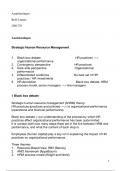
Strategic Human Resource Management
1. Black box debate HR practices —>
organizational performance
2. Contingency perspective HR practices
3. Dark-side perspective Organizational
performance
4. Di erentiated workforce No best set of HR
practices / HR investments
5. HR devolution Black box debate, HRM
process model, senior managers —> line managers
1 Black box debate
Strategic human resource management (SHRM) theory:
HR practices (practices and policies) —> (+) organizational performance
(operational and nancial performance)
Black box debate = our understanding of the process by which HR
practices a ect organizational performance has been quite limited
It is unclear both how many steps there are in the link between HRM and
performance, and what the content of each step is.
Employees (human capital) play a key rol in explaining the impact of HR
practices on organizational performance.
Three theories
1. Resource-Based View, RBV (Barney)
2. AMO framework (Appelbaum)
3. HRM process model (Wright and Nishii)
1
ff ff fi
,1. Resource-Based View
Organizations can build a competetive advantage based on resources
that are rare, valuable, imperfectly imitable and non-substitutable.
Resources
⁃ Organizational resources
⁃ Physical resources
⁃ Human resources
Human resource advantage (Boxall)
⁃ Human capital advantage
⁃ Human process advantage
2. AMO Framework
People perform well if they have the Ability, Motivation and Opportunity
to do so.
⁃ Ability, Human capital theory
⁃ Motivation, Social exchange theory
⁃ Opportunity, Empowerment theory
High-performance work system (HPWS) — a set of HR practices
designed to stimulate employees’ abilities, motivation, and opportunities
to participate. *
Dark side perspective, mutual gains perspective *
3. HRM process model
HR practices that senior managers intend to implement in the
organization (intened HR practices by senior managers)
The practices are actually implemented by line managers (actual HR
practices by line managers)
Employees’ perception of these implemented practices (perceived HR
practices by employees)
‘disconnect’
Dark side perspective, mutual gains perspective *
2
, As such, the RBV logic provides a rationale for how HR practices
positively a ect organizational performance by building a better human
capital pool and by stimulating better processes within the organization.
In sum, the AMO provides a rationale for how HR practices (HPWS)
impact organizational performance by increasing employees’ ability,
motivation, and opportunity to produce high performance.
HRM process model thus addresses the question of how HR practices
impact organizational performance by looking at how these practices are
implemented in the workplace, and how employees experience and
respons to them.
Based on these theories, we can conclude that employees (or human
resources) play a key rol in explaining the impact of HR practices on
organizational performance.
2 Contingency perspective
1. Best-practice approach: Certain HR policies and practices are
universally e ective, irrespective of the context or situation involved.
As long as an organization implements a coherent set of HR
practices, the result will be high organizational performance.
2. Best- t approach = contingency perspective: Context. HRM
practices and policies should be aligned with various aspects of the
organization and the context in which they are implemented.
The best-practice vs. best- t debate
The e ectivenis of a given HRM system (in terms of performnace) is likely
to vary depending on the particular intra- and inter-organizational context
and situation.
Four types of t (Wood)
1. Internal (horizontal) t = t between di erent HRM pratices and
policies
2. Strategic (vertical) t = t between HRM practices/policies and the
strategy of the organization (the organization’s goals)
3. Organizational t = t between HRM practices/policies and other
organizational characteristics
4. Environmental (institutional) t = t between HRM practices/policies
and the external environment
3
ff
fi ffff fifi fififi fi fi fifi fi ff
Rubi Luneta
2081276
Aantekeningen
Strategic Human Resource Management
1. Black box debate HR practices —>
organizational performance
2. Contingency perspective HR practices
3. Dark-side perspective Organizational
performance
4. Di erentiated workforce No best set of HR
practices / HR investments
5. HR devolution Black box debate, HRM
process model, senior managers —> line managers
1 Black box debate
Strategic human resource management (SHRM) theory:
HR practices (practices and policies) —> (+) organizational performance
(operational and nancial performance)
Black box debate = our understanding of the process by which HR
practices a ect organizational performance has been quite limited
It is unclear both how many steps there are in the link between HRM and
performance, and what the content of each step is.
Employees (human capital) play a key rol in explaining the impact of HR
practices on organizational performance.
Three theories
1. Resource-Based View, RBV (Barney)
2. AMO framework (Appelbaum)
3. HRM process model (Wright and Nishii)
1
ff ff fi
,1. Resource-Based View
Organizations can build a competetive advantage based on resources
that are rare, valuable, imperfectly imitable and non-substitutable.
Resources
⁃ Organizational resources
⁃ Physical resources
⁃ Human resources
Human resource advantage (Boxall)
⁃ Human capital advantage
⁃ Human process advantage
2. AMO Framework
People perform well if they have the Ability, Motivation and Opportunity
to do so.
⁃ Ability, Human capital theory
⁃ Motivation, Social exchange theory
⁃ Opportunity, Empowerment theory
High-performance work system (HPWS) — a set of HR practices
designed to stimulate employees’ abilities, motivation, and opportunities
to participate. *
Dark side perspective, mutual gains perspective *
3. HRM process model
HR practices that senior managers intend to implement in the
organization (intened HR practices by senior managers)
The practices are actually implemented by line managers (actual HR
practices by line managers)
Employees’ perception of these implemented practices (perceived HR
practices by employees)
‘disconnect’
Dark side perspective, mutual gains perspective *
2
, As such, the RBV logic provides a rationale for how HR practices
positively a ect organizational performance by building a better human
capital pool and by stimulating better processes within the organization.
In sum, the AMO provides a rationale for how HR practices (HPWS)
impact organizational performance by increasing employees’ ability,
motivation, and opportunity to produce high performance.
HRM process model thus addresses the question of how HR practices
impact organizational performance by looking at how these practices are
implemented in the workplace, and how employees experience and
respons to them.
Based on these theories, we can conclude that employees (or human
resources) play a key rol in explaining the impact of HR practices on
organizational performance.
2 Contingency perspective
1. Best-practice approach: Certain HR policies and practices are
universally e ective, irrespective of the context or situation involved.
As long as an organization implements a coherent set of HR
practices, the result will be high organizational performance.
2. Best- t approach = contingency perspective: Context. HRM
practices and policies should be aligned with various aspects of the
organization and the context in which they are implemented.
The best-practice vs. best- t debate
The e ectivenis of a given HRM system (in terms of performnace) is likely
to vary depending on the particular intra- and inter-organizational context
and situation.
Four types of t (Wood)
1. Internal (horizontal) t = t between di erent HRM pratices and
policies
2. Strategic (vertical) t = t between HRM practices/policies and the
strategy of the organization (the organization’s goals)
3. Organizational t = t between HRM practices/policies and other
organizational characteristics
4. Environmental (institutional) t = t between HRM practices/policies
and the external environment
3
ff
fi ffff fifi fififi fi fi fifi fi ff