Cell Membrane:
Functions of plasma membrane – physical barrier, structural support, protection, transport
by being selectively permeable, organelles such as golgi body and cell recognitions by
intercellular communication.
Fluid mosaic model:
Membrane bilayer is made up of a mosaic of lipids, proteins and carbohydrates. It is not a
rigid/ static structure, the constituents that make up the membrane are capable of
movement which gives it a dynamic and fluid-like consistency.
Membrane bilayer:
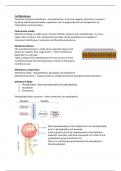
The membrane bilayer is made of two opposite layers each
known as a leaflet, they range from 5 – 10nm in thickness
dependent on cell type.
Lipids, proteins and carbohydrate form the structure of the
membrane bilayer but the proportions of each in the plasma
membrane vary.
Membrane components:
Membrane lipids – phospholipids, glycolipids and cholesterol
Membrane proteins – integral proteins, peripheral proteins and lipid-anchored proteins
Membrane-lipids:
1. Phospholipids – glycerophospholipids and sphingolipids
2. Glycolipids
3. Cholesterol
Phospholipid basic structure – these molecules are amphipathic.
Glycerophospholipid is the simplest form of a phospholipid
and is a phosphatidic acid example.
It has a glycerol (C3H8O3) carbohydrate as the backbone
molecule, two fatty acids that are bound at C1 and C2 and
a phosphate group attached to C3.
There is no alcohol group attached to the phosphate in
this phospholipid.
, Three types of common glycerophospholipids include – phosphatidylserine,
phosphatidylcholine and phosphatidylethanolamine.
Phosphatidylserine – Phosphatidylcholine -
Phosphatidylethanolamine –
blue box – glycerol backbone
green box – phosphate group
red box – ethanolamine
purple boxes – fatty acids
Phospholipases (PL):
Enzymes that cleave bonds in glycerophospholipids. PLC and PLD hydrolyze either side of
the polar head which releases the glycerol backbone and OH-containing groups respectively.
PLA1 and PLA2 hydrolyze fatty acid from C1 and C2 respectively.
Functions of plasma membrane – physical barrier, structural support, protection, transport
by being selectively permeable, organelles such as golgi body and cell recognitions by
intercellular communication.
Fluid mosaic model:
Membrane bilayer is made up of a mosaic of lipids, proteins and carbohydrates. It is not a
rigid/ static structure, the constituents that make up the membrane are capable of
movement which gives it a dynamic and fluid-like consistency.
Membrane bilayer:
The membrane bilayer is made of two opposite layers each
known as a leaflet, they range from 5 – 10nm in thickness
dependent on cell type.
Lipids, proteins and carbohydrate form the structure of the
membrane bilayer but the proportions of each in the plasma
membrane vary.
Membrane components:
Membrane lipids – phospholipids, glycolipids and cholesterol
Membrane proteins – integral proteins, peripheral proteins and lipid-anchored proteins
Membrane-lipids:
1. Phospholipids – glycerophospholipids and sphingolipids
2. Glycolipids
3. Cholesterol
Phospholipid basic structure – these molecules are amphipathic.
Glycerophospholipid is the simplest form of a phospholipid
and is a phosphatidic acid example.
It has a glycerol (C3H8O3) carbohydrate as the backbone
molecule, two fatty acids that are bound at C1 and C2 and
a phosphate group attached to C3.
There is no alcohol group attached to the phosphate in
this phospholipid.
, Three types of common glycerophospholipids include – phosphatidylserine,
phosphatidylcholine and phosphatidylethanolamine.
Phosphatidylserine – Phosphatidylcholine -
Phosphatidylethanolamine –
blue box – glycerol backbone
green box – phosphate group
red box – ethanolamine
purple boxes – fatty acids
Phospholipases (PL):
Enzymes that cleave bonds in glycerophospholipids. PLC and PLD hydrolyze either side of
the polar head which releases the glycerol backbone and OH-containing groups respectively.
PLA1 and PLA2 hydrolyze fatty acid from C1 and C2 respectively.