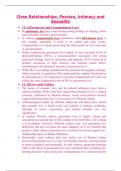
Close Relationships: Passion, Intimacy and
Sexuality
12-1aPassionate and Companionate Love
By passionate love they mean having strong feelings of longing, desire
and excitement toward a special person.
In contrast, companionate love (sometimes called affectionate love) is
less strongly emotional; it tends to be calmer and more serene.
Companionate love means perceiving the other person as your soul mate
or special partner.
People experiencing passionate love appear to have elevated levels of
phenylethylamine (PEA), a neurotransmitter associated with strong
emotional feelings, such as excitement and euphoria. PEA is believed to
produce sensations of high intensity and frequent sexual desire,
contributing to the emotional intensity in passionate love.
While PEA is a leading candidate for the chemical driving these feelings,
further research is required to fully understand the complex biochemistry
of passionate love. It's important to note that companionate love does not
exhibit the same heightened levels of PEA as passionate love.
12-1bLove and Culture
The nature of romantic love and its cultural influences have been a
subject of debate. While some have argued that romantic love is a cultural
construct, influenced by Western history, recent cross-cultural research
suggests that passionate love is not exclusive to Western culture.
Anthropological studies by William Jankowiak and others have shown
that romantic love is found in the vast majority of cultures worldwide,
although its forms, expressions, and cultural attitudes can vary
significantly.
In modern Western culture, passionate love is highly valued and
considered an essential part of life, leading to the belief that a life without
it is incomplete. However, different cultures may view passionate love
differently and may not place the same emphasis on it. It's possible that
people in other cultures experience love similarly but do not regard it as a
fundamental aspect of human fulfilment.
Historically, some cultures and even earlier eras in Western culture
perceived passionate love as a type of temporary insanity, causing people
to behave strangely and irrationally. In such contexts, proposing marriage
while in the throes of passionate love was considered akin to making life-
altering decisions while intoxicated. Companionate love, characterized by
, deep affection and intimacy, was often considered a more suitable
foundation for marriage.
12-1cLove across Time
The transition from passionate love to companionate love is essential for
the long-term success of a relationship or marriage. Passionate love often
arises spontaneously at the beginning of a relationship but tends to be
temporary, lasting for a relatively brief period, usually up to a few years
at most. In contrast, companionate love, characterized by trust, intimacy,
and lasting affection, is the foundation for stable, long-lasting
relationships. Building companionate love takes effort, trust, and time.
One behavioral sign of decreasing passion is the frequency of sexual
intercourse. Studies indicate that, on average, married couples have sex
less frequently as their relationship progresses. For example, after the first
year of marriage, the frequency of sexual intercourse tends to decrease by
about half, and this decline continues more slowly over the years.
The rush associated with high levels of phenylethylamine (PEA), often
linked to passionate love, is likely a feature of new love and the early
stages of relationship bonding. As time passes, this intense biochemical
response is not destined to be permanent. Some individuals may mistake
the natural decline of this intense passion for a loss of interest or love in
their partner.
12-1dSternberg’s Triangle
Robert Sternberg's theory of love proposes that love is composed of three
main components:
Passion: This component involves feelings of romantic attraction,
physical attraction, and sexual interest. It's characterized by high
emotional and physical arousal, making individuals excited and attentive
to their partner. Passion often leads to desires for physical closeness and
intimacy.
Intimacy: Intimacy is considered the core of all love relationships. It
involves feeling emotionally close to a partner, understanding and being
, understood by them, and sharing a mutual concern for each other's well-
being and happiness. Intimate partners care for each other and emphasize
open communication about their lives and feelings.
Decision and Commitment: Sternberg emphasizes that love involves a
conscious decision or commitment, not just a fleeting emotional state.
Emotions can be temporary, but commitments based on decisions remain
constant unless intentionally withdrawn. This aspect of love represents
the enduring commitment to a partner, which goes beyond the
fluctuations of passion or emotional states.
These three components can be mixed in various combinations within a
love relationship, and they are not separate "kinds" of love. An ideal love
relationship often includes substantial measures of all three components.
Relationships with no presence of any of these three ingredients would
not be considered love.
The time courses of these components vary. Passion can develop quickly
but often diminishes over time. Intimacy tends to grow more slowly and
can continue to increase for a long time, remaining high even as the
relationship matures. Commitment is typically made at specific points in
the relationship, such as making a long-term commitment like marriage.
Companionate love emphasizes intimacy and commitment, whereas
passionate love is primarily characterized by passion. As relationships
evolve, passion may decrease while intimacy and commitment become
more prominent, creating the foundation for a long-lasting partnership.
12-1eBenefits of Commitment
Motivation to Commit: Commitment becomes a significant factor in
making people ready to commit to a relationship. An appealing
relationship with passion and rising intimacy can motivate individuals to
commit, but another motivator is the fear of being single. The fear of
ending up alone can lead people to "settle for less" and lower their
standards for potential partners.
Strengthens Relationships: Commitment changes and strengthens a
relationship, making it more resilient, especially when problems and
conflicts arise. Commitment, such as marriage, can motivate a couple to
work through their differences rather than giving up on the relationship. It
can also reduce aggressive responses to each other's provocations and
misdeeds.
Vulnerability and Resilience: Commitment can make people more
sensitive and vulnerable to relationship problems in the short term.
However, it also makes them more resilient to these problems in the long
Sexuality
12-1aPassionate and Companionate Love
By passionate love they mean having strong feelings of longing, desire
and excitement toward a special person.
In contrast, companionate love (sometimes called affectionate love) is
less strongly emotional; it tends to be calmer and more serene.
Companionate love means perceiving the other person as your soul mate
or special partner.
People experiencing passionate love appear to have elevated levels of
phenylethylamine (PEA), a neurotransmitter associated with strong
emotional feelings, such as excitement and euphoria. PEA is believed to
produce sensations of high intensity and frequent sexual desire,
contributing to the emotional intensity in passionate love.
While PEA is a leading candidate for the chemical driving these feelings,
further research is required to fully understand the complex biochemistry
of passionate love. It's important to note that companionate love does not
exhibit the same heightened levels of PEA as passionate love.
12-1bLove and Culture
The nature of romantic love and its cultural influences have been a
subject of debate. While some have argued that romantic love is a cultural
construct, influenced by Western history, recent cross-cultural research
suggests that passionate love is not exclusive to Western culture.
Anthropological studies by William Jankowiak and others have shown
that romantic love is found in the vast majority of cultures worldwide,
although its forms, expressions, and cultural attitudes can vary
significantly.
In modern Western culture, passionate love is highly valued and
considered an essential part of life, leading to the belief that a life without
it is incomplete. However, different cultures may view passionate love
differently and may not place the same emphasis on it. It's possible that
people in other cultures experience love similarly but do not regard it as a
fundamental aspect of human fulfilment.
Historically, some cultures and even earlier eras in Western culture
perceived passionate love as a type of temporary insanity, causing people
to behave strangely and irrationally. In such contexts, proposing marriage
while in the throes of passionate love was considered akin to making life-
altering decisions while intoxicated. Companionate love, characterized by
, deep affection and intimacy, was often considered a more suitable
foundation for marriage.
12-1cLove across Time
The transition from passionate love to companionate love is essential for
the long-term success of a relationship or marriage. Passionate love often
arises spontaneously at the beginning of a relationship but tends to be
temporary, lasting for a relatively brief period, usually up to a few years
at most. In contrast, companionate love, characterized by trust, intimacy,
and lasting affection, is the foundation for stable, long-lasting
relationships. Building companionate love takes effort, trust, and time.
One behavioral sign of decreasing passion is the frequency of sexual
intercourse. Studies indicate that, on average, married couples have sex
less frequently as their relationship progresses. For example, after the first
year of marriage, the frequency of sexual intercourse tends to decrease by
about half, and this decline continues more slowly over the years.
The rush associated with high levels of phenylethylamine (PEA), often
linked to passionate love, is likely a feature of new love and the early
stages of relationship bonding. As time passes, this intense biochemical
response is not destined to be permanent. Some individuals may mistake
the natural decline of this intense passion for a loss of interest or love in
their partner.
12-1dSternberg’s Triangle
Robert Sternberg's theory of love proposes that love is composed of three
main components:
Passion: This component involves feelings of romantic attraction,
physical attraction, and sexual interest. It's characterized by high
emotional and physical arousal, making individuals excited and attentive
to their partner. Passion often leads to desires for physical closeness and
intimacy.
Intimacy: Intimacy is considered the core of all love relationships. It
involves feeling emotionally close to a partner, understanding and being
, understood by them, and sharing a mutual concern for each other's well-
being and happiness. Intimate partners care for each other and emphasize
open communication about their lives and feelings.
Decision and Commitment: Sternberg emphasizes that love involves a
conscious decision or commitment, not just a fleeting emotional state.
Emotions can be temporary, but commitments based on decisions remain
constant unless intentionally withdrawn. This aspect of love represents
the enduring commitment to a partner, which goes beyond the
fluctuations of passion or emotional states.
These three components can be mixed in various combinations within a
love relationship, and they are not separate "kinds" of love. An ideal love
relationship often includes substantial measures of all three components.
Relationships with no presence of any of these three ingredients would
not be considered love.
The time courses of these components vary. Passion can develop quickly
but often diminishes over time. Intimacy tends to grow more slowly and
can continue to increase for a long time, remaining high even as the
relationship matures. Commitment is typically made at specific points in
the relationship, such as making a long-term commitment like marriage.
Companionate love emphasizes intimacy and commitment, whereas
passionate love is primarily characterized by passion. As relationships
evolve, passion may decrease while intimacy and commitment become
more prominent, creating the foundation for a long-lasting partnership.
12-1eBenefits of Commitment
Motivation to Commit: Commitment becomes a significant factor in
making people ready to commit to a relationship. An appealing
relationship with passion and rising intimacy can motivate individuals to
commit, but another motivator is the fear of being single. The fear of
ending up alone can lead people to "settle for less" and lower their
standards for potential partners.
Strengthens Relationships: Commitment changes and strengthens a
relationship, making it more resilient, especially when problems and
conflicts arise. Commitment, such as marriage, can motivate a couple to
work through their differences rather than giving up on the relationship. It
can also reduce aggressive responses to each other's provocations and
misdeeds.
Vulnerability and Resilience: Commitment can make people more
sensitive and vulnerable to relationship problems in the short term.
However, it also makes them more resilient to these problems in the long