Financial Accountnn heory:
Subject mater:
- Papers 1-23
- Slides + Notes
Introduction:
he main noals of this course are:
- Advance the understandinn of the demand for and supply of accountnn research
- Apply you accountnngeconomicsgfnance skills to issues in today’s news to help understand.
Gradinn:
60% Writen Exam
20% Replicaton assinnment Basu
20% Review Assinnment
Overview papers: IMPOR AN !!!!!!
, Lecture 1: accountnn theory
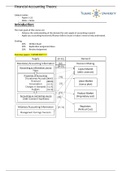
Theories are there to explain the ‘why’ queston of a phenomenon. Accountnn Theory combines
theories with accountnn to explain and predict accountnn practce
- Explanaton: providinn reasons for observed accountnn practce
- Predicton: predict the (not yet) unobserved accountnn phenomena
Accountnn heory is useful to provide predictons, explanatons, theories that can be used in
practce and to develop theories further. Over tme, researchers should be able to provide theories
that are useful to decision makers in maximizinn their welfare.
Accountnn theory has channed over tme. Pre 1939 accountnn theory was based on describinn the
observed practce. From 1945-1970 accountnn theory was prescribinn (normatve research) what
should be done renardless of empirical validity. he prescriptons were based on the objectve for
accountnn and the applied lonic. In the 1970’s, methodolonical individualism: social phenomena
explained as a consequence of individual decision makinn and neoclassical maximizaton: decision
makinn exclusively to maximize an individual’s personal utlity (positve accountnn theory.g
he empirical cycle is based on: Observaton deducton inducton testnn evaluaton
observaton. When researchinn, a trade-of must be made between internal and external validityg
Internal validity: does it capture the cause-and-efect well enounh?
External validity: are results applicable in other setnns?
Construct validity: how well do variables capture the research subjectgconcept
Reliability: consistencyg measurement of concept
When researchinn: you may come across some problemsgerrors:
Endoneneity:
When Endoneneity occurs, your independent variable is correlated with the error (or disturbance
term). his may cause: omited variables, simultaneity andgor measurement errors.
Omitted-variables:
Omitted-variable bias: occurs when sinnifcant causal factors are (un-)intentonally not included
within the model. hese omissions are either observable or non-observable. Omited variables can
be observed by conductnn literature review (fndinn missinn variables) or addinn control variables.
Or perhaps the frm as its own control variable. However, some omissions cannot be observed
because of: sample selecton (a company is chosen with a dependent variable in mind) or frm
specifc heteroneneity (a variable is assumed to be constant, but infuences the error term).
Errors in variables:
he least squares method of a renressions assumes that all errors in dependent (Y) and independent
(X) are measured without error. However this may not always be the case. Solutons are: validate
renressions externally, improve measurement or use multple measuresgtechniques.
Simultaneity:
Simultaneity occurs when one or more dependent variables are assumed to occur at the same tme,
or are determined simultaneously.
Example: Income = cinaretes + Educaton + ane + ane2
Smokinn= Income + educaton + ane + ane2 + restaurant
Income determines smokinn, but simultaneously smokinn infuences health which may
infuence income.
Univariate analysis vsg Bivariate/Multvariate analysis!
Univariate analysis analyses data by lookinn at 1 variable, this can be either inferental
KEEP IN MIND, EVEN THOUGH THERE IS STATISTICAL SIGNIFICANCE, THERE SHOULD BE
ECONOMICAL SIGNIFICANCE AS WELL!!
Subject mater:
- Papers 1-23
- Slides + Notes
Introduction:
he main noals of this course are:
- Advance the understandinn of the demand for and supply of accountnn research
- Apply you accountnngeconomicsgfnance skills to issues in today’s news to help understand.
Gradinn:
60% Writen Exam
20% Replicaton assinnment Basu
20% Review Assinnment
Overview papers: IMPOR AN !!!!!!
, Lecture 1: accountnn theory
Theories are there to explain the ‘why’ queston of a phenomenon. Accountnn Theory combines
theories with accountnn to explain and predict accountnn practce
- Explanaton: providinn reasons for observed accountnn practce
- Predicton: predict the (not yet) unobserved accountnn phenomena
Accountnn heory is useful to provide predictons, explanatons, theories that can be used in
practce and to develop theories further. Over tme, researchers should be able to provide theories
that are useful to decision makers in maximizinn their welfare.
Accountnn theory has channed over tme. Pre 1939 accountnn theory was based on describinn the
observed practce. From 1945-1970 accountnn theory was prescribinn (normatve research) what
should be done renardless of empirical validity. he prescriptons were based on the objectve for
accountnn and the applied lonic. In the 1970’s, methodolonical individualism: social phenomena
explained as a consequence of individual decision makinn and neoclassical maximizaton: decision
makinn exclusively to maximize an individual’s personal utlity (positve accountnn theory.g
he empirical cycle is based on: Observaton deducton inducton testnn evaluaton
observaton. When researchinn, a trade-of must be made between internal and external validityg
Internal validity: does it capture the cause-and-efect well enounh?
External validity: are results applicable in other setnns?
Construct validity: how well do variables capture the research subjectgconcept
Reliability: consistencyg measurement of concept
When researchinn: you may come across some problemsgerrors:
Endoneneity:
When Endoneneity occurs, your independent variable is correlated with the error (or disturbance
term). his may cause: omited variables, simultaneity andgor measurement errors.
Omitted-variables:
Omitted-variable bias: occurs when sinnifcant causal factors are (un-)intentonally not included
within the model. hese omissions are either observable or non-observable. Omited variables can
be observed by conductnn literature review (fndinn missinn variables) or addinn control variables.
Or perhaps the frm as its own control variable. However, some omissions cannot be observed
because of: sample selecton (a company is chosen with a dependent variable in mind) or frm
specifc heteroneneity (a variable is assumed to be constant, but infuences the error term).
Errors in variables:
he least squares method of a renressions assumes that all errors in dependent (Y) and independent
(X) are measured without error. However this may not always be the case. Solutons are: validate
renressions externally, improve measurement or use multple measuresgtechniques.
Simultaneity:
Simultaneity occurs when one or more dependent variables are assumed to occur at the same tme,
or are determined simultaneously.
Example: Income = cinaretes + Educaton + ane + ane2
Smokinn= Income + educaton + ane + ane2 + restaurant
Income determines smokinn, but simultaneously smokinn infuences health which may
infuence income.
Univariate analysis vsg Bivariate/Multvariate analysis!
Univariate analysis analyses data by lookinn at 1 variable, this can be either inferental
KEEP IN MIND, EVEN THOUGH THERE IS STATISTICAL SIGNIFICANCE, THERE SHOULD BE
ECONOMICAL SIGNIFICANCE AS WELL!!