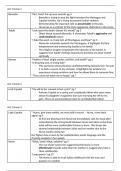
Act 1 Scene 1
Benvolio “Part, fools! Put up your swords! pg 3
- Benvolio is trying to stop the fight between the Montague and
Capulet families. He is trying to prevent further violence
demonstrating his important role as peacemaker in the play.
- He serves as a contrast to the more aggressive characters in the scene
Tybalt “Look upon thy death! [draws his sword]” pg 3
- Direct threat towards Benvolio. It showcases Tybalt’s aggressive and
confrontational nature
“I hate the word, as I hate hell, all Montagues and thee!” pg 3
- Shows his animosity towards the Montagues. It highlights his fiery
temperament and unwavering loyalty to his family.
- The religious imagery emphasizes the intensity of his hatred. It
suggests that Tybalt’s feelings towards his enemies are deep-rooted
spiritually
Romeo “Feather of lead, bright smoke, cold fire, sick health” pg 5
“O brawling love, O loving hate”
- This oxymoron shows Romeos conflicting feeling towards love: he sees
it as both a source of joy and pain. It highlights his tendency to
experience strong emotions and how he allows them to consume him.
“ Thou canst not teach me to forget” pg 7
Act 1 Scene 2
Lord Capulet “My will to her consent is but a part” pg 7
- Portrays Capulet as a caring and considerate father who cares more
about his daughter’s happiness than just marrying her off for his
gain. This is an unconventional view for an Elizabethan father
Act 1 Scene 3
Lady Capulet “-Nurse, give leave awhile, we must talk in secret. – Nurse, come back
again! pg 9
- At first she dismisses the Nurse but immediately calls her back after
remembering the strong bond between Nurse and Juliet as she feels
Juliet will be more comfortable if Nurse is there. This shows the
strained relationship between Juliet and her mother due to the
Nurse mostly raising her
Her higher class is seen by her sophisticated, poetic language and the
rhyming couplets in her speech
Nurse “What, lamb! What, ladybird” pg 9
- The use of pet names her suggest that the Nurse is more
affectionate towards Juliet than her mother is. Suggest they have a
close relationship
“Long speech” pg 10
- The Nurse is able to recall Juliets childhood with the ease and
passion of a mother
Benvolio “Part, fools! Put up your swords! pg 3
- Benvolio is trying to stop the fight between the Montague and
Capulet families. He is trying to prevent further violence
demonstrating his important role as peacemaker in the play.
- He serves as a contrast to the more aggressive characters in the scene
Tybalt “Look upon thy death! [draws his sword]” pg 3
- Direct threat towards Benvolio. It showcases Tybalt’s aggressive and
confrontational nature
“I hate the word, as I hate hell, all Montagues and thee!” pg 3
- Shows his animosity towards the Montagues. It highlights his fiery
temperament and unwavering loyalty to his family.
- The religious imagery emphasizes the intensity of his hatred. It
suggests that Tybalt’s feelings towards his enemies are deep-rooted
spiritually
Romeo “Feather of lead, bright smoke, cold fire, sick health” pg 5
“O brawling love, O loving hate”
- This oxymoron shows Romeos conflicting feeling towards love: he sees
it as both a source of joy and pain. It highlights his tendency to
experience strong emotions and how he allows them to consume him.
“ Thou canst not teach me to forget” pg 7
Act 1 Scene 2
Lord Capulet “My will to her consent is but a part” pg 7
- Portrays Capulet as a caring and considerate father who cares more
about his daughter’s happiness than just marrying her off for his
gain. This is an unconventional view for an Elizabethan father
Act 1 Scene 3
Lady Capulet “-Nurse, give leave awhile, we must talk in secret. – Nurse, come back
again! pg 9
- At first she dismisses the Nurse but immediately calls her back after
remembering the strong bond between Nurse and Juliet as she feels
Juliet will be more comfortable if Nurse is there. This shows the
strained relationship between Juliet and her mother due to the
Nurse mostly raising her
Her higher class is seen by her sophisticated, poetic language and the
rhyming couplets in her speech
Nurse “What, lamb! What, ladybird” pg 9
- The use of pet names her suggest that the Nurse is more
affectionate towards Juliet than her mother is. Suggest they have a
close relationship
“Long speech” pg 10
- The Nurse is able to recall Juliets childhood with the ease and
passion of a mother