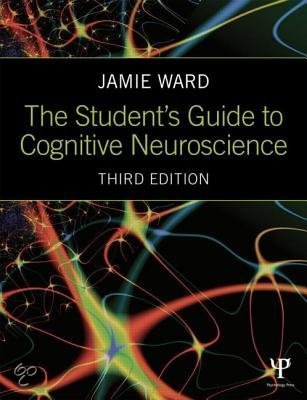
Summary of The Student’s Guide to Cognitive Neuroscience, 3rd edition
(chapters 3, 4, 7, 8, 9, 10, 14, 15, 16) and
Fundamentals of Human Neuropsychology, 7th edition (chapter 23) and
Reader: How we predict what other people are going to do
3.4 Magnetoencephalography ........................ 21
4. The imaged brain ........................................ 23
4.1 Structural imaging ..................................... 23
4.2 Functional imaging .................................... 24
4.3 From image to cognitive theory:
experimental design ...................................... 27
4.4 Analyzing data from functional imaging.......
........................................................................ 29
4.4 Interpreting data from functional imaging31
4.5 Why do functional imaging data sometimes
disagree with lesion data? ............................. 33
4.6 Brain-reading: is 'Big Brother' round the
corner? ........................................................... 34
7. The attending brain..................................... 35
7.1 Spatial and non-spatial attending process 35
7.2 The role of the parietal lobes in attention 36
7.3 Theories of attention........ ........................ 40
7.4 Neglect as a disorder of spatial attention
and awareness ............................................... 42
8. The acting brain .......................................... 46
8.1 A basic cognitive framework for movement
and action ...................................................... 46
1. Introducing Cognitive Neuroscience ...............3
8.2 The role of the frontal lobes in movement
1.1 Cognitive Neuroscience in historical
and action ...................................................... 47
perspective ....................................................... 3
8.3 Planning actions: the SAS model .............. 48
1.2 Does cognitive psychology need the brain? .
8.4 Ownership and awareness of actions ...... 50
.......................................................................... 5
8.5 Action comprehension and imitation ...... 50
1.3 Does neuroscience need cognitive
8.6 Acting on objects ...................................... 51
psychology? ...................................................... 6
8.7 Preparation and execution of actions ....... 54
2. Introducing the brain .....................................7
9. The remembering brain............................... 57
2.1 Structure and function of the neuron ........ 7
9.1 Short term and working memory ............. 57
2.2 The gross organization of the brain.......... 10
9.2 Different types of long-term memory ...... 59
2.3 The cerebral cortex .................................. 12
9.3 Amnesia .................................................... 60
2.4 The subcortex ........................................... 13
9.4 Functions of hippocampus/medial temporal
2.5 The midbrain and the hindbrain............... 14
lobes in memory ............................................ 61
3. The electrophysiological brain ..................... 16
9.5 Theories of remembering, knowing and
3.1 In search of neural representations: single-
forgetting ....................................................... 64
cell recordings ................................................ 16
9.6 The role of the prefrontal cortex in long-
3.2 Electroencephalography and event-related
term memory .................................................. 68
potentials ....................................................... 17
10. The hearing brain ...................................... 70
3.3 Mental chronometry in electrophysiology
10.1 The nature of sound................................ 70
and cognitive psychology ............................... 19
10.2 From ear to brain .................................... 70
______________________________________________________________________________
The Student’s Guide to Cognitive Neuroscience (3rd) | augustus 2018 - v1.1 | Jasper Verkroost 1
, 10.3 Basic processing of auditory information72 23. Brain development and plasticity ............ 112
10.4 Music perception.................................... 75 23.2 Development of the human brain ........ 112
10.5 Voice perception .................................... 78 23.3 Imaging studies of brain development . 116
10.6 Speech perception.................................. 78 23.4 Development of problem-solving ability
14. The executive brain ................................... 82 ...................................................................... 117
14.1 Anatomical and functional divisions of the 23.5 Environmental effects on brain
prefrontal cortex ............................................ 83 development ................................................. 118
14.2 Executive functions in practice............... 83
14.3 The organization of executive functions 85 Reader: How we predict what other people are
14.4 The role of the anterior cingulate in going to do
executive functions ........................................ 89 2. Knowledge of other people........................... 127
15. The social and emotional brain .................. 91 2.1 Knowledge of other people as members of
15.1 Theories of emotion ............................... 91 groups............................................................. 127
15.2 Neural substrates of emotion processing 2.2 Knowledge of other people as
........................................................................ 95 individuals....................................................... 128
15.3 Reading faces....................................... 100 3. Knowledge of actions, intentions, feelings and
15.4 Reading minds ...................................... 102 belief.................................................................. 129
16. The developing brain ............................... 108 3.1 Predicting the course of actions............... 129
16.1 Structural development of the 3.2 Predicting intentions from movements.... 129
brain.................................................... ........ 109 3.3 Contagion and sharing feelings................. 130
16.2 Functional development and the 3.4 Perspective taking: predicting from belief
brain.................................................... ......... 110 and knowledge............................................... 130
16.3 Behavioral genetics .............................. 112 3.5 Communicative intent............................... 131
16.4 Beyond nature vs. nurture: gene- 4. Bottom-up and top-down processes in social
environment interplay ................................. 115 cognition......................................................... 131
______________________________________________________________________________
The Student’s Guide to Cognitive Neuroscience (3rd) | augustus 2018 - v1.1 | Jasper Verkroost 2
, 1. Introducing Cognitive Neuroscience
cognition
- variety of higher mental processes (thinking, perceiving, imagining, speaking, acting, planning)
cognitive neuroscience
- a bridging discipline between cognitive science and cognitive psychology, on the one hand,
and biology and neuroscience, on the other
- aims to explain cognitive processes in terms of brain-based mechanisms
1.1 Cognitive Neuroscience in historical perspective p. 2-8
philosophical approaches to mind and brain
mind-body problem
- the problem of how physical substance (the brain) can give rise to our sensations, thoughts
and emotions (our mind)
dualism (René Descartes, 1596–1650)
- the belief that mind and brain are made up of different kinds of substance
- Descartes: the mind is non-physical and immortal whereas the body is physical and mortal
- there is little hope for cognitive neuroscience if dualism is true: the methods of physical and
biological sciences cannot tap into the nonphysical domain (if such a thing were to exist)
dual-aspect theory (Spinoza, 1632–1677)
- the belief that mind and brain are two levels of description of the same thing
- remains popular with some current researchers in the field
reductionism
- the belief that mindbased concepts (e.g. emotions, memories, attention) will eventually be
replaced by neuroscientific concepts (e.g. neuronal firings patterns, neurotransmitter release)
- as such, psychology will eventually reduce to biology as we learn more about the brain
- those who favor dual-aspect theory over reductionism point out that an emotion will still feel
like an emotion even if we were to fully understand its neural basis and, as such, the
usefulness of cognitive, mind-based concepts will never be fully replaced
scientific approaches to mind and brain
phrenology (Gall, 1758–1828 & Spurzheim, 1776–1832)
- idea that individual differences in cognition can be mapped on to differences in skull shape
- key assumptions: (1) different regions of the brain perform different functions and are
associated with different behaviors; (2) the size of these regions produces distortions of the
______________________________________________________________________________
The Student’s Guide to Cognitive Neuroscience (3rd) | augustus 2018 - v1.1 | Jasper Verkroost 3
, skull and correlates with individual differences in cognition and personality
- although phrenology was fatally flawed, the basic idea of different parts of the brain serving
different functions paved the way for future developments in the nineteenth century
functional specialization
- different regions of the brain are specialized for different functions
language in the brain (Broca, 1861; Wernicke, 1874; Lichtheim, 1885)
- Broca documented two cases in which acquired brain damage had impaired the ability to
speak but left other aspects of cognition relatively intact
- he concluded that language could be localized to a particular region of the brain
- subsequent studies argued that language itself was not a single entity but could be further
subdivided into speech recognition, speech production and conceptual knowledge
- was a huge step forward in terms of thinking about mind and brain, because empirical
observations were: (1) being used to determine what the building blocks of cognition are; (2)
developing models of cognition that did not make direct reference to the brain
cognitive neuropsychology
- the study of braindamaged patients to inform theories of normal cognition
formation of psychology (end of 19th century)
- took the study of the mind away from its biological underpinnings, reasons:
- 1. early pioneers of psychology (e.g. William James, Sigmund Freud), were interested in topics
like consciousness, attention and personality; neuroscience has had virtually nothing to say
about these issues until quite recently
- 2. the notion that one can develop coherent and testable theories of cognition that do not
make claims about the brain
information processing (Broadbent a.o., 1958)
- an approach in which behavior is described in terms of a sequence of cognitive stages
- one could understand the cognitive system in the same way as one could understand the
series of steps performed by a computer program, and without reference to the brain
- interactivity: later stages of processing can begin before earlier stages are complete;
moreover, later stages can influence the outcome of early ones
- top-down processing: the influence of later stages on the processing of earlier ones (e.g.
memory influences on perception)
- parallel processing: different information is processed at the same time (i.e. in parallel)
neural network models
- computational models in which information processing occurs using interconnected nodes
- nodes: the basic units of neural network models that are activated in response to activity in
other parts of the network
______________________________________________________________________________
The Student’s Guide to Cognitive Neuroscience (3rd) | augustus 2018 - v1.1 | Jasper Verkroost 4
(chapters 3, 4, 7, 8, 9, 10, 14, 15, 16) and
Fundamentals of Human Neuropsychology, 7th edition (chapter 23) and
Reader: How we predict what other people are going to do
3.4 Magnetoencephalography ........................ 21
4. The imaged brain ........................................ 23
4.1 Structural imaging ..................................... 23
4.2 Functional imaging .................................... 24
4.3 From image to cognitive theory:
experimental design ...................................... 27
4.4 Analyzing data from functional imaging.......
........................................................................ 29
4.4 Interpreting data from functional imaging31
4.5 Why do functional imaging data sometimes
disagree with lesion data? ............................. 33
4.6 Brain-reading: is 'Big Brother' round the
corner? ........................................................... 34
7. The attending brain..................................... 35
7.1 Spatial and non-spatial attending process 35
7.2 The role of the parietal lobes in attention 36
7.3 Theories of attention........ ........................ 40
7.4 Neglect as a disorder of spatial attention
and awareness ............................................... 42
8. The acting brain .......................................... 46
8.1 A basic cognitive framework for movement
and action ...................................................... 46
1. Introducing Cognitive Neuroscience ...............3
8.2 The role of the frontal lobes in movement
1.1 Cognitive Neuroscience in historical
and action ...................................................... 47
perspective ....................................................... 3
8.3 Planning actions: the SAS model .............. 48
1.2 Does cognitive psychology need the brain? .
8.4 Ownership and awareness of actions ...... 50
.......................................................................... 5
8.5 Action comprehension and imitation ...... 50
1.3 Does neuroscience need cognitive
8.6 Acting on objects ...................................... 51
psychology? ...................................................... 6
8.7 Preparation and execution of actions ....... 54
2. Introducing the brain .....................................7
9. The remembering brain............................... 57
2.1 Structure and function of the neuron ........ 7
9.1 Short term and working memory ............. 57
2.2 The gross organization of the brain.......... 10
9.2 Different types of long-term memory ...... 59
2.3 The cerebral cortex .................................. 12
9.3 Amnesia .................................................... 60
2.4 The subcortex ........................................... 13
9.4 Functions of hippocampus/medial temporal
2.5 The midbrain and the hindbrain............... 14
lobes in memory ............................................ 61
3. The electrophysiological brain ..................... 16
9.5 Theories of remembering, knowing and
3.1 In search of neural representations: single-
forgetting ....................................................... 64
cell recordings ................................................ 16
9.6 The role of the prefrontal cortex in long-
3.2 Electroencephalography and event-related
term memory .................................................. 68
potentials ....................................................... 17
10. The hearing brain ...................................... 70
3.3 Mental chronometry in electrophysiology
10.1 The nature of sound................................ 70
and cognitive psychology ............................... 19
10.2 From ear to brain .................................... 70
______________________________________________________________________________
The Student’s Guide to Cognitive Neuroscience (3rd) | augustus 2018 - v1.1 | Jasper Verkroost 1
, 10.3 Basic processing of auditory information72 23. Brain development and plasticity ............ 112
10.4 Music perception.................................... 75 23.2 Development of the human brain ........ 112
10.5 Voice perception .................................... 78 23.3 Imaging studies of brain development . 116
10.6 Speech perception.................................. 78 23.4 Development of problem-solving ability
14. The executive brain ................................... 82 ...................................................................... 117
14.1 Anatomical and functional divisions of the 23.5 Environmental effects on brain
prefrontal cortex ............................................ 83 development ................................................. 118
14.2 Executive functions in practice............... 83
14.3 The organization of executive functions 85 Reader: How we predict what other people are
14.4 The role of the anterior cingulate in going to do
executive functions ........................................ 89 2. Knowledge of other people........................... 127
15. The social and emotional brain .................. 91 2.1 Knowledge of other people as members of
15.1 Theories of emotion ............................... 91 groups............................................................. 127
15.2 Neural substrates of emotion processing 2.2 Knowledge of other people as
........................................................................ 95 individuals....................................................... 128
15.3 Reading faces....................................... 100 3. Knowledge of actions, intentions, feelings and
15.4 Reading minds ...................................... 102 belief.................................................................. 129
16. The developing brain ............................... 108 3.1 Predicting the course of actions............... 129
16.1 Structural development of the 3.2 Predicting intentions from movements.... 129
brain.................................................... ........ 109 3.3 Contagion and sharing feelings................. 130
16.2 Functional development and the 3.4 Perspective taking: predicting from belief
brain.................................................... ......... 110 and knowledge............................................... 130
16.3 Behavioral genetics .............................. 112 3.5 Communicative intent............................... 131
16.4 Beyond nature vs. nurture: gene- 4. Bottom-up and top-down processes in social
environment interplay ................................. 115 cognition......................................................... 131
______________________________________________________________________________
The Student’s Guide to Cognitive Neuroscience (3rd) | augustus 2018 - v1.1 | Jasper Verkroost 2
, 1. Introducing Cognitive Neuroscience
cognition
- variety of higher mental processes (thinking, perceiving, imagining, speaking, acting, planning)
cognitive neuroscience
- a bridging discipline between cognitive science and cognitive psychology, on the one hand,
and biology and neuroscience, on the other
- aims to explain cognitive processes in terms of brain-based mechanisms
1.1 Cognitive Neuroscience in historical perspective p. 2-8
philosophical approaches to mind and brain
mind-body problem
- the problem of how physical substance (the brain) can give rise to our sensations, thoughts
and emotions (our mind)
dualism (René Descartes, 1596–1650)
- the belief that mind and brain are made up of different kinds of substance
- Descartes: the mind is non-physical and immortal whereas the body is physical and mortal
- there is little hope for cognitive neuroscience if dualism is true: the methods of physical and
biological sciences cannot tap into the nonphysical domain (if such a thing were to exist)
dual-aspect theory (Spinoza, 1632–1677)
- the belief that mind and brain are two levels of description of the same thing
- remains popular with some current researchers in the field
reductionism
- the belief that mindbased concepts (e.g. emotions, memories, attention) will eventually be
replaced by neuroscientific concepts (e.g. neuronal firings patterns, neurotransmitter release)
- as such, psychology will eventually reduce to biology as we learn more about the brain
- those who favor dual-aspect theory over reductionism point out that an emotion will still feel
like an emotion even if we were to fully understand its neural basis and, as such, the
usefulness of cognitive, mind-based concepts will never be fully replaced
scientific approaches to mind and brain
phrenology (Gall, 1758–1828 & Spurzheim, 1776–1832)
- idea that individual differences in cognition can be mapped on to differences in skull shape
- key assumptions: (1) different regions of the brain perform different functions and are
associated with different behaviors; (2) the size of these regions produces distortions of the
______________________________________________________________________________
The Student’s Guide to Cognitive Neuroscience (3rd) | augustus 2018 - v1.1 | Jasper Verkroost 3
, skull and correlates with individual differences in cognition and personality
- although phrenology was fatally flawed, the basic idea of different parts of the brain serving
different functions paved the way for future developments in the nineteenth century
functional specialization
- different regions of the brain are specialized for different functions
language in the brain (Broca, 1861; Wernicke, 1874; Lichtheim, 1885)
- Broca documented two cases in which acquired brain damage had impaired the ability to
speak but left other aspects of cognition relatively intact
- he concluded that language could be localized to a particular region of the brain
- subsequent studies argued that language itself was not a single entity but could be further
subdivided into speech recognition, speech production and conceptual knowledge
- was a huge step forward in terms of thinking about mind and brain, because empirical
observations were: (1) being used to determine what the building blocks of cognition are; (2)
developing models of cognition that did not make direct reference to the brain
cognitive neuropsychology
- the study of braindamaged patients to inform theories of normal cognition
formation of psychology (end of 19th century)
- took the study of the mind away from its biological underpinnings, reasons:
- 1. early pioneers of psychology (e.g. William James, Sigmund Freud), were interested in topics
like consciousness, attention and personality; neuroscience has had virtually nothing to say
about these issues until quite recently
- 2. the notion that one can develop coherent and testable theories of cognition that do not
make claims about the brain
information processing (Broadbent a.o., 1958)
- an approach in which behavior is described in terms of a sequence of cognitive stages
- one could understand the cognitive system in the same way as one could understand the
series of steps performed by a computer program, and without reference to the brain
- interactivity: later stages of processing can begin before earlier stages are complete;
moreover, later stages can influence the outcome of early ones
- top-down processing: the influence of later stages on the processing of earlier ones (e.g.
memory influences on perception)
- parallel processing: different information is processed at the same time (i.e. in parallel)
neural network models
- computational models in which information processing occurs using interconnected nodes
- nodes: the basic units of neural network models that are activated in response to activity in
other parts of the network
______________________________________________________________________________
The Student’s Guide to Cognitive Neuroscience (3rd) | augustus 2018 - v1.1 | Jasper Verkroost 4