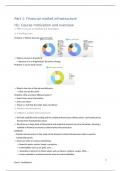
Part 1: Financial market infrastructure
H1: Course motivation and overview
1. Why a course on trading and exchanges
2. A trading story
Problem 1: Where does she want to trade
-> Where you buy is important
-> Because it is so fragmented, the prices change
Problem 2: Lit are dark venues
-> What is the role of the ask and bid price
-> they are not the same
Problem: Why are there different prices?
-> Some have more information
-> Some are faster
-> There is a risk that the seller does not deliver
3. Market microstructure
3.1 What is market microstructure
-> We look explicitly how trading and the trading infrastructure affects prices, and makes prices
deviate from fundamental values
-> We draw on a large body of theoretical and empirical research on price formation, forming a
subfield of financial economics called market microstructure
DEFINTIE
= Market microstructure is the study of the financial market infrastructure that is used for
transacting assets.
-> Asset can refer to various underlyings:
-> financial assets: stocks, bonds, currencies, ...
-> commodities such as oil, gold, corn, ...
-> derivative contracts on these assets such as futures, options, swaps, CDSs, ...
-> it even extends to emission permits used to control pollution
1
Deel 1: Hoofdstuk 1
,DEFINITIE
= The trading infrastructure (also called trading mechanism) is the set of rules that apply during
trading.
DEFINITIE
= The post-trading infrastructure refers to the rules governing clearing and settlement.
-> Clearing refers to all activities made from the time that buyer and seller have agreed to trade
until settlement of the trade.
-> It is the process of transmitting, reconciling and confirming the terms of trade, and the
establishment of final positions for settlement.
-> Settlement is the completion of all obligations.
-> The settlement of a securities trade typically involves two delivery processes: the transfer of
the securities from the seller to the buyer, and the transfer of funds from the buyer to the
seller
-> Recurring themes: how does trading and the trading mechanism affect
1) price formation
2) market liquidity = degree to which an order can be executed within a short amount of time at a
price close to the consensus value
3) price discovery = the speed and accuracy with which information is incorporated into
transaction prices
4) volatility
5) market stability
6) welfare
3.2 Why should I study market microstructure
4. Trading infrastructure
4.1 First disti ncti on
-> quote driven (dealer market) vs order driven (limit order market)
-> Quote market: It are the prices of dealers that are driving the exchange
-> He post at witch price he is willing to buy or sell
-> Order driven: Here are no dealers, the people are interacting directly with each other
-> Limit order: you don’t only set an amount of stocks you want to buy, but also a max price
-> Liquidity
= How easy, fast and cheap you can trade
2
Deel 1: Hoofdstuk 1
, 4.2 Second disti ncti on
-> Continuous Market = trading is possible at any point (during opening hours)
-> Example: most stock markets, FOREX, ...
-> Periodic Market (Call Market) = trading occurs only at specific points in time
-> Example: call (batch) auctions = traders submit orders simultaneously • Example: crossing
Networks
4.3 Third disti ncti on
-> Degree of transparency
-> Pre-trade
-> quotes (ask and bid), depth, best prices only or more?, identity
-> Post-trade
-> size of orders executed, direction of orders executed, identity of the traders
-> Stock markets are transparent
-> Recall the order book from AB Inbev (but note there are no trader ids)
-> The identity of your counterpart is not available
-> You can only see how many people are responsible for the bid are ask price, but not who
those people are
-> There are many more distinctions
-> Tick size, Trading floor vs electronic, Regulated vs OTC, Precedence rules, Pricing: uniform,
discriminatory (as in limit order book), derivative (see crossing networks later), Fragmentation
Part 1: Chapter 2: Key concepts
1. Starti ng point: Effi ciënt markets
1.1 Effi ciënt market hypothesis (EMH)
DEFINITIE
= The fundamental value (also called true or fair value) Ṽ of an asset is the value at which the asset
can be liquidated in a frictionless and efficient market after trading has ended.
-> In general, this value will realize at some point in the future, and you do not know it for sure
today
-> We stress this in notation by the tilde above the variable, where the tilde indicates a random
variable
-> Friction refers to difficulties with which market participants are faced when trading the
asset, we discuss potential sources below in Section
3
Deel 1: Hoofdstuk 1
H1: Course motivation and overview
1. Why a course on trading and exchanges
2. A trading story
Problem 1: Where does she want to trade
-> Where you buy is important
-> Because it is so fragmented, the prices change
Problem 2: Lit are dark venues
-> What is the role of the ask and bid price
-> they are not the same
Problem: Why are there different prices?
-> Some have more information
-> Some are faster
-> There is a risk that the seller does not deliver
3. Market microstructure
3.1 What is market microstructure
-> We look explicitly how trading and the trading infrastructure affects prices, and makes prices
deviate from fundamental values
-> We draw on a large body of theoretical and empirical research on price formation, forming a
subfield of financial economics called market microstructure
DEFINTIE
= Market microstructure is the study of the financial market infrastructure that is used for
transacting assets.
-> Asset can refer to various underlyings:
-> financial assets: stocks, bonds, currencies, ...
-> commodities such as oil, gold, corn, ...
-> derivative contracts on these assets such as futures, options, swaps, CDSs, ...
-> it even extends to emission permits used to control pollution
1
Deel 1: Hoofdstuk 1
,DEFINITIE
= The trading infrastructure (also called trading mechanism) is the set of rules that apply during
trading.
DEFINITIE
= The post-trading infrastructure refers to the rules governing clearing and settlement.
-> Clearing refers to all activities made from the time that buyer and seller have agreed to trade
until settlement of the trade.
-> It is the process of transmitting, reconciling and confirming the terms of trade, and the
establishment of final positions for settlement.
-> Settlement is the completion of all obligations.
-> The settlement of a securities trade typically involves two delivery processes: the transfer of
the securities from the seller to the buyer, and the transfer of funds from the buyer to the
seller
-> Recurring themes: how does trading and the trading mechanism affect
1) price formation
2) market liquidity = degree to which an order can be executed within a short amount of time at a
price close to the consensus value
3) price discovery = the speed and accuracy with which information is incorporated into
transaction prices
4) volatility
5) market stability
6) welfare
3.2 Why should I study market microstructure
4. Trading infrastructure
4.1 First disti ncti on
-> quote driven (dealer market) vs order driven (limit order market)
-> Quote market: It are the prices of dealers that are driving the exchange
-> He post at witch price he is willing to buy or sell
-> Order driven: Here are no dealers, the people are interacting directly with each other
-> Limit order: you don’t only set an amount of stocks you want to buy, but also a max price
-> Liquidity
= How easy, fast and cheap you can trade
2
Deel 1: Hoofdstuk 1
, 4.2 Second disti ncti on
-> Continuous Market = trading is possible at any point (during opening hours)
-> Example: most stock markets, FOREX, ...
-> Periodic Market (Call Market) = trading occurs only at specific points in time
-> Example: call (batch) auctions = traders submit orders simultaneously • Example: crossing
Networks
4.3 Third disti ncti on
-> Degree of transparency
-> Pre-trade
-> quotes (ask and bid), depth, best prices only or more?, identity
-> Post-trade
-> size of orders executed, direction of orders executed, identity of the traders
-> Stock markets are transparent
-> Recall the order book from AB Inbev (but note there are no trader ids)
-> The identity of your counterpart is not available
-> You can only see how many people are responsible for the bid are ask price, but not who
those people are
-> There are many more distinctions
-> Tick size, Trading floor vs electronic, Regulated vs OTC, Precedence rules, Pricing: uniform,
discriminatory (as in limit order book), derivative (see crossing networks later), Fragmentation
Part 1: Chapter 2: Key concepts
1. Starti ng point: Effi ciënt markets
1.1 Effi ciënt market hypothesis (EMH)
DEFINITIE
= The fundamental value (also called true or fair value) Ṽ of an asset is the value at which the asset
can be liquidated in a frictionless and efficient market after trading has ended.
-> In general, this value will realize at some point in the future, and you do not know it for sure
today
-> We stress this in notation by the tilde above the variable, where the tilde indicates a random
variable
-> Friction refers to difficulties with which market participants are faced when trading the
asset, we discuss potential sources below in Section
3
Deel 1: Hoofdstuk 1