NCSBN NCLEX review questions and material Exam Questions with 100% Correct Answers
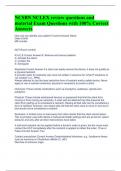
How can you identify your patient? Correct Answer Name Date of birth MR number NOT Room number R.A.C.E Correct Answer R: Remove and rescue patients A: Activate fire alarm C: Contain fire E: Extinguish Restraints Correct Answer If a client can easily remove the device, it does not qualify as a physical restraint. A provider order for restraints can never be written in advance for "what if" situations or "as needed" (i.e., PRN). Always attempt to use the least restrictive form of restraint and/or safety device. Never apply or use a restraint (chemical, physical or seclusion) to punish a client Chemical: These include medications such as anxiolytics, sedatives, opioids and paralytics. Physical: These include mechanical devices or equipment that limit the client from moving or from moving an extremity. A chair with an attached tray that prevents the client from getting up is considered a restraint. Raising all bed rails can be considered a form of restraint; however, one raised side rail that the client uses to move in and out of bed would not be considered a restraint. Seclusion: A locked room or area away from other clients that the client cannot leave. This is primarily used with clients in behavioral health settings who are at risk for violent behavior and only after all other interventions have failed A soft wrist restraint can be applied before a doctor's order is given, but the nurse must contact the HCP immediately after the restraint is applied to obtain the order. (True or False) Correct Answer True Contact precautions Correct Answer Gastrointestinal infections, e.g., foodborne illness such as norovirus or Clostridium difficile (C. diff.) Diarrhea of unknown origin Skin infections or infestations, e.g., impetigo, scabies Presence of, or colonization with, multidrug-resistant bacteria, e.g. methicillin-resistant Staphylococcus aureus (MRSA) Gown, gloves, mask, eye protection Herpes Zoster (shingles) disseminated needs what precautions Correct Answer implement both contact and airborne precautions until lesions are dry and crusted. Droplet precautions Correct Answer Influenza Meningococcal meningitis Mumps Rubella (German measles) Diphtheria Pertussis (Whooping cough) Infections caused by drug-resistant Streptococcus pneumonia Surgical mask 6 ft distance gown and gloves when providing care Airborne precautions Correct Answer Varicella (chicken pox) Tuberculosis Measles (rubella) N95 Filing incidence report Correct Answer Medication administration errors (even if the error did not reach the client) Any time a client makes a complaint Medical device malfunction Any time a client, staff member or visitor is injured or involved in a situation with the potential for injury When a client leaves the health care facility against medical advice (AMA) Loss or theft of a client's or visitor's property Triage Categories Correct Answer Immediate, Delayed, Minimal, Expectant Immediate (red) Correct Answer Chest wounds Shock Open fractures 2/3 degree burns Delayed (yellow) Correct Answer second priority
Written for
- Institution
- Ncsbn
- Course
- Ncsbn
Document information
- Uploaded on
- December 23, 2023
- Number of pages
- 90
- Written in
- 2023/2024
- Type
- Exam (elaborations)
- Contains
- Questions & answers
Subjects
-
how can you identify your patient

Document also available in package deal