Marketing
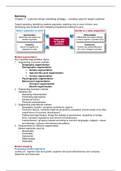
Chapter 7 : customer-driven marketing strategy – creating value for target customer
Target marketing, identifying markets segments, selecting one or more of them, and
developing new products and marketing programmes tailored to each.
Market segmentation
four important segmentation topics:
1. Segmenting consumer markets
- Geographic segmentation
- Demographic segmentation
Gender segmentation
Age and life cycle segmentation
Income segmentation
- Psychographic segmentation
- Behavioural segmentation
- Occasion segmentation
- Benefit segmentation
2. Segmenting business markets
Variables like:
- Operating characteristics
- Purchasing approaches
- Situational factors
- Personal characteristics
3. Segmenting international markets
- Geographic location, grouping countries by regions.
- Economic factors, countries might be grouped by population income levels or by their
overall level of economic development.
- Political and legal factors, things like stability of government, receptivity to foreign
firms, monetary regulations and amount of bureaucracy.
- Cultural factors, grouping markets according to common languages, religions, values
and attitudes, customs and behavioural patterns.
4. Requirements for effective segmentation
Market segments must be:
- Measurable
- Accessible
- Substantial
- Differentiable
- Actionable
Market targeting
Evaluating market segments
Looking at : segment size and growth, segment structural attractiveness and company
objectives and resources.
Chapter 7 : customer-driven marketing strategy – creating value for target customer
Target marketing, identifying markets segments, selecting one or more of them, and
developing new products and marketing programmes tailored to each.
Market segmentation
four important segmentation topics:
1. Segmenting consumer markets
- Geographic segmentation
- Demographic segmentation
Gender segmentation
Age and life cycle segmentation
Income segmentation
- Psychographic segmentation
- Behavioural segmentation
- Occasion segmentation
- Benefit segmentation
2. Segmenting business markets
Variables like:
- Operating characteristics
- Purchasing approaches
- Situational factors
- Personal characteristics
3. Segmenting international markets
- Geographic location, grouping countries by regions.
- Economic factors, countries might be grouped by population income levels or by their
overall level of economic development.
- Political and legal factors, things like stability of government, receptivity to foreign
firms, monetary regulations and amount of bureaucracy.
- Cultural factors, grouping markets according to common languages, religions, values
and attitudes, customs and behavioural patterns.
4. Requirements for effective segmentation
Market segments must be:
- Measurable
- Accessible
- Substantial
- Differentiable
- Actionable
Market targeting
Evaluating market segments
Looking at : segment size and growth, segment structural attractiveness and company
objectives and resources.