Marketing
Chapter 5 : consumer markets and consumer buyer behaviour
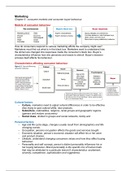
Models of consumer behaviour
How do consumers respond to various marketing efforts the company might use?
Marketers must find out what is in the black box. Marketers want to understand how
the stimuli are changed into responses inside the consumer’s black box. Buyer’s
characteristics influence how she perceives and reacts to stimuli. Buyer’s decision
process itself affects his behaviour.
Characteristics affecting consumer behaviour
Cultural factors
- Culture, marketers need to adjust cultural differences in order to be effective.
Also trying to spot cultural shifts, new products.
- Subculture, nationalities, religions, racial groups and geographic regions.
(gamers and mature consumers)
- Social class, divided in groups and social networks, family and
Personal factors
- Age and life cycle stage, changes usually result from demographics and life-
changing events.
- Occupation, persons occupation affects the goods and services bought.
- Economic situation, person’s economic situation will affect his or her store
and product choices.
- Lifestyle, understand changing consumers values and how they affect buying
behaviour.
- Personality and self concept, person’s distinct personality influences his or
her buying behaviour. Brand personality is the specific mix of human traits
that may be attributed to a particular brand (5 characteristics :excitement,
sincerity, competence, sophistication and ruggedness.
, Psychological factors
Buying decisions influenced by four factors:
- Motivation, motivation research refers to qualitative research designed to
probe consumer’s hidden, subconscious motivations. Interpretive consumer
research: to dig deeper into consumer psyches and develop better marketing
strategies.
- Perception, learn by flow of information through five senses : sight, hearing,
smell, touch and taste. Each receives this in individual way.
Perceptual process:
Selective attention: tendency for people to screen out most of the
information to which they are exposed
Selective distortion: tendency of people to interpret information in a
way that will support what they already believe
Selective retention: consumers are likely to remember good points
made about a brand they favour and forget good points made about
competing brands.
- Learning, learning occurs through the interplay of drives, stimuli, cues,
responses and reinforcement.
Drive: strong internal stimulus that calls for action. Drive becomes
motive when it is directed toward a particular stimulus object.
Cues: minor stimuli that determine when, where and how a person
responds.
- Beliefs and attitudes
Types of buying behaviour
Four types of buying behaviour:
1. Complex buying behaviour
2. Dissonance reducing buying
behaviour
Postpurchase dissonance = after-
sale comfort
3. Variety seeking buying behaviour
4. Habitual buying behaviour
The buyer decision process
Buyer decision process has 5 stages:
1. Need recognition, triggered by internal and external stimuli
2. Information search, consumers can obtain information: personal sources,
commercial sources, public sources, experiential sources
3. Evaluation of alternatives, marketers should study buyers to find out how
they actually evaluate brand alternatives. Know the evaluative processes they
can take steps to influence it.
4. Purchase decision, 2 factors between purchase intention and decision:
attitude of others and unexpected situational factors.
5. Post-purchase behaviour, connection consumer’s expectations and
product’s perceived performance.
Chapter 5 : consumer markets and consumer buyer behaviour
Models of consumer behaviour
How do consumers respond to various marketing efforts the company might use?
Marketers must find out what is in the black box. Marketers want to understand how
the stimuli are changed into responses inside the consumer’s black box. Buyer’s
characteristics influence how she perceives and reacts to stimuli. Buyer’s decision
process itself affects his behaviour.
Characteristics affecting consumer behaviour
Cultural factors
- Culture, marketers need to adjust cultural differences in order to be effective.
Also trying to spot cultural shifts, new products.
- Subculture, nationalities, religions, racial groups and geographic regions.
(gamers and mature consumers)
- Social class, divided in groups and social networks, family and
Personal factors
- Age and life cycle stage, changes usually result from demographics and life-
changing events.
- Occupation, persons occupation affects the goods and services bought.
- Economic situation, person’s economic situation will affect his or her store
and product choices.
- Lifestyle, understand changing consumers values and how they affect buying
behaviour.
- Personality and self concept, person’s distinct personality influences his or
her buying behaviour. Brand personality is the specific mix of human traits
that may be attributed to a particular brand (5 characteristics :excitement,
sincerity, competence, sophistication and ruggedness.
, Psychological factors
Buying decisions influenced by four factors:
- Motivation, motivation research refers to qualitative research designed to
probe consumer’s hidden, subconscious motivations. Interpretive consumer
research: to dig deeper into consumer psyches and develop better marketing
strategies.
- Perception, learn by flow of information through five senses : sight, hearing,
smell, touch and taste. Each receives this in individual way.
Perceptual process:
Selective attention: tendency for people to screen out most of the
information to which they are exposed
Selective distortion: tendency of people to interpret information in a
way that will support what they already believe
Selective retention: consumers are likely to remember good points
made about a brand they favour and forget good points made about
competing brands.
- Learning, learning occurs through the interplay of drives, stimuli, cues,
responses and reinforcement.
Drive: strong internal stimulus that calls for action. Drive becomes
motive when it is directed toward a particular stimulus object.
Cues: minor stimuli that determine when, where and how a person
responds.
- Beliefs and attitudes
Types of buying behaviour
Four types of buying behaviour:
1. Complex buying behaviour
2. Dissonance reducing buying
behaviour
Postpurchase dissonance = after-
sale comfort
3. Variety seeking buying behaviour
4. Habitual buying behaviour
The buyer decision process
Buyer decision process has 5 stages:
1. Need recognition, triggered by internal and external stimuli
2. Information search, consumers can obtain information: personal sources,
commercial sources, public sources, experiential sources
3. Evaluation of alternatives, marketers should study buyers to find out how
they actually evaluate brand alternatives. Know the evaluative processes they
can take steps to influence it.
4. Purchase decision, 2 factors between purchase intention and decision:
attitude of others and unexpected situational factors.
5. Post-purchase behaviour, connection consumer’s expectations and
product’s perceived performance.