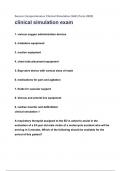
Secure
Comprehensive
Clinical
Simulation
SAE
(Form
2020)
clinical
simulation
exam
1.
various
oxygen
administration
devices
2.
intubation
equipment
3.
suction
equipment
4.
chest
tube
placement
equipment
5.
Bag-valve
device
with
various
sizes
of
mask
6.
medications
for
pain
and
agitation
7.
fluids
for
vascular
support
8.
Venous
and
arterial
line
equipment
9.
cardiac
monitor
and
defibrillator
clinical
simulation
1
A
respiratory
therapist
assigned
to
the
ED
is
asked
to
assist
in
the
evaluation
of
a
24
year
old
male
victim
of
a
motorcycle
accident
who
will
be
arriving
in
5
minutes.
Which
of
the
following
should
be
available
for
the
arrival
of
this
patient? 1.
Vital
signs
(TPR)
and
blood
pressure
2.
general
appearance
3.
breath
sounds
4.
chest
inspection
5.
SpO2
6.
skin
color
7.
ECG
via
cardiac
monitor
8.
pupillary
response
When
the
patient
arrives
at
the
ED,
he
is
awake,
but
agitated.
He
has
a
cervical
collar
on
and
is
moving
all
extremities
while
breathing
room
air.
During
the
initial
evaluation
of
this
patient,
which
of
the
following
should
be
assessed?
oxygen
via
nonrebreathing
mask
at
12L/min
Which
of
the
following
should
be
recommended?
Arterial
blood
gas
analysis
12-lead
ECG Chest
x-ray
CBC
Chemistry
and
toxicology
Electrolytes
The
ED
physician
requests
recommendations
of
diagnostic
studies
and
laboratory
data
that
would
help
to
further
assess
the
patients
condition.
Which
of
the
following
should
be
evaluated?
Endotracheal
intubation
and
manual
ventilation
Which
of
the
following
should
be
recommended
to
the
ED
physician?
Continue
manual
ventilation
and
begin
chest
compressions
clinical
simulation
2
An
evening
shift
respiratory
therapist
on
call
for
labor
and
delivery
(L&D)
receives
a
page
to
report
immediately
to
the
L&D
to
assist
in
the
management
of
an
infant
female
who
was
delivered
limp
and
cyanotic.
The
infant
is
manually
ventilated
via
mask
and
resuscitator
bag.
There
are
no
efforts
at
spontaneous
respirations
and
the
heart
rate
is
approximately
50
breaths/min.
The
infant
is
36
weeks
gestation
and
weighs
2622
grams.
Which
of
the
following
should
be
recommended?
3.0-mm
internal
diameter;
uncuffed
endotracheal
tube One
minute
later,
the
infant
remains
unresponsive
and
with
minimal
improvement
in
color.
The
physician
now
requests
assistance
in
performing
endotracheal
intubation.
Which
of
the
following
endotracheal
tubes
should
be
selected
for
this
infant?
Heart
rate
Spontaneous
respirations
Chest
excursion
Breath
sounds
The
infant
is
intubated
and
manual
ventilation
is
resumed.
Which
of
the
following
should
now
be
assessed?
Reposition
the
endotracheal
tube
Which
of
the
following
should
be
recommended?
Stop
chest
compression;
continue
to
manually
ventilate;
transfer
the
infant
to
the
NICU
Five
minutes
later,
the
infants
color
has
significantly
improved.
The
heart
rate
is
now
136/minute.
No
detectable
spontaneous
respirations
are
observed.
Which
of
the
following
should
be
recommended?
Comprehensive
Clinical
Simulation
SAE
(Form
2020)
clinical
simulation
exam
1.
various
oxygen
administration
devices
2.
intubation
equipment
3.
suction
equipment
4.
chest
tube
placement
equipment
5.
Bag-valve
device
with
various
sizes
of
mask
6.
medications
for
pain
and
agitation
7.
fluids
for
vascular
support
8.
Venous
and
arterial
line
equipment
9.
cardiac
monitor
and
defibrillator
clinical
simulation
1
A
respiratory
therapist
assigned
to
the
ED
is
asked
to
assist
in
the
evaluation
of
a
24
year
old
male
victim
of
a
motorcycle
accident
who
will
be
arriving
in
5
minutes.
Which
of
the
following
should
be
available
for
the
arrival
of
this
patient? 1.
Vital
signs
(TPR)
and
blood
pressure
2.
general
appearance
3.
breath
sounds
4.
chest
inspection
5.
SpO2
6.
skin
color
7.
ECG
via
cardiac
monitor
8.
pupillary
response
When
the
patient
arrives
at
the
ED,
he
is
awake,
but
agitated.
He
has
a
cervical
collar
on
and
is
moving
all
extremities
while
breathing
room
air.
During
the
initial
evaluation
of
this
patient,
which
of
the
following
should
be
assessed?
oxygen
via
nonrebreathing
mask
at
12L/min
Which
of
the
following
should
be
recommended?
Arterial
blood
gas
analysis
12-lead
ECG Chest
x-ray
CBC
Chemistry
and
toxicology
Electrolytes
The
ED
physician
requests
recommendations
of
diagnostic
studies
and
laboratory
data
that
would
help
to
further
assess
the
patients
condition.
Which
of
the
following
should
be
evaluated?
Endotracheal
intubation
and
manual
ventilation
Which
of
the
following
should
be
recommended
to
the
ED
physician?
Continue
manual
ventilation
and
begin
chest
compressions
clinical
simulation
2
An
evening
shift
respiratory
therapist
on
call
for
labor
and
delivery
(L&D)
receives
a
page
to
report
immediately
to
the
L&D
to
assist
in
the
management
of
an
infant
female
who
was
delivered
limp
and
cyanotic.
The
infant
is
manually
ventilated
via
mask
and
resuscitator
bag.
There
are
no
efforts
at
spontaneous
respirations
and
the
heart
rate
is
approximately
50
breaths/min.
The
infant
is
36
weeks
gestation
and
weighs
2622
grams.
Which
of
the
following
should
be
recommended?
3.0-mm
internal
diameter;
uncuffed
endotracheal
tube One
minute
later,
the
infant
remains
unresponsive
and
with
minimal
improvement
in
color.
The
physician
now
requests
assistance
in
performing
endotracheal
intubation.
Which
of
the
following
endotracheal
tubes
should
be
selected
for
this
infant?
Heart
rate
Spontaneous
respirations
Chest
excursion
Breath
sounds
The
infant
is
intubated
and
manual
ventilation
is
resumed.
Which
of
the
following
should
now
be
assessed?
Reposition
the
endotracheal
tube
Which
of
the
following
should
be
recommended?
Stop
chest
compression;
continue
to
manually
ventilate;
transfer
the
infant
to
the
NICU
Five
minutes
later,
the
infants
color
has
significantly
improved.
The
heart
rate
is
now
136/minute.
No
detectable
spontaneous
respirations
are
observed.
Which
of
the
following
should
be
recommended?