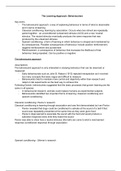
The Learning Approach: Behaviourism
Key terms
- The behaviourist approach: a way of explaining behaviour in terms of what is observable
and in terms of learning
- Classical conditioning: learning by association. Occurs when two stimuli are repeatedly
paired together - an unconditioned (unlearned) stimulus (UCS) and a new ‘neutral’
stimulus. The neutral stimulus eventually produces the same response that was
produced by the unlearned stimulus
- Operant conditioning: a form of learning in which behaviour is shaped and maintained by
its consequences. Possible consequences of behaviour include positive reinforcement,
negative reinforcement and punishment
- Reinforcement: a consequence of behaviour that increases the likelihood of that
behaviour being repeated. Can be positive or negative
The behaviourist approach
Assumptions
The behaviourist approach is only interested in studying behaviour that can be observed or
measured
- Early behaviourists such as John B. Watson (1913) rejected introspection as it involved
too many concepts that were vague and difficult to measure
- Behaviourists tried to maintain more control and objectivity within their research and
relied on lab experiments as the best way to achieve this
Following Darwin, behaviourists suggested that the basic processes that govern learning are the
same in all species
- In behaviourist research, animals could replace humans as experimental subjects
- Behaviourists identified two important forms of learning: classical conditioning and
operant conditioning
Classical conditioning: Pavlov’s research
Classical conditioning is learning through association and was first demonstrated by Ivan Pavlov
- Pavlov revealed that dogs could be conditioned to salivate at the sound of a bell if that
sound was repeatedly presented at the same time as they were given food
- Pavlov’s dogs learned to associate the sound with the food and would produce a
salivation response every time they heard the sound
Pavlov was able to show how a neutral stimulus (the bell) can come to elicit a new learned
response (conditioned response) through association
Operant conditioning - Skinner’s research
Key terms
- The behaviourist approach: a way of explaining behaviour in terms of what is observable
and in terms of learning
- Classical conditioning: learning by association. Occurs when two stimuli are repeatedly
paired together - an unconditioned (unlearned) stimulus (UCS) and a new ‘neutral’
stimulus. The neutral stimulus eventually produces the same response that was
produced by the unlearned stimulus
- Operant conditioning: a form of learning in which behaviour is shaped and maintained by
its consequences. Possible consequences of behaviour include positive reinforcement,
negative reinforcement and punishment
- Reinforcement: a consequence of behaviour that increases the likelihood of that
behaviour being repeated. Can be positive or negative
The behaviourist approach
Assumptions
The behaviourist approach is only interested in studying behaviour that can be observed or
measured
- Early behaviourists such as John B. Watson (1913) rejected introspection as it involved
too many concepts that were vague and difficult to measure
- Behaviourists tried to maintain more control and objectivity within their research and
relied on lab experiments as the best way to achieve this
Following Darwin, behaviourists suggested that the basic processes that govern learning are the
same in all species
- In behaviourist research, animals could replace humans as experimental subjects
- Behaviourists identified two important forms of learning: classical conditioning and
operant conditioning
Classical conditioning: Pavlov’s research
Classical conditioning is learning through association and was first demonstrated by Ivan Pavlov
- Pavlov revealed that dogs could be conditioned to salivate at the sound of a bell if that
sound was repeatedly presented at the same time as they were given food
- Pavlov’s dogs learned to associate the sound with the food and would produce a
salivation response every time they heard the sound
Pavlov was able to show how a neutral stimulus (the bell) can come to elicit a new learned
response (conditioned response) through association
Operant conditioning - Skinner’s research