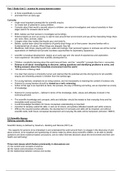
Part 1 Study Unit 2 – science for young learners (exam)
to think scientifically is crucial.
promoted from an early age
Curiosity
single most important prerequisite for scientific enquiry
no innate lack of potential in young children.
Curiosity about their world is second nature to children- are natural investigators and natural scientists in their
eager search for answers about world.
Birth- babies use their senses to investigate surroundings.
Science begins as soon as young L’s start to look around their environment and see all the interesting things there
are -ants, trees, animals, water.
It begins when they realise that liquids pour and birds fly.
Babies, quickly learn about the existence of gravity-drop things out of their prams- become familiar with a
fundamental law of nature: When things are dropped, they fall.
Mealtimes, bath times, playing with toys, walks and outings, their personal hygiene or sickness are all the normal
explorations of childhood and provide countless opportunities for exploratory experience.
scientific conceptual development- begins at an early age and -the result of experiences and exploration.
more experience- the better their scientific development is.
Children -constantly learning about the world around them, and the ``scientific'' concepts they form + encounter.
Science is all about -investigating to discover, asking questions and identifying problems to solve, and
finding answers about the immediate environment and the world.
Will become a lifelong habit.
It is clear that science is inherently human and claimed that the potential and the driving force for all scientific
enquiry are inherently present in children from the earliest age.
For young learners, emphasis be on doing science, and not necessarily on learning the content of science only.
Science for young learners should be viewed as a verb- sciencing.
Action at this age is as important as facts; the process, the way of thinking and acting, are as important as a body
of knowledge.
Science for young learners – defined in terms of the knowledge, skills, values and attitudes involved in the
sciencing process.
The scientific knowledge and concepts, skills and attitudes -should be related to their everyday lives and the
immediate world around them.
A solid knowledge foundation for future conceptual understanding is important
important to develop useful life skills, in and out of school, and positive attitudes towards and within science.
Without the required positive attitudes, the development of concepts and skills will be impaired, and without
scientific skills, both future conceptual development and everyday life skills will be hampered (Johnston 1996:5).
2.2 Scientific literacy
Defining scientific literacy
Scientific literacy is defined by Goodrum, Hackling and Rennie (2001) as
``the capacity for persons to be interested in and understand the world around them, to engage in the discourse of and
about science, to be sceptical and questioning of claims made by others about scientific matters, to be able to identify
questions and draw evidence-based conclusions, and to make informed decisions about the environment and their own
health and well-being''.
Three main issues which feature prominently in discussions are:
(1) the content and concepts of science
(2) the nature and processes of science
(3) the relationship between science and society
to think scientifically is crucial.
promoted from an early age
Curiosity
single most important prerequisite for scientific enquiry
no innate lack of potential in young children.
Curiosity about their world is second nature to children- are natural investigators and natural scientists in their
eager search for answers about world.
Birth- babies use their senses to investigate surroundings.
Science begins as soon as young L’s start to look around their environment and see all the interesting things there
are -ants, trees, animals, water.
It begins when they realise that liquids pour and birds fly.
Babies, quickly learn about the existence of gravity-drop things out of their prams- become familiar with a
fundamental law of nature: When things are dropped, they fall.
Mealtimes, bath times, playing with toys, walks and outings, their personal hygiene or sickness are all the normal
explorations of childhood and provide countless opportunities for exploratory experience.
scientific conceptual development- begins at an early age and -the result of experiences and exploration.
more experience- the better their scientific development is.
Children -constantly learning about the world around them, and the ``scientific'' concepts they form + encounter.
Science is all about -investigating to discover, asking questions and identifying problems to solve, and
finding answers about the immediate environment and the world.
Will become a lifelong habit.
It is clear that science is inherently human and claimed that the potential and the driving force for all scientific
enquiry are inherently present in children from the earliest age.
For young learners, emphasis be on doing science, and not necessarily on learning the content of science only.
Science for young learners should be viewed as a verb- sciencing.
Action at this age is as important as facts; the process, the way of thinking and acting, are as important as a body
of knowledge.
Science for young learners – defined in terms of the knowledge, skills, values and attitudes involved in the
sciencing process.
The scientific knowledge and concepts, skills and attitudes -should be related to their everyday lives and the
immediate world around them.
A solid knowledge foundation for future conceptual understanding is important
important to develop useful life skills, in and out of school, and positive attitudes towards and within science.
Without the required positive attitudes, the development of concepts and skills will be impaired, and without
scientific skills, both future conceptual development and everyday life skills will be hampered (Johnston 1996:5).
2.2 Scientific literacy
Defining scientific literacy
Scientific literacy is defined by Goodrum, Hackling and Rennie (2001) as
``the capacity for persons to be interested in and understand the world around them, to engage in the discourse of and
about science, to be sceptical and questioning of claims made by others about scientific matters, to be able to identify
questions and draw evidence-based conclusions, and to make informed decisions about the environment and their own
health and well-being''.
Three main issues which feature prominently in discussions are:
(1) the content and concepts of science
(2) the nature and processes of science
(3) the relationship between science and society