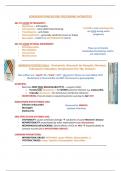
CONSIDERATIONS BEFORE PRESCRIBING ANTIBIOTICS
ABs TO AVOID IN PREGNANCY:
- Quinolones – arthropathy
- Tetracyclines – bone deformities/staining Penicillins and cephalosporins
- Trimethoprim – anti-folate are SAFE during entire
- Chloramphenicol – grey-baby syndrome (even w/ drops) pregnancy
- Macrolides – EXCEPT for ERYTHROMYCIN (SAFE)
ABs TO AVOID IN RENAL IMPAIRMENT:
- Aminoglycosides These are all mainly
- Glycopeptides metabolised by kidneys and/or
- Tetracyclines are nephrotoxic
- Nitrofurantoin
AMINOGLYCOSIDES (AGs) – Gentamicin, Neomycin (in Naseptin, Otomize),
Tobramycin (Tobradex), Streptomycin (for TB), Amikacin
AGs suffixes are ‘-mycin’ OR –‘micin’ ; NOT ‘-thromycin’ (these are macrolides), NOT
clindamycin (a lincosamide) and NOT vancomycin (a glycopeptide)
OVERVIEW:
- AGs have ZERO ORAL BIOAVAILABILITY (F) – so given either:
o Parenterally: Gentamicin – for SEVERE systemic infection e.g. endocarditis
o Topically: Neomycin – for skin/mucus membrane infections
- MONITORING of serum-levels is required (systemic use) due to AG’s NTI
INDICATIONS (FOR SYSTEMIC USE):
- Infective endocarditis Reserved for SERIOUS
- Meningitis systemic infections
- Septicaemia
SIDE EFFECTS (FOR SYSTEMIC USE):
- OTOTOXICITY: causes vestibular damage symptoms of acute Meniere’s disease
- NEPHROTOXICITY: exacerbated by other nephrotoxins (see interactions)
- NEUROMUSCULAR BLOCKADE: blocks effects of ACh on NMJ impaired ability to
contract muscles (CI in MYSATHENIA GRAVIS)
COMMON INTERACTIONS:
- NEPHROTOXIC DRUGS: ANTI-RAAS, Loops, NSAIDs, Glycopeptides, Li
- OTOTOXIC DRUGS: Loops, Cisplatin, Glycopeptides, Macrolides
, CEPHALOSPORINS (CPs) – Cefalexin (1st-Gen), Ceftriaxone (3rd-Gen),
Ceftaroline (5th-Gen)
CPs all have the prefix ‘-Cef’ OR ‘Ceph’
1st GEN. CPs:
- Are orally bioavailable
- Main INDICATIONS = Urinary Tract Infections (UTIs):
o Pyelonephritis (Upper UTI)
o 2nd Line in LUTI in PREGNANCY (after Nitrofurantoin)
3rd & 5th GEN. CPs:
- Have NO oral bioavailability – so only used IV in HOSPITAL (like systemic GPs)
- Broad range of INDICATIONS = normally used in complicated infections
CROSS-SENSITIVITY:
- CPs contain a β-lactam ring (like Penicillins & Carbapenems) so CROSS-SENSITIVITY
can occur between the classes
- If pt has a TYPE I HS reaction to Penicillins, then CPs are an absolute CI in this pt
GLYCOPEPTIDES – Vancomycin, Teicoplanin
OVERVIEW:
- Very similar to AGs (not orally F & used for serious systemic infection & has a NTI)
- Serum-levels of vancomycin: 10-20mg/L (NTI)
- Also INDICATED in:
o Clostridium difficile (C. diff) infection
o Methicillin-Resistant Staph. aureus (MRSA)
QUICK OVERVIEW OF C. diff INFECTION:
- C.diff exists as part of normal GI microbiome in small quantities (asymptomatic)
- OVERGROWTH often CAUSED by:
o Clindamycin & late-gen Cephs (kills other bacteria that keep C. diff at bay)
o PPIs (lower GI acidity more hospitable environment)
- Overgrowth SYMPTOMS:
o Colitis (abdominal pain)
o Foul-smelling, watery diarrhoea
o Fever
- TREATMENT = ORAL VANCOMYCIN – NOT absorbed systemically (acts locally)
SIDE EFFECTS (SYSTEMIC USE):
- SAME AS AGs: oto-/nephrotoxicity but NOT neuromuscular blockade
- RED MAN SYNDROME: allergic-LIKE reaction specific to Vancomycin – caused by
HISTAMINE RELEASE (often occurs when infusion rate is TOO FAST)
- BLOOD DYSCRASIA: neutropenia, agranulocytosis
, LINCOSAMIDES – Clindamycin
INDICATIONS:
- SYSTEMIC: Many SERIOUS infections (esp OSTEOMYELITIS due to good bone
absorption)
- TOPICAL: Acne (Duac, Dalacin T Lotion), Bacterial Vaginosis (Dalacin Cream)
SIDE EFFECTS:
- C.diff INFECTION manifests as colitis & watery diarrhoea – discontinue if suspected
(contact specialists if cannot be discontinued) – can be FATAL
CONTRAINDICATIONS:
- EXISTING DIARRHOEA (does NOT apply to topical forms – Poor absorption)
MACROLIDES – Azithromycin, Clarithromycin, Erythromycin
OVERVIEW:
- Have similar spectrum of activity as Penicillins – often used in pen. allergic pts
- Commonly used in bacterial STIs: Chlamydia and Gonorrhoea
- Oral dosing regimen:
o Azithromycin – OD
o Clarithromycin – BD
o Erythromycin – TDS
COMMON INDICATIONS:
- Common RTIs: CAP, bronchitis
- STIs: gonorrhoea, chlamydia (& trachoma – NOT an STI)
- H.pylori: alongside PPI & metronidazole/amoxicillin
SIDE EFFECTS:
- HEPATOTOXICITY: manifests as jaundice, hepatitis
- OTOTOXCITY: only in HIGH DOSES
- QT-INTERVAL PROLONGATION
COMMON INTERACTIONS:
- DRUGS THAT PROLONG QT INTERVAL: Amiodarone, Methadone, TCAs,
Antiemetics, Quinolones
METRONIDAZOLE
COMMON INDICATIONS:
- Oral infections & Gingivitis (on Dental Rx)
- H. pylori: alongside Clarithromycin/Amoxicillin + PPI
- Anaerobic infections & PROTOZOAL infections (e.g. giardiasis)
- Topically for Rosacea (Rozex) & Bacterial Vaginosis (Zidoval)
ABs TO AVOID IN PREGNANCY:
- Quinolones – arthropathy
- Tetracyclines – bone deformities/staining Penicillins and cephalosporins
- Trimethoprim – anti-folate are SAFE during entire
- Chloramphenicol – grey-baby syndrome (even w/ drops) pregnancy
- Macrolides – EXCEPT for ERYTHROMYCIN (SAFE)
ABs TO AVOID IN RENAL IMPAIRMENT:
- Aminoglycosides These are all mainly
- Glycopeptides metabolised by kidneys and/or
- Tetracyclines are nephrotoxic
- Nitrofurantoin
AMINOGLYCOSIDES (AGs) – Gentamicin, Neomycin (in Naseptin, Otomize),
Tobramycin (Tobradex), Streptomycin (for TB), Amikacin
AGs suffixes are ‘-mycin’ OR –‘micin’ ; NOT ‘-thromycin’ (these are macrolides), NOT
clindamycin (a lincosamide) and NOT vancomycin (a glycopeptide)
OVERVIEW:
- AGs have ZERO ORAL BIOAVAILABILITY (F) – so given either:
o Parenterally: Gentamicin – for SEVERE systemic infection e.g. endocarditis
o Topically: Neomycin – for skin/mucus membrane infections
- MONITORING of serum-levels is required (systemic use) due to AG’s NTI
INDICATIONS (FOR SYSTEMIC USE):
- Infective endocarditis Reserved for SERIOUS
- Meningitis systemic infections
- Septicaemia
SIDE EFFECTS (FOR SYSTEMIC USE):
- OTOTOXICITY: causes vestibular damage symptoms of acute Meniere’s disease
- NEPHROTOXICITY: exacerbated by other nephrotoxins (see interactions)
- NEUROMUSCULAR BLOCKADE: blocks effects of ACh on NMJ impaired ability to
contract muscles (CI in MYSATHENIA GRAVIS)
COMMON INTERACTIONS:
- NEPHROTOXIC DRUGS: ANTI-RAAS, Loops, NSAIDs, Glycopeptides, Li
- OTOTOXIC DRUGS: Loops, Cisplatin, Glycopeptides, Macrolides
, CEPHALOSPORINS (CPs) – Cefalexin (1st-Gen), Ceftriaxone (3rd-Gen),
Ceftaroline (5th-Gen)
CPs all have the prefix ‘-Cef’ OR ‘Ceph’
1st GEN. CPs:
- Are orally bioavailable
- Main INDICATIONS = Urinary Tract Infections (UTIs):
o Pyelonephritis (Upper UTI)
o 2nd Line in LUTI in PREGNANCY (after Nitrofurantoin)
3rd & 5th GEN. CPs:
- Have NO oral bioavailability – so only used IV in HOSPITAL (like systemic GPs)
- Broad range of INDICATIONS = normally used in complicated infections
CROSS-SENSITIVITY:
- CPs contain a β-lactam ring (like Penicillins & Carbapenems) so CROSS-SENSITIVITY
can occur between the classes
- If pt has a TYPE I HS reaction to Penicillins, then CPs are an absolute CI in this pt
GLYCOPEPTIDES – Vancomycin, Teicoplanin
OVERVIEW:
- Very similar to AGs (not orally F & used for serious systemic infection & has a NTI)
- Serum-levels of vancomycin: 10-20mg/L (NTI)
- Also INDICATED in:
o Clostridium difficile (C. diff) infection
o Methicillin-Resistant Staph. aureus (MRSA)
QUICK OVERVIEW OF C. diff INFECTION:
- C.diff exists as part of normal GI microbiome in small quantities (asymptomatic)
- OVERGROWTH often CAUSED by:
o Clindamycin & late-gen Cephs (kills other bacteria that keep C. diff at bay)
o PPIs (lower GI acidity more hospitable environment)
- Overgrowth SYMPTOMS:
o Colitis (abdominal pain)
o Foul-smelling, watery diarrhoea
o Fever
- TREATMENT = ORAL VANCOMYCIN – NOT absorbed systemically (acts locally)
SIDE EFFECTS (SYSTEMIC USE):
- SAME AS AGs: oto-/nephrotoxicity but NOT neuromuscular blockade
- RED MAN SYNDROME: allergic-LIKE reaction specific to Vancomycin – caused by
HISTAMINE RELEASE (often occurs when infusion rate is TOO FAST)
- BLOOD DYSCRASIA: neutropenia, agranulocytosis
, LINCOSAMIDES – Clindamycin
INDICATIONS:
- SYSTEMIC: Many SERIOUS infections (esp OSTEOMYELITIS due to good bone
absorption)
- TOPICAL: Acne (Duac, Dalacin T Lotion), Bacterial Vaginosis (Dalacin Cream)
SIDE EFFECTS:
- C.diff INFECTION manifests as colitis & watery diarrhoea – discontinue if suspected
(contact specialists if cannot be discontinued) – can be FATAL
CONTRAINDICATIONS:
- EXISTING DIARRHOEA (does NOT apply to topical forms – Poor absorption)
MACROLIDES – Azithromycin, Clarithromycin, Erythromycin
OVERVIEW:
- Have similar spectrum of activity as Penicillins – often used in pen. allergic pts
- Commonly used in bacterial STIs: Chlamydia and Gonorrhoea
- Oral dosing regimen:
o Azithromycin – OD
o Clarithromycin – BD
o Erythromycin – TDS
COMMON INDICATIONS:
- Common RTIs: CAP, bronchitis
- STIs: gonorrhoea, chlamydia (& trachoma – NOT an STI)
- H.pylori: alongside PPI & metronidazole/amoxicillin
SIDE EFFECTS:
- HEPATOTOXICITY: manifests as jaundice, hepatitis
- OTOTOXCITY: only in HIGH DOSES
- QT-INTERVAL PROLONGATION
COMMON INTERACTIONS:
- DRUGS THAT PROLONG QT INTERVAL: Amiodarone, Methadone, TCAs,
Antiemetics, Quinolones
METRONIDAZOLE
COMMON INDICATIONS:
- Oral infections & Gingivitis (on Dental Rx)
- H. pylori: alongside Clarithromycin/Amoxicillin + PPI
- Anaerobic infections & PROTOZOAL infections (e.g. giardiasis)
- Topically for Rosacea (Rozex) & Bacterial Vaginosis (Zidoval)