Praxis 5005 Life Science Questions and Answers Rated A+
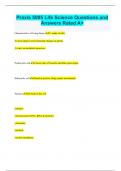
Praxis 5005 Life Science Questions and Answers Rated A+ Characteristics of living things 1) made of cells 2) must adapt to environmental changes or perish 3) carry on metabolic processes Prokaryotic cell consist only of bacteria and blue-green algae Eukaryotic cell found in protists, fungi, plants and animals Nucleus the brain of the cell contains: -chromosomes (DNA, RNA & proteins) -chromatin -nucleoli -nuclear membrane Ribosomes site of protein synthesis Endoplasmic reticulum vast system of interconnected membranous, enfolded and convoluted sacks that are located in the cell's cytoplasm two types: -smooth (no ribosomes on surface) -rough (ribosomes on surface) Golgi apparatus sort, modify and package molecules that are made in other parts of the cell Lysosomes contain digestive enzymes that break down food, substances not needed, viruses, damaged cell components and the cell itself Mitochondria make ATP to supply energy to the cell Plastids in photosynthetic organisms only 3 types: 1) chloroplasts (green, work in photosynthesis) 2) chromoplasts (store yellow and orange pigments; provide color to leaves, fruit, flowers) 3) amyloplasts (store starch) Cell wall in plant cells only; thick enough for support & protection but porous enough to allow water to enter Vacuoles hold stored food and pigments Cytoskeleton protein filaments attached to the plasma membrane and organelles 4 basic tissues 1) epithelial- things that cover 2) connective- bone, cartilage, blood 3)nervous-neurons, photoreceptor 4) muscle-skeletal muscles, cardiac muscles (capable of movement called contraction) Organ structure made of different tissues that carries out a specific function ex: stomach, brain, biceps, muscles, tongue Photosynthesis the process by which green leaves prepare food (glucose and oxygen) using carbon dioxide, water, and minerals in the presence of sunlight and chlorophyll Respiration chemical reaction that happens within cells to release energy from food Transpiration the process of water movement through a plant and its evaporation from aerial parts, such as from leaves but also from stems and flowers Gamete sex cell or germ cell; eggs and sperm Chromatin loose chromosomes when the cell is not dividing Chromosome tightly coiled, visible chromatin; when the cell is dividing Homologues chromosomes that contain the same information; same length and contain the same genes Diploid two in number; a pair of chromosomes Haploid one in number; half of a pair Mitosis the division of somatic cells 4 stages: 1) prophase 2) metaphase 3) anaphase 4) telophase Prophase chromatin coils up on each other to produce thick strands of DNA wrapped around protein (chromosome); the duplicate chromosomes are attached to the original Metaphase kinetochore fibers attach to the chromosomes which causes the chromosomes to line up in the center of the cell Anaphase centromeres split in half and homologous chromosomes separate; the chromosomes are pulled to the poles of the cell, with identical sets at either end Telophase each new cell structure are reconstructed; nuclear membrane is formed; nucleoli form within them Cytokinesis division of the cytoplasm and organelles Meiosis separation of sex cells that have 23 chromosomes; they need each other to combine to make complete 46; splits twice; same phases as mitosis but twice Alleles traits or characteristics Law of dominance in a pair of alleles, one trait may cover up the allele of the other trait ex: brown eyes are dominant Law of segregation only one of the two possible alleles from each parent is passed on to the offspring Law of independent assortment alleles sort independently of each other Punnet squares used to show the possible ways that genes combine and indicate probability of the occurrence of a certain genotype or phenotype Dominant the stronger of two traits; if it is present it will be expressed as a capital letter Recessive the weaker of two traits; in order for it to be expressed there has to be two recessive genes present; lowercase letter Homozygous two of the same genes present Heterozygous one dominant gene and one recessive gene Genotype the actual genes that an organism has Phenotype how the trait is expressed in an organism ex: blue eyes, brown hair Incomplete dominance neither gene masks the other; a new phenotype is formed ex: red & white flowers --> pink flower Codominance genes may form new phenotypes Linkage genes are found on the same chromosome appear together unless crossing over has occurred in meiosis ex: blue eyes and blonde hair usually occur together Lethal alleles recessive alleles due to the early death of the offspring Inborn errors of metabolism protein is affected is an enzyme ex: albinism Polygenic characteristics many alleles code for a phenotype ex: there could be 20 different genes that code for skin color Sex-linked traits Y chromosome found only in males (XY) carries little important info but the X in females (XX) carries very important info Sex-influenced traits traits are influenced by the sex hormones ex: male baldness Mutation inheritable changes in DNA Duplication mutation one gene is repeated Inversion mutation a segment of the sequence is flipped around Deletion mutation a gene is left out Insertion or translocation mutation a segment from another place on the DNA is inserted in the wrong place Breakage mutation a piece of DNA is lost Metamorphosis change in form ex: butterflies, bees, flies, insects Complete metamorphosis 1) egg 2) larva 3) pupa 4) adult Incomplete metamorphosis 1) egg 2) nymph 3) adult ex: grasshoppers & dragonflies Natural selection 1) Individuals in a certain species vary from generation to generation 2) some of the variations are determined by the genetic makeup of the species 3) more individuals are produced than will survive 4) some genes allow for better survival of an animal Innate behavior behavior that is inborn or instinctual Learned behavior behavior that is modified due to past experience Classification of living things 1) Kingdom (ex: animal) 2) Phylum (ex: cordate) 3) Subphylum (ex: vertebrate) 4) Class (ex: mammal) 5) Order (ex: primate) 6) Family (ex: hominidae) 7) Genus (ex: homo) 8) Species (ex: sapiens) Taxonomy the science of classification Marine covers 75% of Earth; the depth of water Tropical rain forest temp is constant; rainfall exceeds 200 cm per year; around the area of the equator Savanna traditional biome in between the rain forest and the desert Desert Temperate deciduous trees; bear; squirrels Taiga far north and far south of the equator close to the poles; plants and animals that can withstand harsh winters Tundra located north and south of the taiga; incredibly cold Polar or permafrost rarely gets above freezing; most water is bound up as ice; life is limited Population a group of the same species in a specific area Community a group of populations residing in the same area Parasitism two species occupy a similar place, but the parasite benefits from the host while the host is harmed Commensalism two species occupy a similar place, but neither is harmed or benefits from the relationship Mutualism two species occupy a similar place and both benefit from each other Competition two species occupy the same habitat or eat the same food Predation animals eat other animals; animals they eat are called the prey Carrying capacity total amount of life a habitat can support Food chain refers to the natural system by which energy is transmitted from one organism to another Food web bunch of food chains that make up an ecosystem; mass of connected food chains; they are connected if one part is removed, it can affect the whole web Food chain becomes a food web? when one or more interrelation links are added; a food chain is a single link with a single flow of energy; a food web contains several links and flow of energy Nutrition -Carbs -Proteins -Fats -Vitamins & minerals -Water
Written for
- Institution
- Praxis 5005 Life Science
- Course
- Praxis 5005 Life Science
Document information
- Uploaded on
- October 20, 2023
- Number of pages
- 15
- Written in
- 2023/2024
- Type
- Exam (elaborations)
- Contains
- Questions & answers
Subjects
-
praxis 5005 life science questions and answers rat

Document also available in package deal