
UNIT 9 - GEOMETRY OF STRAIGHT LINES
ANGLES
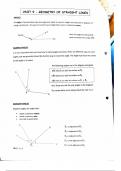
An angle is formed when two line-segments meet at a point. Angles are measured in degrees (°)
using aprotractor. The point at which two straight lines meet is called the vertex.
Vertex Here line segments AB and BC
meet at vertex B to create ABC.
NAMING ANGLES
name
It is very important that we know how to name angles correctly. There are different ways to
vertex
angles, but we generally chose the shortest way to name the angle. The angle must have the
of the angle in its name.
The following angles are in the diagram alongside:
C ABCwhich can also be written as B,.
A
CBD which can also be written as B.
ABD which can also be written as B, + B2.
N.B.These are not the only angles in the diagram.
The vertex letter must always have the 'hat' on it.
B
D
ADJACENT ANGLES
Adjacent angles are angles that:
share a commonvertex.
share acommon arm.
are next to each other.
P
X, is adjacent to R2
R, is adjacent to R4
R, is adjacent to R3
R, is not adjacent to R3
C
R, is not adjacent to R4
86 | Page
, COMPLEMENTARY ANGLES adjacent to
necessarily haveto be
not
Complementary angles are angles that add up to 90. The angles do complementary adjacent
becomplementary.Ifthe angles are complementary and adjacent, we call them
angles.
W
0+ = 48° + 42°
=90°
42° angles.
/48°
:0and are complementary
X
P complementary adjacent
Q and Q2,are up to 90° and
they
add
angles because they
are adjacent angles.
are not
NB: Be careful, Q, and Q,
1 necessarily 45 each.
R
SUPPLEMENTARY ANGLES
180°. The angles do not necessarily have to be
Supplementary angles are angles that add up to
adjacent.
70
P+X= 70°+ 110° = 180
Q
:P andX are supplementary angles.
110°
R
If adiacent angles do add up to 180* then they can be placed on astraight line. If the angles are
supplementary and adjacent, we callthem supplementary adjacent angles.
T
70° + 95° + 15° = 180°.
the angles are
Therefore,
70\ 95° 15°
supplementary and
because they are adjacent, SUW is a
W
U straight line.
ANGLES
An angle is formed when two line-segments meet at a point. Angles are measured in degrees (°)
using aprotractor. The point at which two straight lines meet is called the vertex.
Vertex Here line segments AB and BC
meet at vertex B to create ABC.
NAMING ANGLES
name
It is very important that we know how to name angles correctly. There are different ways to
vertex
angles, but we generally chose the shortest way to name the angle. The angle must have the
of the angle in its name.
The following angles are in the diagram alongside:
C ABCwhich can also be written as B,.
A
CBD which can also be written as B.
ABD which can also be written as B, + B2.
N.B.These are not the only angles in the diagram.
The vertex letter must always have the 'hat' on it.
B
D
ADJACENT ANGLES
Adjacent angles are angles that:
share a commonvertex.
share acommon arm.
are next to each other.
P
X, is adjacent to R2
R, is adjacent to R4
R, is adjacent to R3
R, is not adjacent to R3
C
R, is not adjacent to R4
86 | Page
, COMPLEMENTARY ANGLES adjacent to
necessarily haveto be
not
Complementary angles are angles that add up to 90. The angles do complementary adjacent
becomplementary.Ifthe angles are complementary and adjacent, we call them
angles.
W
0+ = 48° + 42°
=90°
42° angles.
/48°
:0and are complementary
X
P complementary adjacent
Q and Q2,are up to 90° and
they
add
angles because they
are adjacent angles.
are not
NB: Be careful, Q, and Q,
1 necessarily 45 each.
R
SUPPLEMENTARY ANGLES
180°. The angles do not necessarily have to be
Supplementary angles are angles that add up to
adjacent.
70
P+X= 70°+ 110° = 180
Q
:P andX are supplementary angles.
110°
R
If adiacent angles do add up to 180* then they can be placed on astraight line. If the angles are
supplementary and adjacent, we callthem supplementary adjacent angles.
T
70° + 95° + 15° = 180°.
the angles are
Therefore,
70\ 95° 15°
supplementary and
because they are adjacent, SUW is a
W
U straight line.


