
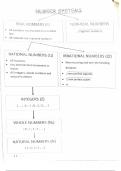
NUMBER SYSTEMS
REAL NUMBERS (R) NON-REAL NUMBERS
All numbers represented on anumber negative numbers
line
All rational and irrational numbers
RATIONAL NUMBERS (Q) IRRATIONAL NUMBERS (Q)
Allfractions
Non-recurring and non-terminating
Any decimal that terminates or
recurs decimals
Allintegers, whole numbers and non perfect squares
natural numbers
non perfect cubes
INTEGERS (Z)
{..;-2; -1;0;1;2; ... )
WHOLE NUMBERS (No)
{0;1;2;3; .. )
NATURAL NUMBERS (N)
{1;2;3;4; ...)
2|ae
, RATIONAL NUMBERS
KaTional numbers are numbers thot can be written as a where aand
frGCIi
bare integers, but b0.
Example: -2=;0,333333
1 - : 0,=i;-7
2
2
10
IRRATIONAL NUMBERS
We knowthat the v1= 1 and v4 =2
:. surely N3 has a value between 1 and 2? So, V3 = 1,...
And since 3 is closer to 4 than 1, maybe 3 is closer to 2 than 1.
Check on your calculator.
Now, let's find the position of v3 on the number line.
1 2
1.73
V3 =1,732050808...calculator
V3 1,73 (correct to 2 decimal digits)
So, this number does exist - it is REAL!
But,we can only get an approximate value of it.Notice howthe digits after the
decimal have no pattern at all and go on and on.
Irrational numbers are infinite, NON-RECURRING (no pattern) decimals.
ACTIVITY 1
Complete the following table by ticking ()and crossing (x) the correct
column(s):
Simplify the nurnber first, if necessary.
NUMBER IR Q' No N
3,14159
22
7
-5
1.121122111..
3|PaRe
, No N
NUMBER R
0,333..
49
|25
-10
-2
/o,008
V9
We carn use an inequality symbol to represent sets of numbers in Maths
Example:
List the set of numbers represented by each of the following inequalities:
a) X<6,x ENo
2
b) x<5:xEN
I;2, 3;4,5
c) -4<x<1:xeZ
Interval
notodn
-4, 3,-2, -,0. -42
(only
reealo )
usebroc
kels
d) What about the following? X> 2;xE R
tion
el buldet notati
)
3
4|?e
REAL NUMBERS (R) NON-REAL NUMBERS
All numbers represented on anumber negative numbers
line
All rational and irrational numbers
RATIONAL NUMBERS (Q) IRRATIONAL NUMBERS (Q)
Allfractions
Non-recurring and non-terminating
Any decimal that terminates or
recurs decimals
Allintegers, whole numbers and non perfect squares
natural numbers
non perfect cubes
INTEGERS (Z)
{..;-2; -1;0;1;2; ... )
WHOLE NUMBERS (No)
{0;1;2;3; .. )
NATURAL NUMBERS (N)
{1;2;3;4; ...)
2|ae
, RATIONAL NUMBERS
KaTional numbers are numbers thot can be written as a where aand
frGCIi
bare integers, but b0.
Example: -2=;0,333333
1 - : 0,=i;-7
2
2
10
IRRATIONAL NUMBERS
We knowthat the v1= 1 and v4 =2
:. surely N3 has a value between 1 and 2? So, V3 = 1,...
And since 3 is closer to 4 than 1, maybe 3 is closer to 2 than 1.
Check on your calculator.
Now, let's find the position of v3 on the number line.
1 2
1.73
V3 =1,732050808...calculator
V3 1,73 (correct to 2 decimal digits)
So, this number does exist - it is REAL!
But,we can only get an approximate value of it.Notice howthe digits after the
decimal have no pattern at all and go on and on.
Irrational numbers are infinite, NON-RECURRING (no pattern) decimals.
ACTIVITY 1
Complete the following table by ticking ()and crossing (x) the correct
column(s):
Simplify the nurnber first, if necessary.
NUMBER IR Q' No N
3,14159
22
7
-5
1.121122111..
3|PaRe
, No N
NUMBER R
0,333..
49
|25
-10
-2
/o,008
V9
We carn use an inequality symbol to represent sets of numbers in Maths
Example:
List the set of numbers represented by each of the following inequalities:
a) X<6,x ENo
2
b) x<5:xEN
I;2, 3;4,5
c) -4<x<1:xeZ
Interval
notodn
-4, 3,-2, -,0. -42
(only
reealo )
usebroc
kels
d) What about the following? X> 2;xE R
tion
el buldet notati
)
3
4|?e


