
INTEGERS
Integers are positive and negative WHOLE numbers (and zero).
Therefore -3 is NOT an integer.
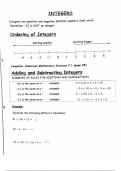
Ordering of Inteqers
Gettingsmaller Getting bigger
1 2 3 4 5
-4 -3 -2 -1
Complete: Classroom Mathematics Exercise 2.1 (page 28)
Adding and Subtracting Integers
SUMMARY OF RULES FOR ADDITION AND SUBTRACTION
+(+)is the same as a + example 5+ (+5) =5+5=10
+(-) is the same as a - example -5 +(-5) = -5-5 =-10
-(+) is the same as a - example 5-(+5) =5-5 =0
-() is the same as a t example -5 (-5) = - 5 +5 = 0
Example:
Calculate the following without a calculator:
a) (-14) + 12 =-2
b) -3-8= - \
c) (-13) +(-12) +6= - \
, wnen calculations become more complicated, you can simplify things by:
grouping the positive numbers together and the negative numbers together
Tinding the total for the positive numbers and the to tal for the negative
numbers
calculating the difference between these to tals
Example :
Calculate the following without using a
calculator:
-15 + 4
+7-1+3 11 + 20t
Complete: Classroom Mathematics Exercise 2.2 (page
Complete: Classroom Mathematics Exercise 2.3 (page 30)
31)
The Additive Inverse of a
Number
Every integer has an opposite. For example, the opposite of +5 is -5.
-5 is called the additive
inverse of +5 and vice versa,
If we add a number to its
additive inverse we will
e.g. (-5) + (+5)=0 or (+5) +(-5) = 0 always get zero.
If one number is added to
another number and the sum of the two
is O. then the one number is the
additive inverse of the other numbers
number
Example:
Write down the additive inverse of the following integers:
a) -6
b) +4
c) -17
d) +40 - 40
Integers are positive and negative WHOLE numbers (and zero).
Therefore -3 is NOT an integer.
Ordering of Inteqers
Gettingsmaller Getting bigger
1 2 3 4 5
-4 -3 -2 -1
Complete: Classroom Mathematics Exercise 2.1 (page 28)
Adding and Subtracting Integers
SUMMARY OF RULES FOR ADDITION AND SUBTRACTION
+(+)is the same as a + example 5+ (+5) =5+5=10
+(-) is the same as a - example -5 +(-5) = -5-5 =-10
-(+) is the same as a - example 5-(+5) =5-5 =0
-() is the same as a t example -5 (-5) = - 5 +5 = 0
Example:
Calculate the following without a calculator:
a) (-14) + 12 =-2
b) -3-8= - \
c) (-13) +(-12) +6= - \
, wnen calculations become more complicated, you can simplify things by:
grouping the positive numbers together and the negative numbers together
Tinding the total for the positive numbers and the to tal for the negative
numbers
calculating the difference between these to tals
Example :
Calculate the following without using a
calculator:
-15 + 4
+7-1+3 11 + 20t
Complete: Classroom Mathematics Exercise 2.2 (page
Complete: Classroom Mathematics Exercise 2.3 (page 30)
31)
The Additive Inverse of a
Number
Every integer has an opposite. For example, the opposite of +5 is -5.
-5 is called the additive
inverse of +5 and vice versa,
If we add a number to its
additive inverse we will
e.g. (-5) + (+5)=0 or (+5) +(-5) = 0 always get zero.
If one number is added to
another number and the sum of the two
is O. then the one number is the
additive inverse of the other numbers
number
Example:
Write down the additive inverse of the following integers:
a) -6
b) +4
c) -17
d) +40 - 40


