

CORE COURSE
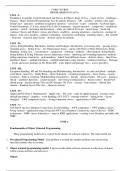
PROGRAMMING IN JAVA
UNIT - I:
Foundation, Essentials, Control Statement and Classes & Objects, Stage of Java – origin of Java – challenges -
features - Object-Oriented Programming; Java Essentials: Elements - API - variables - primitive data types –
String Class - operators –combined assignment operators - conversion –scope – comments - keyboard input;
Control Statements: if ,if-else, nested if & if-else-if statements – logical operators – comparison – conditional
operator – switch – increment and decrement – while, do-while & for loops – nested loops – break and
continue; Classes and Objects: classes and objects -modifiers - passing arguments– constructors - package &
import - static class members –method overloading– constructor overloading –returning objects – this variable
– recursion – nested & inner classes – abstract classes & methods.
UNIT - II:
Arrays, String Handling, Inheritance, Interface and Packages, Introduction –processing array – passing arrays –
returning arrays – String arrays – two Dimensional Arrays - Arrays with Three or More Dimensions; String
Handling : String class – concatenation – comparison – substring – methods – other methods–String Buffer,
String Builder & String Tokenizer classes; Inheritance: basics –inheriting and overriding superclass methods –
calling superclass constructor – polymorphism – inherit from different classes – abstract classes – final Class;
Interfaces: Basics – multiple Interfaces – multiple inheritance using interface – multilevel interface – Packages
– Create and access packages in Net Beans IDE – static Import and package class – access specifiers.
UNIT - III:
Exception Handling, I/O and File Handling and Multithreading, Introduction - try and catch block - multiple
catch block - nested try - finally Block – throw Statement – exception propagation – throw Clause - custom
exception – built-in exception; Multithreading: Introduction – threads – thread creation – life cycle – joining a
thread – scheduler &priority – synchronization – inter-thread communication – thread control – thread Pool –
thread group – daemon thread; Files and I\O Streams: file Class – streams – byte streams – filtered byte
streams – Random Access File class – character streams.
UNIT - IV:
Applet and GUI Part I, Fundamentals – applet class – life cycle – steps for applet program – passing values
through parameters – graphics – event handling; GUI I:GUI – creating windows – dialog boxes – layout
managers – AWT component classes – Swing component classes – applications of AWT controls.
UNIT - V:
GUI Part II and Java Database Connectivity, Event handling – AWT components – AWT graphics classes –
Swing controls – application using Swing and AWT; Java Database Connectivity: types of drivers – JDBC
architecture – JDBC classes &interfaces – steps in JDBC applications – creating a new Database and table with
JDBC.
UNIT 1
Fundamentals of Object Oriented Programming:
Many programming models have evolved in the domain of software solutions. The main models are
1. Procedural Programming Model : Each problem is divided into smaller problems and solved using
specified modules that act on data.
2. Object oriented programming model: It perceived the entire software system as a collections of objects
which contain attributes and behaviors.
Object:
,An object is a tangible entity that may exhibit some well-defined behavior. (Or) Object is an
instance of Class (or) Everything is an object.
Class:
A class is a se of attributes and behaviors shared by similar objects. (or) in simple way
Collection of objects is called Class.
Abstraction:
Abstraction focuses on the essential characteristics of an objects.
Encapsulation :
Encapsulation hides the implementation details of an object and thereby , hides its complexity.
Inheritance :
Inheritance creates a hierarchy of classes and helps in the reuse of the attributes and methods of a class.
Polymorphism:
Polymorphism triggers different reactions in objects in response to the same message.(or) More
than one function in same name.
, Ex:
Public void abc (int a , int b)
{
}
public void abc (int x, int y, int z)
{
}
Super class :
A super class shares its attributes and behavior with its child classes.
Sub class:
A subclass inherits attributes and behaviors from its super class.
HISTORY OF JAVA:
IN 1991, SUN Microsystems began a project called “Green “ to develop software for use in consumer
electronics. The leader of the project James Gosling and include Patrick Naughton, Mike Sheridan. The team
wanted a fundamentally new way of computing, based on the power of networks , and wanted the same
software to run on different kinds of computers and different operating system. They create new language
and give the name OAK.
In this time the WWW (World Wide Web) was in a period of dramatic growth , Sun realized that Oak was
perfectly suited for Internet process. In 1994 , they completed work on a product known as a Webrunner.
Later renamed as HotJava. Hotjava demonstrated the power of Oak as Internet development tools.
In 1995 , OAK was renamed as Java (Marketing purpose).
, FEATURES OF JAVA :
Java is a simple language that can be learned easily, even if you have just started programming.
A java programmer need not know the internals of java. The syntax of Java is similar to C++. Unlike C++
in which the programmer handles memory manipulation, Java handles the required memory manipulation and
thus prevents errors that arise due to improper memory usage.
Java is purely object-oriented and provides abstraction, encapsulation, inheritance , and polymorphism.
Even the most basic program ha a class. Any code that you write in Java is inside a class.
Java is tuned to the Web. Java programs can access data across the Web as easily as they access data from a
local system. You can build Distributed applications in Java that use resources from any other networked
computer.
Java is both Interpreted and Compiled. The code is compiled to a bytecode that is binary
and platform-independent.
When you compile a piece of code, all the errors are listed together. You can execute a program only
when all the errors have been rectified. Only when the execution reaches the statement with an error is the
error reported. This makes it easy for a programmer to debug the code.
A programmer cannot write Java code that interacts with the memory of the system. Instead of assuming
that programmers know what they are doing, java ensures the same. For instance , Java forces you to handle
unexpected errors. This ensures that Java programs are robust(reliable), and bug free and do not crash.
PROGRAMMING IN JAVA
UNIT - I:
Foundation, Essentials, Control Statement and Classes & Objects, Stage of Java – origin of Java – challenges -
features - Object-Oriented Programming; Java Essentials: Elements - API - variables - primitive data types –
String Class - operators –combined assignment operators - conversion –scope – comments - keyboard input;
Control Statements: if ,if-else, nested if & if-else-if statements – logical operators – comparison – conditional
operator – switch – increment and decrement – while, do-while & for loops – nested loops – break and
continue; Classes and Objects: classes and objects -modifiers - passing arguments– constructors - package &
import - static class members –method overloading– constructor overloading –returning objects – this variable
– recursion – nested & inner classes – abstract classes & methods.
UNIT - II:
Arrays, String Handling, Inheritance, Interface and Packages, Introduction –processing array – passing arrays –
returning arrays – String arrays – two Dimensional Arrays - Arrays with Three or More Dimensions; String
Handling : String class – concatenation – comparison – substring – methods – other methods–String Buffer,
String Builder & String Tokenizer classes; Inheritance: basics –inheriting and overriding superclass methods –
calling superclass constructor – polymorphism – inherit from different classes – abstract classes – final Class;
Interfaces: Basics – multiple Interfaces – multiple inheritance using interface – multilevel interface – Packages
– Create and access packages in Net Beans IDE – static Import and package class – access specifiers.
UNIT - III:
Exception Handling, I/O and File Handling and Multithreading, Introduction - try and catch block - multiple
catch block - nested try - finally Block – throw Statement – exception propagation – throw Clause - custom
exception – built-in exception; Multithreading: Introduction – threads – thread creation – life cycle – joining a
thread – scheduler &priority – synchronization – inter-thread communication – thread control – thread Pool –
thread group – daemon thread; Files and I\O Streams: file Class – streams – byte streams – filtered byte
streams – Random Access File class – character streams.
UNIT - IV:
Applet and GUI Part I, Fundamentals – applet class – life cycle – steps for applet program – passing values
through parameters – graphics – event handling; GUI I:GUI – creating windows – dialog boxes – layout
managers – AWT component classes – Swing component classes – applications of AWT controls.
UNIT - V:
GUI Part II and Java Database Connectivity, Event handling – AWT components – AWT graphics classes –
Swing controls – application using Swing and AWT; Java Database Connectivity: types of drivers – JDBC
architecture – JDBC classes &interfaces – steps in JDBC applications – creating a new Database and table with
JDBC.
UNIT 1
Fundamentals of Object Oriented Programming:
Many programming models have evolved in the domain of software solutions. The main models are
1. Procedural Programming Model : Each problem is divided into smaller problems and solved using
specified modules that act on data.
2. Object oriented programming model: It perceived the entire software system as a collections of objects
which contain attributes and behaviors.
Object:
,An object is a tangible entity that may exhibit some well-defined behavior. (Or) Object is an
instance of Class (or) Everything is an object.
Class:
A class is a se of attributes and behaviors shared by similar objects. (or) in simple way
Collection of objects is called Class.
Abstraction:
Abstraction focuses on the essential characteristics of an objects.
Encapsulation :
Encapsulation hides the implementation details of an object and thereby , hides its complexity.
Inheritance :
Inheritance creates a hierarchy of classes and helps in the reuse of the attributes and methods of a class.
Polymorphism:
Polymorphism triggers different reactions in objects in response to the same message.(or) More
than one function in same name.
, Ex:
Public void abc (int a , int b)
{
}
public void abc (int x, int y, int z)
{
}
Super class :
A super class shares its attributes and behavior with its child classes.
Sub class:
A subclass inherits attributes and behaviors from its super class.
HISTORY OF JAVA:
IN 1991, SUN Microsystems began a project called “Green “ to develop software for use in consumer
electronics. The leader of the project James Gosling and include Patrick Naughton, Mike Sheridan. The team
wanted a fundamentally new way of computing, based on the power of networks , and wanted the same
software to run on different kinds of computers and different operating system. They create new language
and give the name OAK.
In this time the WWW (World Wide Web) was in a period of dramatic growth , Sun realized that Oak was
perfectly suited for Internet process. In 1994 , they completed work on a product known as a Webrunner.
Later renamed as HotJava. Hotjava demonstrated the power of Oak as Internet development tools.
In 1995 , OAK was renamed as Java (Marketing purpose).
, FEATURES OF JAVA :
Java is a simple language that can be learned easily, even if you have just started programming.
A java programmer need not know the internals of java. The syntax of Java is similar to C++. Unlike C++
in which the programmer handles memory manipulation, Java handles the required memory manipulation and
thus prevents errors that arise due to improper memory usage.
Java is purely object-oriented and provides abstraction, encapsulation, inheritance , and polymorphism.
Even the most basic program ha a class. Any code that you write in Java is inside a class.
Java is tuned to the Web. Java programs can access data across the Web as easily as they access data from a
local system. You can build Distributed applications in Java that use resources from any other networked
computer.
Java is both Interpreted and Compiled. The code is compiled to a bytecode that is binary
and platform-independent.
When you compile a piece of code, all the errors are listed together. You can execute a program only
when all the errors have been rectified. Only when the execution reaches the statement with an error is the
error reported. This makes it easy for a programmer to debug the code.
A programmer cannot write Java code that interacts with the memory of the system. Instead of assuming
that programmers know what they are doing, java ensures the same. For instance , Java forces you to handle
unexpected errors. This ensures that Java programs are robust(reliable), and bug free and do not crash.



