Political Science 144
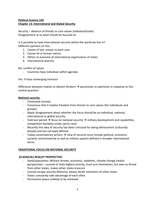
Chapter 12: International and Global Security
Security – absence of threats to core values (individual/state)
Disagreement as to what should be focused on
Is it possible to have international security within the world we live in?
Different opinions on this:
1. Causes of war unique to each case
2. Causes lie in human nature
3. Others in outcome of international organisation of states
4. International anarchy
No: conflict of values
- Countries have individual selfish agendas
Yes: if have converging interests
Difference between realists vs idealist thinkers pessimistic vs optimistic in response to this
central question
National security
- Contested concept
- Consensus that it implies freedom from threats to core values (for individuals and
groups)
- Major disagreement about whether the focus should be on individual, national,
international or global security
- Cold war period focus on national security military development and capabilities,
competition between states (arms race)
- Recently this idea of security has been criticized for being ethnocentric (culturally
biased) and too narrowly defined
- Today contemporary writers view of security must include political, economic,
societal, environmental as well as military aspects defined in broader international
terms
TRADITIONAL FOCUS ON NATIONAL SECURITY
(CLASSICAL) REALIST PERSPECTIVE:
- State/population: Military threats, economic, epidemic, climate change (realist
perspective) – survival of state highest priority, must arm themselves, but seen as threat
from other states, makes other states insecure
- Cannot escape security dilemma, always doubt intentions of other states
- States constantly take advantage of each other
- Permanent peace unlikely to be achieved
1
Chapter 12: International and Global Security
Security – absence of threats to core values (individual/state)
Disagreement as to what should be focused on
Is it possible to have international security within the world we live in?
Different opinions on this:
1. Causes of war unique to each case
2. Causes lie in human nature
3. Others in outcome of international organisation of states
4. International anarchy
No: conflict of values
- Countries have individual selfish agendas
Yes: if have converging interests
Difference between realists vs idealist thinkers pessimistic vs optimistic in response to this
central question
National security
- Contested concept
- Consensus that it implies freedom from threats to core values (for individuals and
groups)
- Major disagreement about whether the focus should be on individual, national,
international or global security
- Cold war period focus on national security military development and capabilities,
competition between states (arms race)
- Recently this idea of security has been criticized for being ethnocentric (culturally
biased) and too narrowly defined
- Today contemporary writers view of security must include political, economic,
societal, environmental as well as military aspects defined in broader international
terms
TRADITIONAL FOCUS ON NATIONAL SECURITY
(CLASSICAL) REALIST PERSPECTIVE:
- State/population: Military threats, economic, epidemic, climate change (realist
perspective) – survival of state highest priority, must arm themselves, but seen as threat
from other states, makes other states insecure
- Cannot escape security dilemma, always doubt intentions of other states
- States constantly take advantage of each other
- Permanent peace unlikely to be achieved
1