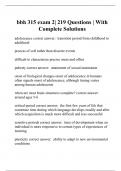
bbh 315 exam 2| 219 Questions | With Complete Solutions
adolescence correct answer: transition period from childhood to adulthood process of soft rather than discrete events difficult to characterize precise onset and offset puberty correct answer: attainment of sexual maturation onset of biological changes onset of adolescence in humans often signals onset of adolescence, although timing varies among human adolescents when are most brain structures complete? correct answer: around ages 5-6 critical period correct answer: the first few years of life that constitute time during which language develops readily and after which acquisition is much more difficult and less successful sensitive periods correct answer: time of development when an individual is more responsive to certain types of experiences of learning plasticity correct answer: ability to adapt to new environmental conditions more able to plasticize in children than adults gender socialization and risk taking correct answer: socialization agents: parents, peers, school, media affects children's behavior risk taking: taking maladaptive options, attribute of masculine psychology, boys take more risks than girls prefrontal cortex correct answer: grows just before puberty - controls planning, working memory, organization, and modulates mood - as it matures, people reason better, develop more impulse control, and make more informed decisions when does the brain overproduce synapses? correct answer: during infantry and during pre-puberty (age 11 for girls, age 12 for boys) what happens during the time of overproduction of synapses? correct answer: cuts back (prune) in order to strengthen brain and consolidate learning when does the brain finally grow to adult maturity? correct answer: by the early 20s different parts of the brain cortex mature at a different rate which matures first then second? correct answer: parts for sensory processing mature first impulse control and planning mature last intellectual power of adolescent brain, however is match for adults compared to adults, adolescents have... correct answer: higher levels of reward and sensation seeking, peer interactions, and risk taking, due to hyper active limbic systems less sensitivity to unpleasant stimuli and different responses to cues and contexts associated with stimuli greater emotional volatility when do we see an increase in sensitivity to positive rewards? correct answer: in adolescence what is caused by evolutionary basis...? correct answer: heightened brain reward system it is needed for finding survival "rewards" (water, food, sexual reproduction) how does the changes in adolescence relate to risk-taking correct answer: risky behaviors in adolescents may be due in part to immature prefrontal cortex - mortality rates jump between early and late adolescence - may be over-simplified: Risky behaviors in adolescence aren't necessarily universal - behaviors shaped by genes, experiences, environmental factors, and brain changes during adolescence, children develop the ability to correct answer: understand abstract ideas (math) and to develop sense of mortality (rights, responsibilities, and privileges) establish/maintain relationships by learning to share intimacy without worry or inhibition move toward more mature sense of self question old values without losing identity use speech to express one's self boys physical development correct answer: testicles/scrotum grow as early as 9 penis begins to lengthen voice changes *nocturnal emissions marks beginning of puberty* - age 13-17 (avg. 14.5) - coincide with height spurt girls physical development correct answer: breast buds develop as early as 8; breasts fully develop 12-18 pubic, armpit and leg hair begin to grow age 9-10; reach adult patterns menarche 2 years after early breast and pubic hair appear - age 10-15 (avg=12.5) - height spurt 9.5-14.5, peaks 12 what does the development of children during age 12-18 also include? correct answer: predictable physical and mental changes as well adolescence and puberty are different correct answer: adolescence: gradual period of transition from childhood to adulthood (soft events) puberty: attainment of sexual maturation (hard event) behavior adolescent development: mental often in comparison with others correct answer: physical changes lead to worries about body changes especially difficult without proper education separate from parents, peers become more important safety adolescent development: mental correct answer: feelings of strength, independence, limited future orientation, and need for peer approval may lead to risk-taking sexuality adolescent development: mental correct answer: increased interest in sexual topics (not necessarily sexual activity) established own sexual identity experiment with expressing and receiving sexual advances power struggles with parents adolescent development: mental correct answer: establish need for independence changes in brain development occur in ages 5-6 and pre-puberty years correct answer: brain overproduces and prunes to strengthen brain and consolidate learn different parts of brain mature at different times risky behaviors in adolescents may be due in part to immature frontal cortex adolescent development includes predictable physical and mental changes as well that may motivate greater risk-taking; adolescents have: correct answer: higher levels of reward-and-sensation seeking, peer interactions, and risk taking less sensitivity to unpleasant stimuli and different responses to cues and contexts greater true or false Nolen-Hoeksema and Hilt (2006) argue that men have a much higher risk for alcohol use disorders than women in part because women often believe society "disapproves" of their drinking more than it does for men and so "protects them" from heavy drinking correct answer: truuuuuu according to Nolen-Hoeksema and Hilt (2006) ______ carry a lower genetic risk for alcohol related dependency issues than do _____ and they suffer _____ biological consequences correct answer: women men more true or false
Written for
- Institution
- Pennsylvania State University - All Campuses
- Course
- Bbh 315
Document information
- Uploaded on
- September 20, 2023
- Number of pages
- 51
- Written in
- 2023/2024
- Type
- Exam (elaborations)
- Contains
- Questions & answers
Subjects
-
bbh 315 exam 2
-
adolescence
-
sensitive periods
-
bbh 315 exam 2 219 questions with complete solu
-
when are most brain structures complete
-
gender socialization and risk taking
-
when does the brain overprodu

Document also available in package deal