Unit 2: Practical Scientific Procedures and Techniques
Learning Aim A/B
Titration
Aim:
To carry out titration and colorimetry to determine the concentration of solutions
To figure out what the reactions end point is
Titrating hydrochloric acid against a standard solution of sodium carbonate to
determine its concentration
Introduction:
Within this assignment I will be carrying out titration, titration is a typical quantitative
chemical analysis procedure used in laboratories to quantify the concentration of a
specified analyse. I will carry out a titration to accurately and skilfully determine the
concentration of a sample of sodium hydroxide. This includes being observed
preparing the solution and standardizing the HCL to be used using NaHCO3. The
equipment must be calibrated, calibration must be used to determine the
measurement accuracy of your titration.
Calibration:
To perform the titration firstly the equipment must be calibrated, calibration is used to
minimise any measurement uncertainty by ensuring the accuracy of test equipment.
The equipment that is calibrated is 25 cm³ bulb pipette, a 500ml burette and a
weighing scale. This equipment was calibrated for me, the bulb pipette and burette
were calibrated by the lab technician. The weighing scale however is calibrated by a
professional to ensure the accuracy of the readings on the scale.
Calibrating a 50ml burette:
To calibrate a burette, 50ml of distilled water is poured into the burette until the 50ml
line (the bottom of the meniscus should lie on that line). Open the tap and let the
water run into a beaker (the beaker should be weighed first before adding the
distilled water). Weight the distilled water on a scale, subtract the weight of the
beaker from the amount on the weighing scale (this should then be the amount of
water). The weight of the water should be 50g as density of water= 1g/cm³, meaning
50ml of distilled water is equal to 50g.
Calibrating a weighing scale:
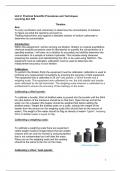
To calibrate a weighing scale there are equipment
called weight masses (image below) that are weight
masses and can only be moved by using equipment
that is not contaminated as it will alter the mass.
Place one on the weighing scale and the reading
should be the same to the one on the mass.
Calibrating a 25cm³ bulb pipette:
1
, To calibrate the pipette, a pipette filler is placed on the pipette and press S to suck
up distilled water to the 25 mark (the bottom of the meniscus has to lie on the line).
Remove the pipette filler and let the water flow through into a weighing boat. Weigh
the distilled water. The weight should be 25g as the density of water= 1g/cm³,
meaning 25cm³ equals to 25g.
Preparing a standard solution:
To prepare a standard solution of NaHCO3
Na= 1(23)
H= 1(1)
C= 1(12)
O= 3(16)
(Numbers in brackets are the relative molecular mass)
(1x23)+ (1x1) + (1x12) + (3x16) = 84
Moles=concentration x volume
=0.1x0.25
=0.025 mol
Mass= moles x Mr
=0.025x 84
=2.1g
2.1g of sodium hydrogen carbonate is used when preparing the standard
solution
Equipment for standard solution:
Weighing boat
50ml beaker
Stirring rod
250ml volumetric flask
Filter funnel
Waste beaker
Weighing scale
Equipment for titration:
1 50cm³ burette
1 25cm³ bulb pipette
1 pipette filler
1 filter funnel
1 250cm³ conical flask
1 clamp
1 white tile
1 retort stand
2 volumetric flasks
1 balance
1 25cm³ pipette
Weighing boat
2
Learning Aim A/B
Titration
Aim:
To carry out titration and colorimetry to determine the concentration of solutions
To figure out what the reactions end point is
Titrating hydrochloric acid against a standard solution of sodium carbonate to
determine its concentration
Introduction:
Within this assignment I will be carrying out titration, titration is a typical quantitative
chemical analysis procedure used in laboratories to quantify the concentration of a
specified analyse. I will carry out a titration to accurately and skilfully determine the
concentration of a sample of sodium hydroxide. This includes being observed
preparing the solution and standardizing the HCL to be used using NaHCO3. The
equipment must be calibrated, calibration must be used to determine the
measurement accuracy of your titration.
Calibration:
To perform the titration firstly the equipment must be calibrated, calibration is used to
minimise any measurement uncertainty by ensuring the accuracy of test equipment.
The equipment that is calibrated is 25 cm³ bulb pipette, a 500ml burette and a
weighing scale. This equipment was calibrated for me, the bulb pipette and burette
were calibrated by the lab technician. The weighing scale however is calibrated by a
professional to ensure the accuracy of the readings on the scale.
Calibrating a 50ml burette:
To calibrate a burette, 50ml of distilled water is poured into the burette until the 50ml
line (the bottom of the meniscus should lie on that line). Open the tap and let the
water run into a beaker (the beaker should be weighed first before adding the
distilled water). Weight the distilled water on a scale, subtract the weight of the
beaker from the amount on the weighing scale (this should then be the amount of
water). The weight of the water should be 50g as density of water= 1g/cm³, meaning
50ml of distilled water is equal to 50g.
Calibrating a weighing scale:
To calibrate a weighing scale there are equipment
called weight masses (image below) that are weight
masses and can only be moved by using equipment
that is not contaminated as it will alter the mass.
Place one on the weighing scale and the reading
should be the same to the one on the mass.
Calibrating a 25cm³ bulb pipette:
1
, To calibrate the pipette, a pipette filler is placed on the pipette and press S to suck
up distilled water to the 25 mark (the bottom of the meniscus has to lie on the line).
Remove the pipette filler and let the water flow through into a weighing boat. Weigh
the distilled water. The weight should be 25g as the density of water= 1g/cm³,
meaning 25cm³ equals to 25g.
Preparing a standard solution:
To prepare a standard solution of NaHCO3
Na= 1(23)
H= 1(1)
C= 1(12)
O= 3(16)
(Numbers in brackets are the relative molecular mass)
(1x23)+ (1x1) + (1x12) + (3x16) = 84
Moles=concentration x volume
=0.1x0.25
=0.025 mol
Mass= moles x Mr
=0.025x 84
=2.1g
2.1g of sodium hydrogen carbonate is used when preparing the standard
solution
Equipment for standard solution:
Weighing boat
50ml beaker
Stirring rod
250ml volumetric flask
Filter funnel
Waste beaker
Weighing scale
Equipment for titration:
1 50cm³ burette
1 25cm³ bulb pipette
1 pipette filler
1 filter funnel
1 250cm³ conical flask
1 clamp
1 white tile
1 retort stand
2 volumetric flasks
1 balance
1 25cm³ pipette
Weighing boat
2