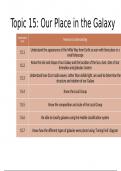
Topic 15: Our Place in the Galaxy
Specification
Point Necessary Understanding
15.1 Understand the appearance of the Milky Way from Earth as seen with binoculars or a
small telescope
Know the size and shape of our Galaxy and the location of the Sun, dust, sites of star
15.2 formation and globular clusters
Understand how 21cm radio waves, rather than visible light, are used to determine the
15.3
structure and rotation of our Galaxy
15.4 Know the Local Group
15.5 Know the composition and scale of the Local Group
15.6 Be able to classify galaxies using the Hubble classification system
15.7 Know how the different types of galaxies were placed using ‘Tuning Fork’ diagram
, Understand the appearance of the Milky Way from Earth as seen with binoculars or a small
15.1
telescope
The appearance of the Milky Way differs drastically
depending on if you observe it using your eyes,
binoculars, or a powerful telescope.
Using binoculars or a digital camera, far more of the
Milky Way can be observed, including nebula and
space gases.
Using a telescopes dramatically improves the
resolution, clarity, field-of-view, and magnification
of the Milky Way.
Through using filters and different types of
telescopes, you can capture different EM waves,
forming completely different images and information
of the Milky Way than if you observe using your eyes
or binoculars.
[1]
, 15.1
How does the Milky Way appear different when using your eyes,
binoculars, and a small telescope?
Explain why a telescope improves the resolution, magnification,
and field-of-view of the Milky Way compared to binoculars.
Specification
Point Necessary Understanding
15.1 Understand the appearance of the Milky Way from Earth as seen with binoculars or a
small telescope
Know the size and shape of our Galaxy and the location of the Sun, dust, sites of star
15.2 formation and globular clusters
Understand how 21cm radio waves, rather than visible light, are used to determine the
15.3
structure and rotation of our Galaxy
15.4 Know the Local Group
15.5 Know the composition and scale of the Local Group
15.6 Be able to classify galaxies using the Hubble classification system
15.7 Know how the different types of galaxies were placed using ‘Tuning Fork’ diagram
, Understand the appearance of the Milky Way from Earth as seen with binoculars or a small
15.1
telescope
The appearance of the Milky Way differs drastically
depending on if you observe it using your eyes,
binoculars, or a powerful telescope.
Using binoculars or a digital camera, far more of the
Milky Way can be observed, including nebula and
space gases.
Using a telescopes dramatically improves the
resolution, clarity, field-of-view, and magnification
of the Milky Way.
Through using filters and different types of
telescopes, you can capture different EM waves,
forming completely different images and information
of the Milky Way than if you observe using your eyes
or binoculars.
[1]
, 15.1
How does the Milky Way appear different when using your eyes,
binoculars, and a small telescope?
Explain why a telescope improves the resolution, magnification,
and field-of-view of the Milky Way compared to binoculars.