English Grammar
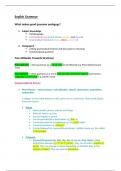
What makes good grammar pedagogy?
1. Subject Knowledge
Metalanguage
Grammatical Form (word classes, phrases and clauses)
Grammatical Function (subject, object, adverbial)
2. Pedagogical
Linking grammatical features and discussion to meaning
Contextualised grammar
Two Attitudes Towards Grammar
Prescriptivism – views grammar as a set of rules to be followed e.g. Prescriptivist Lynne
Truss
Descriptivism – views grammar as a set of contextually dependent options and choices.
Language is a resource. E.g. David Crystal
Grammatical Form:
1. Word Classes – noun pronoun, verb adjective, adverb, determiner, preposition,
conjunction
(category of word that behaves in the same way in a sentence). Most word classes
have sub-classes:
1. Nouns
Name people, places, animals and things
Abstract nouns e.g. love
Can be singular or plural
Can be preceded by a determiner e.g. the cat
Can be preceded by an adjective e.g. the fluffy rabbit
Can be possessive e.g. George’s
Can be followed by a prepositional phrase/ relative clause e.g. the rabbit
in the garden
2. Pronouns
Personal Pronouns (he, him, she, her, it, we, us, they, them). Make
distinctions between 1st, 2nd or 3rd person. They can be either singular or
plural. They can change in shape depending on whether they’re the
subject or object. They can also be possessive.
What makes good grammar pedagogy?
1. Subject Knowledge
Metalanguage
Grammatical Form (word classes, phrases and clauses)
Grammatical Function (subject, object, adverbial)
2. Pedagogical
Linking grammatical features and discussion to meaning
Contextualised grammar
Two Attitudes Towards Grammar
Prescriptivism – views grammar as a set of rules to be followed e.g. Prescriptivist Lynne
Truss
Descriptivism – views grammar as a set of contextually dependent options and choices.
Language is a resource. E.g. David Crystal
Grammatical Form:
1. Word Classes – noun pronoun, verb adjective, adverb, determiner, preposition,
conjunction
(category of word that behaves in the same way in a sentence). Most word classes
have sub-classes:
1. Nouns
Name people, places, animals and things
Abstract nouns e.g. love
Can be singular or plural
Can be preceded by a determiner e.g. the cat
Can be preceded by an adjective e.g. the fluffy rabbit
Can be possessive e.g. George’s
Can be followed by a prepositional phrase/ relative clause e.g. the rabbit
in the garden
2. Pronouns
Personal Pronouns (he, him, she, her, it, we, us, they, them). Make
distinctions between 1st, 2nd or 3rd person. They can be either singular or
plural. They can change in shape depending on whether they’re the
subject or object. They can also be possessive.