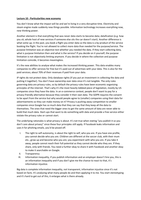
Lecture 10 - Particularities new economy
You don’t know what the impact will be and we’re living in a very disruptive time. Electricity and
steam engine made suddenly new things possible. Information technology increases everything now,
new thinking power.
Another element is that everything that was never data starts to become data; datafication (e.g. how
you sit; whole host of new services if someone else sits the car doesn’t start). Another difference is
what some up; in the past, you book a flight you enter data so the data is a by-product of the service
booking the flight. You’re not allowed to collect more data than needed for the purpose/service. The
purpose limitation was an objective test whether you needed the data. If they start collecting data,
what is purpose limitation then and what is the service? If you decide on it yourself, the purpose
limitation is not objectively limiting anymore. If you decide in where the collection and purpose
limitation coincide, it becomes meaningless.
It’s the new abilities to analyse what makes the increased thinking power. This data enables many
companies to offer services for free but it’s paid out of advertises with your data. This is also for the
paid services; about 70% of their revenues if paid from your data.
IP rights do not protect data. Only database rights (if you put an investment in collecting the data and
putting it together). You don’t have ownership over data since it’s not tangible. The only rules
governing data are privacy rules, so by default the privacy rules have been economic organizing
principles of the internet. That’s why it’s the most heavily lobbied piece of legislation, mostly by US
companies since they have the data. In an e-commerce context, people don’t want to pay for a
privacy friendly alternative because they consider it their own data. The GDPR requires the consent
to be apart from the service but why would people agree to (smaller) companies using their data for
advertisements so they can make money on it? Privacy is pushing away competition to smaller
companies since Google has so much data that they can say that they keep all the data to
themselves. The ones that need the bigger ones to get the same amount of data are never able to
build that much data. Start-ups that want to do something with data and provide a free service either
violate the privacy rules or cannot start.
The underlying rationales is what privacy is about. It’s not true when stating “you publish it so you
don’t care about privacy” since these four principles still apply. If Facebook leaks information and
uses it for phishing emails, you’d be pissed off.
I. The right to self-autonomy, is about the right to self, who you are. If you have one profile,
you cannot decide who you are. Children are different at the soccer club, with their mum
etc., grow up and become who you are; you experiment with who you are. If you take it
away, people cannot reach their full potential as they cannot decide who they are. If they
share, only with friends. You need a further okay to share it with Facebook and another okay
to make it searchable on Google.
II. Transparency
III. Information inequality, if you publish information and an employer doesn’t hire you, this is
an information inequality and if you don’t give me the chance to react to that, it’s
information injustice.
Big data is complete information inequality, not transparent, information injustice since it’s not
based on facts. It’s analysing what many people do and then applying it to me. You start stereotyping
and it’s hard to get out of this, it enlarges what is there already.
You don’t know what the impact will be and we’re living in a very disruptive time. Electricity and
steam engine made suddenly new things possible. Information technology increases everything now,
new thinking power.
Another element is that everything that was never data starts to become data; datafication (e.g. how
you sit; whole host of new services if someone else sits the car doesn’t start). Another difference is
what some up; in the past, you book a flight you enter data so the data is a by-product of the service
booking the flight. You’re not allowed to collect more data than needed for the purpose/service. The
purpose limitation was an objective test whether you needed the data. If they start collecting data,
what is purpose limitation then and what is the service? If you decide on it yourself, the purpose
limitation is not objectively limiting anymore. If you decide in where the collection and purpose
limitation coincide, it becomes meaningless.
It’s the new abilities to analyse what makes the increased thinking power. This data enables many
companies to offer services for free but it’s paid out of advertises with your data. This is also for the
paid services; about 70% of their revenues if paid from your data.
IP rights do not protect data. Only database rights (if you put an investment in collecting the data and
putting it together). You don’t have ownership over data since it’s not tangible. The only rules
governing data are privacy rules, so by default the privacy rules have been economic organizing
principles of the internet. That’s why it’s the most heavily lobbied piece of legislation, mostly by US
companies since they have the data. In an e-commerce context, people don’t want to pay for a
privacy friendly alternative because they consider it their own data. The GDPR requires the consent
to be apart from the service but why would people agree to (smaller) companies using their data for
advertisements so they can make money on it? Privacy is pushing away competition to smaller
companies since Google has so much data that they can say that they keep all the data to
themselves. The ones that need the bigger ones to get the same amount of data are never able to
build that much data. Start-ups that want to do something with data and provide a free service either
violate the privacy rules or cannot start.
The underlying rationales is what privacy is about. It’s not true when stating “you publish it so you
don’t care about privacy” since these four principles still apply. If Facebook leaks information and
uses it for phishing emails, you’d be pissed off.
I. The right to self-autonomy, is about the right to self, who you are. If you have one profile,
you cannot decide who you are. Children are different at the soccer club, with their mum
etc., grow up and become who you are; you experiment with who you are. If you take it
away, people cannot reach their full potential as they cannot decide who they are. If they
share, only with friends. You need a further okay to share it with Facebook and another okay
to make it searchable on Google.
II. Transparency
III. Information inequality, if you publish information and an employer doesn’t hire you, this is
an information inequality and if you don’t give me the chance to react to that, it’s
information injustice.
Big data is complete information inequality, not transparent, information injustice since it’s not
based on facts. It’s analysing what many people do and then applying it to me. You start stereotyping
and it’s hard to get out of this, it enlarges what is there already.