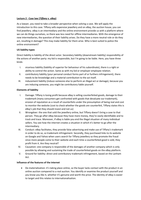
Lecture 2 - Case law (Tiffany v. eBay)
As a lawyer, you need to take a broader perspective when solving a case. We will apply the
introduction to this case. Tiffany sells expensive jewellery and on eBay, the auction house, you can
find jewellery. eBay is an intermediary and the online environment provide us with a platform where
we can do things ourselves, so there was less need for offline intermediaries. With the emergence of
new intermediaries, the question of their liability arises. Do they have a more neutral role or do they
act, resulting in damage? This may make liability for them arise. Who is best suited to police the
online environment?
US liability types
Direct liability is liability of the direct actor. Secondary liability (downstream liability) responsibility of
the actions of another party: my kid is responsible, but I’m going to be liable. Here, you have three
kinds:
I. vicarious liability (liability of superior for behaviour of his subordinate), there is a right or
ability to control the action. Same as with my kid or employer employee relation.
II. contributory liability (your personal conduct forms part of or furthers infringement), there
needs to be knowledge and a material contribution to the act itself.
III. inducement liability (induce someone else to perform an illegal act or damage), because you
are inducing someone, you might be contributory liable yourself.
Elements of liability
I. Damage: Tiffany is losing profit because eBay is selling counterfeited goods, damage to their
trademark (many consumers get confronted with goods that devaluate our trademark),
erosion of reputation as a result of counterfeits under the presumption of being real and cost
to monitor the website (cost to check whether the goods are counterfeit, Tiffany states this is
eBay’s job that they should invest and not us)
II. Wrongdoer: the one that sold the jewellery online, but Tiffany doesn’t bring a case to that
person. They go after eBay because they have more money, they’re easily identifiable and to
track and trace. Moreover, if eBay is liable you end the illegal situation of many individual
sellers. You see how the internet creates a situation in which it’s better to go after the
intermediary.
III. Conduct: eBay facilitates, they provide false advertising and make use of Tiffany’s trademark
in order to do so, so trademark infringement. Secondly, they purchased links to its website
on Google and Yahoo when users search for Tiffany jewellery so they promote the fraud
since more people come to their website and each time a counterfeited good is sold, they
profit from it. Are they neutral?
IV. Causation: one company is responsible of the damages of another company which is only
possible by allowing and sustaining the trade of counterfeited goods on the eBay platform.
V. Ground for liability: direct and contributory trademark infringement, based on the Lanham
Act.
Influence of the features of the internet
De-materialization: it’s taking place online, so the buyer lacks contact with the product in an
online auction compared to a real auction. You identify or examine the product yourself and
you know you like it, whether it’s genuine and worth the price. The identity of eBay is easier
to target and this relates to internationalisation.
As a lawyer, you need to take a broader perspective when solving a case. We will apply the
introduction to this case. Tiffany sells expensive jewellery and on eBay, the auction house, you can
find jewellery. eBay is an intermediary and the online environment provide us with a platform where
we can do things ourselves, so there was less need for offline intermediaries. With the emergence of
new intermediaries, the question of their liability arises. Do they have a more neutral role or do they
act, resulting in damage? This may make liability for them arise. Who is best suited to police the
online environment?
US liability types
Direct liability is liability of the direct actor. Secondary liability (downstream liability) responsibility of
the actions of another party: my kid is responsible, but I’m going to be liable. Here, you have three
kinds:
I. vicarious liability (liability of superior for behaviour of his subordinate), there is a right or
ability to control the action. Same as with my kid or employer employee relation.
II. contributory liability (your personal conduct forms part of or furthers infringement), there
needs to be knowledge and a material contribution to the act itself.
III. inducement liability (induce someone else to perform an illegal act or damage), because you
are inducing someone, you might be contributory liable yourself.
Elements of liability
I. Damage: Tiffany is losing profit because eBay is selling counterfeited goods, damage to their
trademark (many consumers get confronted with goods that devaluate our trademark),
erosion of reputation as a result of counterfeits under the presumption of being real and cost
to monitor the website (cost to check whether the goods are counterfeit, Tiffany states this is
eBay’s job that they should invest and not us)
II. Wrongdoer: the one that sold the jewellery online, but Tiffany doesn’t bring a case to that
person. They go after eBay because they have more money, they’re easily identifiable and to
track and trace. Moreover, if eBay is liable you end the illegal situation of many individual
sellers. You see how the internet creates a situation in which it’s better to go after the
intermediary.
III. Conduct: eBay facilitates, they provide false advertising and make use of Tiffany’s trademark
in order to do so, so trademark infringement. Secondly, they purchased links to its website
on Google and Yahoo when users search for Tiffany jewellery so they promote the fraud
since more people come to their website and each time a counterfeited good is sold, they
profit from it. Are they neutral?
IV. Causation: one company is responsible of the damages of another company which is only
possible by allowing and sustaining the trade of counterfeited goods on the eBay platform.
V. Ground for liability: direct and contributory trademark infringement, based on the Lanham
Act.
Influence of the features of the internet
De-materialization: it’s taking place online, so the buyer lacks contact with the product in an
online auction compared to a real auction. You identify or examine the product yourself and
you know you like it, whether it’s genuine and worth the price. The identity of eBay is easier
to target and this relates to internationalisation.