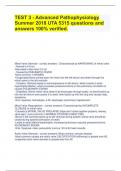
TEST 3 - Advanced Pathophysiology Summer 2018 UTA 5315 questions and answers 100% verified. Mitral Valve Stenosis - correct answers. - Characterized by NARROWING of mitral valve - Normal is 4 -6 cm -Narrowed is less than 2.5 cm - Caused by RHEU MATIC FEVER -More common in WOMEN -Oxygenated blood comes back into heart into the left atrium and down through the mitral valve to the left ventricle - Complex: Stenosis leads to volume/pressure in left atrium, which results in atrial hypertrophy/dilation , which increases pressure/volume in the pulmonary circulation & causes PULMONARY EDEMA - Simplified: Skinny mitral valve doesn't let blood pass through easily, so blood backs up into the left atrium and causes it to swell, then backs up into the lung and causes resp. symptoms -S/sx: dyspnea, hemoptysis, a -fib, dysphagia, pulmonary hypertension Mitral Valve Regurgitation - correct answers. -Characterized by INCOMPLETE CLOSURE of mitral valve -Caused by MITRAL VALVE PROLAPSE (flaps don't close together properly, leaving valve ajar); more common in WOMEN; STICKING CHEST PAIN -Blood in left ventricle backs up to left ventricle during systole (mitral valve should be closed during systole/contracti on of heart) -Leads to atrial dilation/hypertrophy, increased pulmonary vascular pressure/volume, PULMONARY EDEMA -S/sx: Dyspnea, rales, pansystolic murmur, S3 & S4 heart sounds Aortic Valve Stenosis - correct answers. -Most common valvular disease -Most c ommon causes are aortic valve CALCIFICATION (stiffening) in people over 60; congenital aortic valve stenosis in people less than 30 -Normal valve 3 cm; symptoms seen when valve less than 1 cm; severe when valve is less than 0.5 cm -Narrowed valve prevents outflow from left ventricle to aorta. This backs up blood to the left atrium and ultimately floods the lung causing PULMONARY EDEMA S/Sx: Pulmonary hypertension/edema, poor outflow of aorta to body (aorta sends out oxygenated blood to body), causing fainti ng or chest pain Simplified: Aorta is stiff and can't send out oxygenated blood properly to the body, depriving tissues of oxygen. Blood gets backed up into lungs, causing pulmonary edema. Aortic Valve Regurgitation - correct answers. -Valve is TOO WIDE or TOO NARROW, blood doesn't pass through effectively, causing back flow of blood into the left ventricle -Marked by EARLY DIASTOLIC MURMUR (on systole, heart contracts and pushes blood up the aorta, but on diastole, heart relaxes and ineffective aortic val ve is not able to hold blood up in aorta, so blood falls and makes a swish sound, which is the murmur) -Most commonly caused by AORTIC ROOT DILATION(starting point of aorta is too wide) -Other causes: infective endocarditis, rheumatic fever, aortitis from syphilis, coarctation (congenital narrowing of aorta), aortic dissection (tear), ankylosing spondylitis (inflammatory arthritis) -Acute: increases left ventricular end -diastolic pressure (LVEDP) (increased blood back down in the left ventricle increases p ressure), decreased stroke volume (not much blood is being pushed from left ventricle because blood's backed up and overwhelming left ventricle), normal or decreased pulse pressure, decreased cardiac output (aorta is not effectively pumping blood from hear t) Chronic: Body adjusts; LVEDP normalizes, systolic bp increases (compensation: harder contraction to push blood out of aorta before it falls back down to left ventricle), diastolic bp decreases (compensation: decreased relaxation of heart to stop blood from seeping back out of aorta), cardiac output is normal, pulse pressure is increase. Blood ultimately is backed up into the left atrium and pulmonary circulation. Atherosclerosis Causes - correct answers. -Begins with tissue injury Sources of injury: CIGARETTES (toxins) Hypertension (increased force of the blood hitting the blood vessel can weaken it) Diabetes Hyperlipidemia (lipids take place of endothelial cells lining the blood vessel, initiating an inflammatory response) Patho of Atherosclerosis r/t Hyperlipidemia - Inflammatory Response - correct answers.1. Tissue injury to endothelial cells lining the blood vessel. 2. Endothelial cells become inflammed and unable to produce sufficient antithrombotic and vasodilating cyto kines, increasing risk for clot formation and creating a tighter space for plaques and clots to grow. 3. Macrophages and platelets are called to the area of injury, further congesting the growing plaque area. 4. LDL replaces endothelial cells in the lining of the blood vessel. 5. Macrophages engulf the LDL particles. 6. Macrophages eat too much LDL, causing them to burst and become foam cells (under a microscope they look like sea foam) 7. Accumulation of foam cells causes a fatty streak. Fatting streak fur ther triggers inflammatory responses, repeating the whole cycle, and growing the fatty streak. 8. Smooth muscle hyperplasia from all the inflammation grows, produces collagen, and covers the fatty streak to create a fibrous plaque. 9. The plaque may calci fy, protrude into the vessel, and occlude blood flow, resulting in ischemia or infarction. Hyperlipidemia - correct answers.Leading cause of coronary artery disease Most commonly affects promximal portions of coronary arteries, larger branches of carotid arteries, circle of Willis (base of brain), large vessels of lower extremities, renal arteries, mesenteric (intestinal) arteries Consequences of Atherosclerosis - correct answers.Reduced blood flow Coronary artery disease, myocardial infarction, carotid artery disease, cerebral vascular disease, stroke, mesenteric ischemia, peripheral vascular disease, renal artery stenosis Congenital Heart Disease - correct answers. -Most common heart disease affecting children -Etiology is unknown in 90% of cases Caus es: Genetic/environmental factors (multifactorial factors) Primary genetic factors (single gene disorders, chromosome disorders) Sole environmental factors (Accutane/isotretinoin for acne, alcohol, maternal rubella infection) Maternal Risk Factors: Age ov er 45, prior child with heart defect, poorly controlled diabetes during pregnancy, alcohol, congenital infection during pregnancy (rubella), aspirin, lupus, Dilantin/phenytoin/diphenylhydantoin for seizures LEFT to RIGHT shunt (Congenital heart defect) - correct answers. -Oxygenated blood from the left side of the heart mixes with unoxygenated blood in the right side of the heart. -Oxygen saturation on left side is usually 95%, whereas right side is 75%
Exam (elaborations)
TEST 3 - Advanced Pathophysiology Summer 2018 UTA 5315 questions and answers 100% verified.
Rating
Sold
-
Pages
29
Grade
A+
Uploaded on
21-08-2023
Written in
2023/2024
TEST 3 - Advanced Pathophysiology Summer 2018 UTA 5315 questions and answers 100% verified. Mitral Valve Stenosis - correct answers.- Characterized by NARROWING of mitral valve - Normal is 4-6 cm -Narrowed is less than 2.5 cm - Caused by RHEUMATIC FEVER -More common in WOMEN -Oxygenated blood comes back into heart into the left atrium and down through the mitral valve to the left ventricle - Complex: Stenosis leads to volume/pressure in left atrium, which results in atrial hypertrophy/dilation, which increases pressure/volume in the pulmonary circulation & causes PULMONARY EDEMA - Simplified: Skinny mitral valve doesn't let blood pass through easily, so blood backs up into the left atrium and causes it to swell, then backs up into the lung and causes resp. symptoms -S/sx: dyspnea, hemoptysis, a-fib, dysphagia, pulmonary hypertension Mitral Valve Regurgitation - correct answers.-Characterized by INCOMPLETE CLOSURE of mitral valve -Caused by MITRAL VALVE PROLAPSE (flaps don't close together properly, leaving valve ajar); more common in WOMEN; STICKING CHEST PAIN -Blood in left ventricle backs up to left ventricle during systole (mitral valve should be closed during systole/contraction of heart) -Leads to atrial dilation/hypertrophy, increased pulmonary vascular pressure/volume, PULMONARY EDEMA -S/sx: Dyspnea, rales, pansystolic murmur, S3 & S4 heart sounds Aortic Valve Stenosis - correct answers.-Most common valvular disease -Most common causes are aortic valve CALCIFICATION (stiffening) in people over 60; congenital aortic valve stenosis in people less than 30
Show more
Read less
Institution
Advanced Pathophysiology Summer 2018 UTA
Course
Advanced Pathophysiology Summer 2018 UTA
Whoops! We can’t load your doc right now. Try again or contact support.
Written for
- Institution
- Advanced Pathophysiology Summer 2018 UTA
- Course
- Advanced Pathophysiology Summer 2018 UTA
Document information
- Uploaded on
- August 21, 2023
- Number of pages
- 29
- Written in
- 2023/2024
- Type
- Exam (elaborations)
- Contains
- Questions & answers
Subjects
-
test 3 advanced pathophysiology summer 2018
Content preview
R214,69
Get access to the full document:
100% satisfaction guarantee
Immediately available after payment
Both online and in PDF
No strings attached

Document also available in package deal
Package deal
Advanced Pathophysiology Exam all modules verified package.
9
2024
R 2.011,28
More info