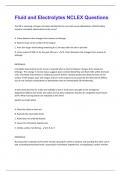
Fluid and Electrolytes NCLEX Questions And Answers Graded A+
The RN is assessing a 70-year-old client admitted to the unit with severe dehydration. Which finding requires immediate intervention by the nurse? A. Client behavior that changes from anxious to lethargic B. Deep furrows on the surface of the tongue C. Poor skin turgor with tenting remaining for 2 minutes after the skin is pinched D. Urine output of 950 mL for the past 24 hours - A. Client behavior that changes from anxious to lethargic RATIONALE: Immediate intervention by the nurse is required when a client's behavior changes from anxious to lethargic. This change in mental status suggests poor cerebral blood flow and fluid shifts within the brain cells. Immediate intervention is needed to prevent further cerebral dysfunction.Deep furrows on the surface of the tongue, poor skin turgor, and low urine output are all caused by the fluid volume deficit, but do not indicate complications of dehydration that are immediately life-threatening. A client with diarrhea for 3 days and inability to eat or drink well is brought to the emergency department (ED) by her family. She states she has been taking her diuretics for congestive heart failure (CHF). What nursing actions are indicated at this time? SELECT ALL THAT APPLY. A. Place the client on bed rest. B. Evaluate the electrolyte levels. C. Administer the ordered diuretic. D. Assess for orthostatic hypotension E. Initiate cardiac monitoring. - A, B, D, E RATIONALE: Nursing actions indicated at this time include: placing the client on bedrest and assisting the client out of bed, evaluating electrolyte levels, assessing for orthostatic hypotension, and applying a cardiac monitor.Safety is required to prevent falls due to weakness from a likely fluid volume deficit and electrolyte imbalance. The nurse should review the laboratory and diagnostic results to detect likely loss of sodium, potassium, and magnesium secondary to diarrhea and diuretic us. Fluid volume deficit is likely with diarrhea and diuretic use and leads to fluid and electrolyte imbalances, especially hypokalemia. Assessing for orthostatic changes will confirm presence of volume deficit. Monitoring for inverted T wave or presence of U wave on the ECG as well as dysrhythmias is indicated when hypokalemia is anticipated.Diuretics increase loss of fluids and electrolytes. The nurse would question this order in the presence of assessment data indicating fluid loss from the diuretics and diarrhea. A client with hypokalemia has a prescription for parenteral potassium chloride (KCl). Which of these interventions does the nurse use to safely administer KCl? SELECT ALL THAT APPLY. A. Use a potassium infusion prepared by a registered pharmacist. B. Assess for burning or redness during infusion. C. Infuse at a rate of no more than 10 mEq per hour. D. Administer only through a central venous catheter. E. Administer by IV push only during cardiac arrest. - A, B, C
Written for
- Institution
- Fluid and Electrolytes NCLEX
- Course
- Fluid and Electrolytes NCLEX
Document information
- Uploaded on
- August 16, 2023
- Number of pages
- 18
- Written in
- 2023/2024
- Type
- Exam (elaborations)
- Contains
- Questions & answers
Subjects
-
fluid and electrolytes nclex

Document also available in package deal