Genetic Mapping
INDEPENDENT ASSORTMENT
• Heterozygous for 2 genes individual produces 4 gametes in equal frequencies
• Eg if AaBb
o AB
o Ab
o aB
o ab
• gives 9:3:3:1 F2 genetic frequency
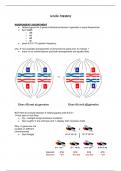
why à two possible arrangements of chromosome pairs prior to meiosis 1
• trans vs cis conformations and both arrangements are equally likely
BUT! Not all crosses between 2 heterozygotes yield 9:3:3:1
à first seen in fruit flies!
• Vg = vestigial wings (recessive mutation)
• See roughly ¾ are wild type and ¼ display both recessive traits
Why à genes are not
located on different
chromosomes
• See linkage!
,HOW TO DETERMINE LINKAGE OR NO
• Generate heterozygote
• Test cross with heterozygote and homozygous recessive
o Homozygous recessive produces 1 type of gamete
o Allows for heterozygote formation in F1 generation
o Back cross = F1 x P generation
• F2 progeny reflect gamete formation of heterozygote
• Look at male progeny à phenotype reflects the genotype of their inherited X
chromosome from female parental
• F1 females = dihybrids
o Inherit two alleles for each X linked gene
o Phenotype is determined by dominance relations between allele pairs
Recombinant phenotypes = that combination of traits not present in the parental generation
Recombination frequency (RF) = recombinant progeny/total progeny
• Independent assortment RF = 50%
• Linked genes RF = <50%
• Linkage indicates physical association of genes
o Ie. genes are on same chromosome
Statistical test for linkage à
• Test cross
• Determine number of progeny displaying parental and recombinant phenotypes
• H0 = no significant deviation from 1:1 ratio of parental to recombinant phenotypes
, • H1 = there is significant deviation from 1:1 ratio of parental to recombinant
phenotypes and thus there is linkage
• Degrees of freedom à
How Does Recombination Occur?
• Recombination – reciprocal exchange of genetic material between two non-sister
chromatids
o Occurrence in progeny of new gene combinations not seen in previous
generations
• Cross over occurs at chiasma
• Recombinant progeny à2 ways
o Recombination of genes on the same chromosome during gamete formation
o Independent assortment of genes on non homologous chromosomes
No cross over result = 4 non recombinant chromatids
Cross over result = 2 recombinant and 2 non recombinant chromatids
• 1 Cross over (CO) = 0.5 RF
Sturtevant’s Idea à
• Recombination frequencies can be used as a proxy for distance between genes
• Further apart genes are on a chromosome à more likely to have a CO
• 1% RF = 1 map unit (centiMorgan) ( m.u. or cM )
Mapping the X Chromosome
• Strange patterns of inheritance indicate X chromosome location (based on Morgan’s
data)
• Knew location of one gene at the tip of the X chromosome
• Did 2 point test crosses
o Heterozygous for 2 genes x homozygous recessive to map AUTOSOMAL
genes
• Only scored male F2 phenotypes
o Males don’t pass on X chromosome
• Mate heterozygous female with any male to analyze F2
Parental and recombinant phenotype is not fixed and depends on how you generate the
heterozygote for test cross
• Designations of parental and recombinant type relate to past history
Sturtevant did another series of 2 point test crosses between what he thought were
adjacent genes based off of initial 2 point crosses à did not add up!
• See larger distances looking at the adjacent cross distances
WHY??
• Double cross overs!
• Chromatids can exchange information >1 time and lead to non recombination of the
specific genes under analysis
à can lead to underestimation of genetic distances
• Double cross overs are more likely as genes are further apart
INDEPENDENT ASSORTMENT
• Heterozygous for 2 genes individual produces 4 gametes in equal frequencies
• Eg if AaBb
o AB
o Ab
o aB
o ab
• gives 9:3:3:1 F2 genetic frequency
why à two possible arrangements of chromosome pairs prior to meiosis 1
• trans vs cis conformations and both arrangements are equally likely
BUT! Not all crosses between 2 heterozygotes yield 9:3:3:1
à first seen in fruit flies!
• Vg = vestigial wings (recessive mutation)
• See roughly ¾ are wild type and ¼ display both recessive traits
Why à genes are not
located on different
chromosomes
• See linkage!
,HOW TO DETERMINE LINKAGE OR NO
• Generate heterozygote
• Test cross with heterozygote and homozygous recessive
o Homozygous recessive produces 1 type of gamete
o Allows for heterozygote formation in F1 generation
o Back cross = F1 x P generation
• F2 progeny reflect gamete formation of heterozygote
• Look at male progeny à phenotype reflects the genotype of their inherited X
chromosome from female parental
• F1 females = dihybrids
o Inherit two alleles for each X linked gene
o Phenotype is determined by dominance relations between allele pairs
Recombinant phenotypes = that combination of traits not present in the parental generation
Recombination frequency (RF) = recombinant progeny/total progeny
• Independent assortment RF = 50%
• Linked genes RF = <50%
• Linkage indicates physical association of genes
o Ie. genes are on same chromosome
Statistical test for linkage à
• Test cross
• Determine number of progeny displaying parental and recombinant phenotypes
• H0 = no significant deviation from 1:1 ratio of parental to recombinant phenotypes
, • H1 = there is significant deviation from 1:1 ratio of parental to recombinant
phenotypes and thus there is linkage
• Degrees of freedom à
How Does Recombination Occur?
• Recombination – reciprocal exchange of genetic material between two non-sister
chromatids
o Occurrence in progeny of new gene combinations not seen in previous
generations
• Cross over occurs at chiasma
• Recombinant progeny à2 ways
o Recombination of genes on the same chromosome during gamete formation
o Independent assortment of genes on non homologous chromosomes
No cross over result = 4 non recombinant chromatids
Cross over result = 2 recombinant and 2 non recombinant chromatids
• 1 Cross over (CO) = 0.5 RF
Sturtevant’s Idea à
• Recombination frequencies can be used as a proxy for distance between genes
• Further apart genes are on a chromosome à more likely to have a CO
• 1% RF = 1 map unit (centiMorgan) ( m.u. or cM )
Mapping the X Chromosome
• Strange patterns of inheritance indicate X chromosome location (based on Morgan’s
data)
• Knew location of one gene at the tip of the X chromosome
• Did 2 point test crosses
o Heterozygous for 2 genes x homozygous recessive to map AUTOSOMAL
genes
• Only scored male F2 phenotypes
o Males don’t pass on X chromosome
• Mate heterozygous female with any male to analyze F2
Parental and recombinant phenotype is not fixed and depends on how you generate the
heterozygote for test cross
• Designations of parental and recombinant type relate to past history
Sturtevant did another series of 2 point test crosses between what he thought were
adjacent genes based off of initial 2 point crosses à did not add up!
• See larger distances looking at the adjacent cross distances
WHY??
• Double cross overs!
• Chromatids can exchange information >1 time and lead to non recombination of the
specific genes under analysis
à can lead to underestimation of genetic distances
• Double cross overs are more likely as genes are further apart