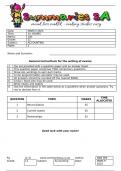
NAME:
STUDENT NUMBER:
SUBJECT: TECHNIQUES IN TRIAL AND LITIGATION
MODULE CODE: TLI4801
ASSESSMENT FORM: FORMAL MANDATORY ASSESSMENT
DUE DATE: 10 AUGUST 2023
HONESTY DECLARATION:
In writing and submitting this paper i affirm that:
1. I understand what academic dishonesty entails and are aware of UNISA’s
policies in this regard.
2. I have not allowed, and will not allow, anyone to copy my work with the
intention of passing it off as his or her own work.
3. I did not make use of another student’s work with or without permission and
submitted it as your own.
DATE: XXXXXXXXXXXXXX
SIGNATURE: XXXXXXXXXXXXX
QUESTION 1
, 1 (a) The summons applicable to Mrs White’s divorce action is a combined summons
because the claim is unliquidated. An unliquidated claim is a claim in which the quantum
must be determined for example, where the status of parties is affected, such as in a
divorce. Therefore, the claim is not for a claim for a debt or liquidated demand, where
one would use a simple summons (or possibly a provisional sentence summons based
on a liquid document). The combined summons is used often involving serious factual
disputes that involve the leading of oral evidence to resolve the issues.
Therefore, the combined summons is the appropriate summons to use in Mrs White’s
divorce action divorce action where the status of parties are/will be affected. 1
(b) The relevant pleading is the particulars of claim.
An unliquidated claim is made by way of “particulars of claim”, which is a separate
document attached to the summons. A combined summons comprises the summons
and the particulars of claim which is combined in one document and it forms a unit. The
material facts are set out with sufficient particularity in the particulars of claim, and it
contains the evidence to substantiate the claim for example, a divorce action in this
instance. The particulars of claim set out the particulars in consecutive numbered
paragraphs containing as far as possible separate averments. 2
Plaintiff’s Prayer:
Wherefore Plaintiff claims:
(1) A decree of divorce.
(2) An order directing that each party shall be co-holders of parental rights in respect of
the minor children.
1
Marnewick CG Litigation Skills for South African Lawyers 4th edition
(2019 LexisNexis) : chapter 6.
2
Rule 18((3) and 4) of the Uniform Rules and Marnewick: chapter 6.
STUDENT NUMBER:
SUBJECT: TECHNIQUES IN TRIAL AND LITIGATION
MODULE CODE: TLI4801
ASSESSMENT FORM: FORMAL MANDATORY ASSESSMENT
DUE DATE: 10 AUGUST 2023
HONESTY DECLARATION:
In writing and submitting this paper i affirm that:
1. I understand what academic dishonesty entails and are aware of UNISA’s
policies in this regard.
2. I have not allowed, and will not allow, anyone to copy my work with the
intention of passing it off as his or her own work.
3. I did not make use of another student’s work with or without permission and
submitted it as your own.
DATE: XXXXXXXXXXXXXX
SIGNATURE: XXXXXXXXXXXXX
QUESTION 1
, 1 (a) The summons applicable to Mrs White’s divorce action is a combined summons
because the claim is unliquidated. An unliquidated claim is a claim in which the quantum
must be determined for example, where the status of parties is affected, such as in a
divorce. Therefore, the claim is not for a claim for a debt or liquidated demand, where
one would use a simple summons (or possibly a provisional sentence summons based
on a liquid document). The combined summons is used often involving serious factual
disputes that involve the leading of oral evidence to resolve the issues.
Therefore, the combined summons is the appropriate summons to use in Mrs White’s
divorce action divorce action where the status of parties are/will be affected. 1
(b) The relevant pleading is the particulars of claim.
An unliquidated claim is made by way of “particulars of claim”, which is a separate
document attached to the summons. A combined summons comprises the summons
and the particulars of claim which is combined in one document and it forms a unit. The
material facts are set out with sufficient particularity in the particulars of claim, and it
contains the evidence to substantiate the claim for example, a divorce action in this
instance. The particulars of claim set out the particulars in consecutive numbered
paragraphs containing as far as possible separate averments. 2
Plaintiff’s Prayer:
Wherefore Plaintiff claims:
(1) A decree of divorce.
(2) An order directing that each party shall be co-holders of parental rights in respect of
the minor children.
1
Marnewick CG Litigation Skills for South African Lawyers 4th edition
(2019 LexisNexis) : chapter 6.
2
Rule 18((3) and 4) of the Uniform Rules and Marnewick: chapter 6.