Test Bank for Cognition 6th Edition by Radvansky
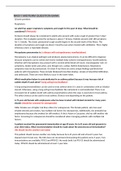
Test Bank for Cognition 6th Edition by Radvansky. Which term or phrase is closest in meaning to the term “cognition”? a. Emotion b. Mental activity c. Behavior d. Social activity Answer: b 15 Full file at Section Ref: What Is Cognitive Psychology? Difficulty: Easy Objective: 1.1 Objective text: Define the term “cognition” and the goals of a cognitive psychologist Bloom’s Level: Knowledge 1-2. Suppose that a psychologist writes an article on children’s acquisition of gender stereotypes. Which of the following article titles would be most consistent with the cognitive approach? a. “How parents’ reinforcement of behaviors shapes stereotypes” b. “The effects of classical conditioning on children’s emotional reactions to gender stereotypes” c. “How early emotional reactions to parents influence later gender stereotypes” d. “Children’s memory for gender-consistent information” Answer: d Section Ref: What Is Cognitive Psychology? Difficulty: Medium Objective: 1.1 Objective text: Define the term “cognition” and the goals of a cognitive psychologist Bloom’s Level: Application 16 Full file at 1-3. Suppose that you are writing a paper about cognitive processes in people who are depressed. Which of the following topics would be most relevant for your paper? a. Observations of social interactions between people with depression. b. The effects of vitamin supplements on the activity level of people with depression. c. The ability of depressed individuals to recall people’s names. d. The relationship between childhood experiences and current adjustment in people with depression. Answer: c Section Ref: What Is Cognitive Psychology? Difficulty: Medium Objective: 1.1 Objective text: Define the term “cognition” and the goals of a cognitive psychologist Bloom’s Level: Application 1-4. John is reading his Cognitive Psychology textbook. He notices that his stomach is grumbling, but he thinks, “I will finish this section of the chapter and then go to lunch.” John’s thought illustrates the cognitive process of _______. a. pattern recognition b. memory c. imagery d. decision making Answer: d Section Ref: What Is Cognitive Psychology? Difficulty: Easy Objective: 1.1 Objective text: Define the term “cognition” and the goals of a cognitive psychologist Bloom’s Level: Comprehension 1-5. Suppose that several psychologists want to explore interpersonal interactions during adulthood. Which of the following topics would be most consistent with the cognitive approach? a. “How do early childhood experiences contribute to the development of love relationships during adulthood?” b. “Can interpersonal attraction be influenced by classical conditioning?” c. “When meeting someone for the first time, what attribute does a person perceive most quickly, gender or ethnicity?” d. “Do people spend less time with depressed individuals, as opposed to nondepressed individuals?” Answer: c Section Ref: What Is Cognitive Psychology? Difficulty: Medium Objective: 1.1 17 Full file at Objective text: Define the term “cognition” and the goals of a cognitive psychologist Bloom’s Level: Application 1-6. What does the introductory chapter conclude about the influence of cognitive approaches on other areas of psychology? a. Cognitive psychology has had very little influence on areas outside traditional experimental psychology. b. Cognitive psychology has influenced experiments in some research-oriented areas of psychology, but it has not yet had an impact on applied areas. c. Cognitive psychology has influenced disciplines that are concerned with the behavior of humans as individuals, but it has not yet influenced the areas of psychology concerned with social interactions. d. Cognitive psychology has had an important impact on a variety of areas throughout psychology. Answer: d Section Ref: What Is Cognitive Psychology? Difficulty: Medium Objective: 1.1 Objective text: Define the term “cognition” and the goals of a cognitive psychologist Bloom’s Level: Analysis 1-7. Chapter 1 of your Cognition textbook discusses the status of cognitive psychology. According to this discussion, the cognitive approach a. primarily emphasizes our unconscious thoughts. b. can explain a major part of your daily experiences. c. is prominent within social psychology, but it has not yet been applied to biological areas of psychology. d. has had surprisingly little connection with clinical psychology. Answer: b Section Ref: What Is Cognitive Psychology? Difficulty: Easy Objective: 1.1 Objective text: Define the term “cognition” and the goals of a cognitive psychologist Bloom’s Level: Comprehension 1-8. According to the introductory chapter in your textbook, the influence of cognitive psychology a. has been relatively weak, both within psychology and in other disciplines. b. has been limited primarily to areas related to education. c. has not yet reached applied areas of psychology. d. has extended to other disciplines, such as neurology. Answer: d Section Ref: What Is Cognitive Psychology? Difficulty: Easy 18 Full file at Objective: 1.1 Objective text: Define the term “cognition” and the goals of a cognitive psychologist Bloom’s Level: Knowledge 1-9. Imagine that you are attending a lecture by a guest speaker who describes a theory and then says, “Let’s now look at the empirical evidence.” Which of the following would most likely be the speaker’s next sentence? a. “Other psychologists have objected to my approach on the following theoretical grounds.” b. “We conducted an experiment to test this hypothesis.” c. “The theorists who belonged to the empirical school rejected the behaviorist tradition, for the following reasons.” d. “By combining both the cognitive approach and the psychodynamic approach, we can devise a new theoretical approach to the problem.” Answer: b Section Ref: A Historical Perspective on Cognitive Psychology Difficulty: Hard Objective: 1.2 Objective text: Explain the roots of cognitive psychology and how it differs from previous psychological approaches Bloom’s Level: Synthesis 1-10. Suppose that your professor tells you that you must locate a journal article about cognitive psychology that presents empirical evidence. You should look for an article that a. studies humans, rather than other animals. b. emphasizes evidence collected in experiments. c. provides a theoretical explanation for previous research. d. uses at least two different statistical analyses. Answer: b Section Ref: A Historical Perspective on Cognitive Psychology Difficulty: Medium Objective: 1.2 Objective text: Explain the roots of cognitive psychology and how it differs from previous psychological approaches Bloom’s Level: Application 1-11. The philosopher ____ can be called the first cognitive psychologist, because he examined topics such as memory and perception and emphasized the importance of empirical evidence. a. Plato b. Sophocles c. Aristotle d. Descartes Answer: c 19 Full file at Section Ref: A Historical Perspective on Cognitive Psychology Difficulty: Easy Objective: 1.2 Objective text: Explain the roots of cognitive psychology and how it differs from previous psychological approaches Bloom’s Level: Knowledge 1-12. In the introspection technique, a. people describe what they are thinking as they perform a task. b. people report their daily experiences in an informal, unstructured fashion. c. the experimenter observes how people respond to learning tasks. d. emotional responses are emphasized, rather than a variety of thought processes. Answer: a Section Ref A Historical Perspective on Cognitive Psychology Difficulty: Easy Objective: 1.2 Objective text: Explain the roots of cognitive psychology and how it differs from previous psychological approaches Bloom’s Level: Comprehension 1-13. When researchers use the introspection technique, a. people report their sensations as accurately as possible. b. people report their experiences in a spontaneous, unsystematic fashion. c. the researchers observe how people respond to learning tasks. d. the researchers encourage people to interpret their reactions to selected stimuli. Answer: a Section Ref: A Historical Perspective on Cognitive Psychology Difficulty: Medium Objective: 1.2 Objective text: Explain the roots of cognitive psychology and how it differs from previous psychological approaches Bloom’s Level: Analysis 1-14. Your textbook discusses the early history of cognitive psychology. According to this discussion, a. Hermann Ebbinghaus opposed cognitive psychology because it did not pay enough attention to emotions. b. Mary Whiton Calkins studied people’s introspections about nonsense words. c. William James suggested that our everyday cognitive processes are passive, rather than active. d. Wilhelm Wundt emphasized that introspection could provide useful information, if participants were well trained. Answer: d Section Ref: A Historical Perspective on Cognitive Psychology 20 Full file at Difficulty: Easy Objective: 1.2 Objective text: Explain the roots of cognitive psychology and how it differs from previous psychological approaches Bloom’s Level: Comprehension 1-15. The primary contribution of Hermann Ebbinghaus to current cognitive psychology was a. the emphasis on ecological validity. b. the emphasis on research employing hundreds of subjects in each study. c. research about factors that might influence human memory. d. the notion of top-down processing. Answer: c Section Ref: A Historical Perspective on Cognitive Psychology Difficulty: Medium Objective: 1.2 Objective text: Explain the roots of cognitive psychology and how it differs from previous psychological approaches Bloom’s Level: Analysis 1-16. Which of the following women was an early researcher in memory who reported the recency effect and also became the first female president of the American Psychological Association? a. Dorothea Dix b. Leta Stetter Hollingworth c. Mary Whiton Calkins d. Margaret Floy Washburn Answer: c Section Ref: A Historical Perspective on Cognitive Psychology Difficulty: Easy Objective: 1.2 Objective text: Explain the roots of cognitive psychology and how it differs from previous psychological approaches Bloom’s Level: Knowledge 1-17. Chris just telephoned Roberta and listed eight items that they need for the afternoon picnic. Roberta didn’t have a pencil, so she couldn’t write them down. However, she remembers the last three items very well because of a. object permanence. b. long-term memory. c. an event-related potential. d. the recency effect. Answer: d Section Ref: A Historical Perspective on Cognitive Psychology Difficulty: Medium 21 Full file at Objective: 1.2 Objective text: Explain the roots of cognitive psychology and how it differs from previous psychological approaches Bloom’s Level: Application 1-18. Based on the information in Chapter 1, how would you describe the approach of William James? a. He emphasized rigorous experimentation and carefully controlled research. b. He asked research participants to report their sensations and perceptions as objectively as possible. c. He emphasized the kinds of psychological experiences that people encounter in their everyday lives. d. He emphasized that we must look for the unconscious forces that underlie cognitive activities. Answer: c Section Ref: A Historical Perspective on Cognitive Psychology Difficulty: Hard Objective: 1.2 Objective text: Explain the roots of cognitive psychology and how it differs from previous psychological approaches Bloom’s Level: Synthesis 1-19. William James made his most important contributions to cognitive psychology in his work on a. problem-solving strategies. b. memory in everyday life. c. complex decision making. d. cognitive development in children. Answer: b Section Ref: A Historical Perspective on Cognitive Psychology Difficulty: Hard Objective: 1.2 Objective text: Explain the roots of cognitive psychology and how it differs from previous psychological approaches Bloom’s Level: Evaluation 1-20. In contrast to Hermann Ebbinghaus, William James was more likely to focus on a. well-controlled experiments. b. a behavioral approach to memory and language. c. people’s everyday experiences. d. clear operational definitions. Answer: c Section Ref: A Historical Perspective on Cognitive Psychology Difficulty: Medium 22 Full file at Objective: 1.2 Objective text: Explain the roots of cognitive psychology and how it differs from previous psychological approaches Bloom’s Level: Analysis 1-21. Which statement about the history of cognition is correct? a. Behaviorists favored the introspection technique. b. William James emphasized that the human mind is active, rather than passive. c. Research in cognition thrived during the period when behaviorism was strongest. d. Behaviorists were influential in conducting research on problem solving. Answer: b Section Ref: A Historical Perspective on Cognitive Psychology Difficulty: Easy Objective: 1.2 Objective text: Explain the roots of cognitive psychology and how it differs from previous psychological approaches Bloom’s Level: Knowledge 1-22. Chapter 1 presents some information about the history of cognition. According to this discussion a. the issue of how humans acquire knowledge was not considered until about 80 years ago. b. the birthday of scientific psychology is usually traced to the first studies of John B. Watson. c. behaviorism is an approach that relies on objective, observable reactions. d. behaviorists have been primarily interested in studying images and thought processes. Answer: c Section Ref: A Historical Perspective on Cognitive Psychology Difficulty: Easy Objective: 1.2 Objective text: Explain the roots of cognitive psychology and how it differs from previous psychological approaches Bloom’s Level: Knowledge 1-23. Which of the following movements emphasized the human tendency to actively organize what we see? a. Behaviorism b. Gestalt psychology c. Empiricism d. Clinical psychology Answer: b Section Ref: A Historical Perspective on Cognitive Psychology Difficulty: Easy 23 Full file at Objective: 1.2 Objective text: Explain the roots of cognitive psychology and how it differs from previous psychological approaches Bloom’s Level: Comprehension 1-24. Which of the following early approaches to psychology developed the idea of insight when people solve problems? a. Introspectionism b. The Gestalt approach c. Behaviorism d. Ebbinghaus and his followers Answer: b Section Ref: A Historical Perspective on Cognitive Psychology Difficulty: Easy Objective: 1.2 Objective text: Explain the roots of cognitive psychology and how it differs from previous psychological approaches Bloom’s Level: Knowledge 1-25. According to the discussion in Chapter 1, behaviorism places the most emphasis on a. interpersonal relationships. b. observable activities. c. unconscious emotions. d. mental processes. Answer: b Section Ref: A Historical Perspective on Cognitive Psychology Difficulty: Medium Objective: 1.2 Objective text: Explain the roots of cognitive psychology and how it differs from previous psychological approaches Bloom’s Level: Analysis 1-26. With practice and reinforcement, a rat learns to navigate a maze. A behaviorist would operationalize the rat’s “learning” as a. the decrease in the rate of errors, over time. b. the rat’s memory for the correct sequence of right and left turns. c. the rat’s internal “map” of the maze. d. the rat’s decreasing reliance on cheese as a reinforcer. Answer: a Section Ref: A Historical Perspective on Cognitive Psychology Difficulty: Medium Objective: 1.2 Objective text: Explain the roots of cognitive psychology and how it differs from previous psychological approaches Bloom’s Level: Analysis 24 Full file at 1-27. Which of the following research topics would be most likely to interest a behaviorist? a. The effect of parents’ marital satisfaction on children’s nightmares. b. The effect of praise on children’s running speed. c. Individual differences in verbal ability. d. The relationship between the true size of an object and its size as represented in a mental image. Answer: b Section Ref: A Historical Perspective on Cognitive Psychology Difficulty: Medium Objective: 1.2 Objective text: Explain the roots of cognitive psychology and how it differs from previous psychological approaches Bloom’s Level: Application 1-28. Which of the following students provides the most accurate summary of the behaviorists’ contributions to cognitive psychology? a. Anton: “The behaviorists refined the introspection technique through the use of careful interview techniques.” b. Elena: “The most important contributions of the behaviorists were related to research methodology.” c. Sarah: “Behaviorists clarified the cognitive abilities of infants and children, especially in their research on object permanence.” d. Jason: “Behaviorists’ contributions to cognitive psychology focused on theoretical models, rather than on empirical results.” Answer: b Section Ref: What Is Cognitive Psychology? Difficulty: Hard Objective: 1.2 Objective text: Explain the roots of cognitive psychology and how it differs from previous psychological approaches Bloom’s Level: Synthesis 1-29. An operational definition is most likely to a. describe precisely how the researchers will measure a particular concept. b. examine the correlation between two well-established variables. c. point out alternative explanations for the results of a study. d. adopt an information-processing approach, rather than a behaviorist approach. Answer: a Section Ref: A Historical Perspective on Cognitive Psychology Difficulty: Medium Objective: 1.2 Objective text: Explain the roots of cognitive psychology and how it differs from previous psychological approaches 25 Full file at Bloom’s Level: Application 1-30. Which of the following perspectives was most likely to emphasize the importance of a precise operational definition? a. William James’s work on the tip-of-the-tongue effect b. Wilhelm Wundt’s introspection approach c. The behaviorists’ research with animals d. The gestalt approach to perception Answer: c Section Ref: A Historical Perspective on Cognitive Psychology Difficulty: Medium Objective: 1.2 Objective text: Explain the roots of cognitive psychology and how it differs from previous psychological approaches Bloom’s Level: Analysis 1-31. Behaviorists and cognitive psychologists are most likely to agree on which of the following points? a. Researchers need to have detailed definitions about how a concept will be measured. b. Researchers must emphasize the external stimuli in the environment. c. Theorists must try to explain higher mental processes in terms of mental events. d. Most thought processes can be explained in terms of people’s observable responses to stimuli. Answer: a Section Ref: A Historical Perspective on Cognitive Psychology Difficulty: Medium Objective: 1.2 Objective text: Explain the roots of cognitive psychology and how it differs from previous psychological approaches Bloom’s Level: Analysis 1-32. A psychologist who favors the Gestalt approach would be most likely to criticize the fact that behaviorists a. ignore the context in which a behavior occurs. b. overemphasize introspection. c. are not sufficiently rigorous in designing their psychological research. d. pay too much attention to insight. Answer: a Section Ref: A Historical Perspective on Cognitive Psychology Difficulty: Medium Objective: 1.2 Objective text: Explain the roots of cognitive psychology and how it differs from previous psychological approaches 26 Full file at Bloom’s Level: Analysis 1-33. During the 1950s, many psychologists were becoming discouraged with behaviorism, and cognitive psychology began to emerge. A major reason they were disappointed with behaviorism is that a. it considered only psychological processes that are clearly observable. b. it paid too much attention to individual differences. c. it failed to develop objective methods of measuring behavior. d. it focused too much on emotional factors, and not enough on observable behaviors. Answer: a Section Ref: A Historical Perspective on Cognitive Psychology Difficulty: Medium Objective: 1.2 Objective text: Explain the roots of cognitive psychology and how it differs from previous psychological approaches Bloom’s Level: Analysis
Connected book
- 2013
- 9781292021478
- Unknown
Written for
- Institution
- Cognition 6th Edition by Radvansky
- Course
- Cognition 6th Edition by Radvansky
Document information
- Uploaded on
- August 6, 2023
- Number of pages
- 126
- Written in
- 2023/2024
- Type
- Exam (elaborations)
- Contains
- Questions & answers
Subjects
-
cognition 6th edition
-
radvansky
-
cognition 6th edition by radvansky
-
test bank for cognition 6th edition by radvansky