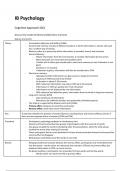
IB Psychology
Cognitive Approach SAQ
Discuss One model of Memory (Multi Store memory)
Glanzer and Cunitz
Theory - Presented by Atkinson and Shiffrin (1968)
- Assume that memory consists of different locations in which information is stored, and each
has a uniform way of storing
- Memory refers to a process by which information is encoded, stored, and retrieved
- Sensory Memory
- Detect information from the environment, it encodes information by five senses
- Most important are visual store and auditory store
- It holds until it either gets transferred to short term memory or lost if attention is not
given
- Duration is 2-5 seconds
- If attention is given, information will then be transferred to STM
- Short-term memory
- Gateway by which information can gain access to long-term memory
- Capacity of STM assumed to be limited
- Its duration is about 6-18 seconds
- With rehearsal, information may stay in STM up to 30 seconds
- Information in STM can quickly lost if not rehearsed
- Information can be displaced by new information
- With rehearsal and attention given, information then be stored in long-term memory
- Long-term memory (LTM)
- Vast storehouse of information
- Believed to be indefinite duration and potentially unlimited capacity
- This theory is supported by Glanzer and Cunitz (1966)
- Primary effect: tendency to recall the word earlier
- Recency effect: recall most recent information
Aim To examine whether the position of words influences recall (primary and recency effects) and see if
there are two separate stores of memory (STM and LTM)
Procedure - Participants: psychology students in introductory class
- Glanzer and Cunitz presented two groups of participants with the same list of words
- One group recalled the words immediately after the presentation, while the other group
recalled the words after waiting 30 seconds
- These participants had to count backward in threes which prevented rehearsal and caused the
recency effect to disappear.
- Both groups could freely recall the words in any order
Results - Delaying recall by 30 seconds destroys the recency effect, participants only remembered the
first few words = words earlier are rehearsed and moved to LTM due to primary effect but
displaced information in STM, no more recency
- No delay condition= participants can remember first few words and last few words
- Words earlier are moved to LTM as primary effect
, - Words at the last are still in STM as recency effect
Conclusion - MSM is correct
- Showing that LTM and ST are in different stores
- STM can be replaced
- The distractor task reduces recency effects as it interferes with STM
Discuss Reconstructive memory
Loftus and Palmer
Reconstructive - Psychologists argue that episodic memory is not just a photographic snapshot in the brain,
memory Theory but instead it is reconstructed
- Schema theory suggest that memory is based on schema
- When we encode and retrieve episodic memories, we are influenced by our perceptions, past
knowledge and personal beliefs
- Loftus supports Bartlett’s idea of memory as reconstructive
- Loftus claims that the nature of questions asked by police or in a courtroom can influence
witnesses’ memory
- Leading question are suggestive in some way and post-event information facilitate schema
processing which may influence the accuracy of recall → misinformation effect
Aim Investigate whether the use of leading question would affect the estimation of speed
Procedure - Researchers predicted that using the word ‘smashed’ would result in a higher estimation of
speed than using the word ‘hit’
- IV: intensity of the verb used in the critical question
- DV: estimation of speed
- Participants: 45 students
- Divide into 5 groups of nine students
- 7 films of traffic accidents were shown and the length of the films ranged from 5-30 seconds
- These films were taken from driver’s education films
- The study was an independent sample designs
- Each participant watched all 7 films
- When the participants had watched a film they were asked to give an account of the accident
they seen and answered a questionnaire with different questions on the accident
- One question is the critical question where they were asked to estimate the speed of the cars
involved in the accident
- The participants were asked to estimate the speed of the cars involved in the accident
- They were asked the same question but with different words
- Such as the critical words “hit” “collide” “bumped” “smashed” or “contacted”
Results - Mean estimates of speed were highest in “smashed” condition (40.8 mph)
- Lowest in the “contacted” group (31.8 mph)
- The result indicated that the critical word in the question consistently affected the
participants’ answers to the question
- The researcher argued that it may be that the different speed estimates are the result of
response-biassed saan
- The distortion of memory is based on reconstruction so that it is not the actual details of the
Cognitive Approach SAQ
Discuss One model of Memory (Multi Store memory)
Glanzer and Cunitz
Theory - Presented by Atkinson and Shiffrin (1968)
- Assume that memory consists of different locations in which information is stored, and each
has a uniform way of storing
- Memory refers to a process by which information is encoded, stored, and retrieved
- Sensory Memory
- Detect information from the environment, it encodes information by five senses
- Most important are visual store and auditory store
- It holds until it either gets transferred to short term memory or lost if attention is not
given
- Duration is 2-5 seconds
- If attention is given, information will then be transferred to STM
- Short-term memory
- Gateway by which information can gain access to long-term memory
- Capacity of STM assumed to be limited
- Its duration is about 6-18 seconds
- With rehearsal, information may stay in STM up to 30 seconds
- Information in STM can quickly lost if not rehearsed
- Information can be displaced by new information
- With rehearsal and attention given, information then be stored in long-term memory
- Long-term memory (LTM)
- Vast storehouse of information
- Believed to be indefinite duration and potentially unlimited capacity
- This theory is supported by Glanzer and Cunitz (1966)
- Primary effect: tendency to recall the word earlier
- Recency effect: recall most recent information
Aim To examine whether the position of words influences recall (primary and recency effects) and see if
there are two separate stores of memory (STM and LTM)
Procedure - Participants: psychology students in introductory class
- Glanzer and Cunitz presented two groups of participants with the same list of words
- One group recalled the words immediately after the presentation, while the other group
recalled the words after waiting 30 seconds
- These participants had to count backward in threes which prevented rehearsal and caused the
recency effect to disappear.
- Both groups could freely recall the words in any order
Results - Delaying recall by 30 seconds destroys the recency effect, participants only remembered the
first few words = words earlier are rehearsed and moved to LTM due to primary effect but
displaced information in STM, no more recency
- No delay condition= participants can remember first few words and last few words
- Words earlier are moved to LTM as primary effect
, - Words at the last are still in STM as recency effect
Conclusion - MSM is correct
- Showing that LTM and ST are in different stores
- STM can be replaced
- The distractor task reduces recency effects as it interferes with STM
Discuss Reconstructive memory
Loftus and Palmer
Reconstructive - Psychologists argue that episodic memory is not just a photographic snapshot in the brain,
memory Theory but instead it is reconstructed
- Schema theory suggest that memory is based on schema
- When we encode and retrieve episodic memories, we are influenced by our perceptions, past
knowledge and personal beliefs
- Loftus supports Bartlett’s idea of memory as reconstructive
- Loftus claims that the nature of questions asked by police or in a courtroom can influence
witnesses’ memory
- Leading question are suggestive in some way and post-event information facilitate schema
processing which may influence the accuracy of recall → misinformation effect
Aim Investigate whether the use of leading question would affect the estimation of speed
Procedure - Researchers predicted that using the word ‘smashed’ would result in a higher estimation of
speed than using the word ‘hit’
- IV: intensity of the verb used in the critical question
- DV: estimation of speed
- Participants: 45 students
- Divide into 5 groups of nine students
- 7 films of traffic accidents were shown and the length of the films ranged from 5-30 seconds
- These films were taken from driver’s education films
- The study was an independent sample designs
- Each participant watched all 7 films
- When the participants had watched a film they were asked to give an account of the accident
they seen and answered a questionnaire with different questions on the accident
- One question is the critical question where they were asked to estimate the speed of the cars
involved in the accident
- The participants were asked to estimate the speed of the cars involved in the accident
- They were asked the same question but with different words
- Such as the critical words “hit” “collide” “bumped” “smashed” or “contacted”
Results - Mean estimates of speed were highest in “smashed” condition (40.8 mph)
- Lowest in the “contacted” group (31.8 mph)
- The result indicated that the critical word in the question consistently affected the
participants’ answers to the question
- The researcher argued that it may be that the different speed estimates are the result of
response-biassed saan
- The distortion of memory is based on reconstruction so that it is not the actual details of the