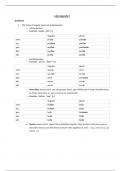
Latin Appendix 1
Accidence
The forms of regular nouns of all declensions
1st Declension
Example - puella, “girl” (f.)
singular plural
nom. puella puellae
acc. puellam puellas
gen. puellae puellarum
dat. puellae puellis
abl. puella puellis
2nd Declension
Example - servus, “slave” (m.)
singular plural
nom. servus servi
acc. servum servos
gen. servi servorum
dat. servo servis
abl. servo servis
Masculine nouns end in –us, except puer (boy), ager (field) and vir (man). Decline these
as if they were puer-us, agr-us and vir-us respectively.
Example - bellum, “war” (n.)
singular plural
nom. bellum bella
acc. bellum bella
gen. belli bellorum
dat. bello bellis
abl. bello bellis
Neuter nouns end in –um in the nominative singular. They decline in the same way as
masculine nouns, just with the two neuter rules applied (i.e. nom. = acc.; nom. & acc. pl.
end in –a.)
Accidence
The forms of regular nouns of all declensions
1st Declension
Example - puella, “girl” (f.)
singular plural
nom. puella puellae
acc. puellam puellas
gen. puellae puellarum
dat. puellae puellis
abl. puella puellis
2nd Declension
Example - servus, “slave” (m.)
singular plural
nom. servus servi
acc. servum servos
gen. servi servorum
dat. servo servis
abl. servo servis
Masculine nouns end in –us, except puer (boy), ager (field) and vir (man). Decline these
as if they were puer-us, agr-us and vir-us respectively.
Example - bellum, “war” (n.)
singular plural
nom. bellum bella
acc. bellum bella
gen. belli bellorum
dat. bello bellis
abl. bello bellis
Neuter nouns end in –um in the nominative singular. They decline in the same way as
masculine nouns, just with the two neuter rules applied (i.e. nom. = acc.; nom. & acc. pl.
end in –a.)