Acids + Bases
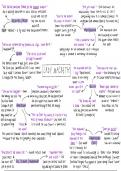
Arrhenius Acid: Arrhenius Base: Bronsted Bronsted Base:
Lowry Acid:
Lowry
-
-
-> substance that in 2 -> substance inc (ON]
>needs renders
Proton ->
proton acceptor
[H+]when
it)
dissolve e when dissolved in water <needs pair of
non-bonding ef
of
*
in
will
any
acid-base reaction,
favour the reaction that
the equilibrium
moves the
short
·restricted
comings
aqueous
to
Arrhenius
solutions
concept:
proton
stronger
to the base
bases Acid-base titrations
only on-containing
· *
·Bronsted expands compounds
considered ->
equivalence point
Lowry
-
of neutralisation
point
->
↓
pH[H+]
How
expands base to include
apes that
-
accepts protons
P
M =
-10g
=
-log[4,O]
(at252)
-
includes ions and molecules
solutions
(HSO,) as acids/bases
well
pH pOH pkw=14.00
as
+
=
-
includes non-agenous
can act as both acid
-
considers amphoteric/amphiprotic species ->
base
and a
acids bases eg. 420 Autoionisation
strong
-
strong
HC
LiOH
In water:
HBr NaOH pure
HI (*) kon equilibrium X 100
K=(H10r] =1.0x0-
H2SO4
RbOH %Ionisation:SHAJinzial :(H+] (OH-]
=
=
1.0x10⁻²
HNOs C.OH
acid (Ht] equilibrium
greater
at
HCOs CaCOH)2 ->
higher -
stronger
->
Sr(OH), the solution *?
HC0p -> inc more
= dilute
Bu(OH),
weak acids weak bases of cation/anion
Effect in solution
HA(ag) A Laq) H+(aq)
-
+
affect
-weak
cons base anion -> not pl
Ray- -strong conj. base anion -
increase
pH
↓ cations of I and Ca"Sr" Bat- affectph
group
not
greater ha/kb acid/base
stronger
=
-other metalions - decrease in pH
-if both conj. acid + base are
strong, ion with larger Ka, Ky will have
greater
inference
Kara kw.ka=
influence
↳
-
Ka> kp ⑮ ub
acidic
=> =basic =neutral
HF 10 PH [H+] NMs
-
=
CH,N
strong
Acid.Base properties of salts
HNO2
CoH,LOON -> strong HONH- ->
conj.
conj
-
HS-
CH, COOH
acid (t) Hot-=
bases(-) ions reactw ith water ->
hydrolysis
·
HCLO COS
HCN
CLO-
·
is salt acidic/basic?
CoHs OH
↳ Inspectcation,
anion
separately & cation
has no
cation:acidneutral I
14.00 determine
pka+ pky combine to
=
effect on
overall solution pH?
weak
·
con;
acid of strong base -
very
acids the neutral
easier remove :does not reactwith water:
polyprotic
A always to
-
first proton than to remove the second
konjbase of acid is save a
strong
, Chemical equilibrium
Equilibrium constant
partial pressures: Reaction Quotient (a)
aA bB
(Pe
+
c dD+
kp =
I
gives butfor a
->
same ratio as
system
Ko=
Ibar 10 Pa
= notat
equilibrium
if Q = K :
system at equilibrium
solutions -> K determine which
only gases, aqueous compare & and
->
known to
direction proceed to reach
only temp affected reaction will
eq.
->
if Q k reaction shifts
right
< to
if k > [reaCt] reactant)
1 [prod] - cuse up -> Fwd
spontaneous
& k
=
·reaction atag
k 1
=
Sprod] [react] =
-
a > K reaction shifts to left
k< 1 (prod] [react]
* - <use up product) reverse
-
spontaneous
under non-standard conditions: ob=-RTW
Kraverse -Reward
Le ChateliersPrinciple
Knew (Kold]"
=
(co-efficients in balance can changel
disturbed
by change
-> in
system
Kret =
K, x
K2 (adding reactions) ·temp
·pressure comme
concentration
Table:
ICE system will shift to counteractt he
change
if (RJo > 100 x Kc ->
approx
initial reactantconc
change intemp:(K changes)
absorb heat
inc
temp:shifts
-> to
Harber Reaction: :encothermic favoured (04>0)
Ne 3H2+
-
INMs -> dec temp:shifts to release heat
:exothermic favoured (04(0)
Arrhenius Acid: Arrhenius Base: Bronsted Bronsted Base:
Lowry Acid:
Lowry
-
-
-> substance that in 2 -> substance inc (ON]
>needs renders
Proton ->
proton acceptor
[H+]when
it)
dissolve e when dissolved in water <needs pair of
non-bonding ef
of
*
in
will
any
acid-base reaction,
favour the reaction that
the equilibrium
moves the
short
·restricted
comings
aqueous
to
Arrhenius
solutions
concept:
proton
stronger
to the base
bases Acid-base titrations
only on-containing
· *
·Bronsted expands compounds
considered ->
equivalence point
Lowry
-
of neutralisation
point
->
↓
pH[H+]
How
expands base to include
apes that
-
accepts protons
P
M =
-10g
=
-log[4,O]
(at252)
-
includes ions and molecules
solutions
(HSO,) as acids/bases
well
pH pOH pkw=14.00
as
+
=
-
includes non-agenous
can act as both acid
-
considers amphoteric/amphiprotic species ->
base
and a
acids bases eg. 420 Autoionisation
strong
-
strong
HC
LiOH
In water:
HBr NaOH pure
HI (*) kon equilibrium X 100
K=(H10r] =1.0x0-
H2SO4
RbOH %Ionisation:SHAJinzial :(H+] (OH-]
=
=
1.0x10⁻²
HNOs C.OH
acid (Ht] equilibrium
greater
at
HCOs CaCOH)2 ->
higher -
stronger
->
Sr(OH), the solution *?
HC0p -> inc more
= dilute
Bu(OH),
weak acids weak bases of cation/anion
Effect in solution
HA(ag) A Laq) H+(aq)
-
+
affect
-weak
cons base anion -> not pl
Ray- -strong conj. base anion -
increase
pH
↓ cations of I and Ca"Sr" Bat- affectph
group
not
greater ha/kb acid/base
stronger
=
-other metalions - decrease in pH
-if both conj. acid + base are
strong, ion with larger Ka, Ky will have
greater
inference
Kara kw.ka=
influence
↳
-
Ka> kp ⑮ ub
acidic
=> =basic =neutral
HF 10 PH [H+] NMs
-
=
CH,N
strong
Acid.Base properties of salts
HNO2
CoH,LOON -> strong HONH- ->
conj.
conj
-
HS-
CH, COOH
acid (t) Hot-=
bases(-) ions reactw ith water ->
hydrolysis
·
HCLO COS
HCN
CLO-
·
is salt acidic/basic?
CoHs OH
↳ Inspectcation,
anion
separately & cation
has no
cation:acidneutral I
14.00 determine
pka+ pky combine to
=
effect on
overall solution pH?
weak
·
con;
acid of strong base -
very
acids the neutral
easier remove :does not reactwith water:
polyprotic
A always to
-
first proton than to remove the second
konjbase of acid is save a
strong
, Chemical equilibrium
Equilibrium constant
partial pressures: Reaction Quotient (a)
aA bB
(Pe
+
c dD+
kp =
I
gives butfor a
->
same ratio as
system
Ko=
Ibar 10 Pa
= notat
equilibrium
if Q = K :
system at equilibrium
solutions -> K determine which
only gases, aqueous compare & and
->
known to
direction proceed to reach
only temp affected reaction will
eq.
->
if Q k reaction shifts
right
< to
if k > [reaCt] reactant)
1 [prod] - cuse up -> Fwd
spontaneous
& k
=
·reaction atag
k 1
=
Sprod] [react] =
-
a > K reaction shifts to left
k< 1 (prod] [react]
* - <use up product) reverse
-
spontaneous
under non-standard conditions: ob=-RTW
Kraverse -Reward
Le ChateliersPrinciple
Knew (Kold]"
=
(co-efficients in balance can changel
disturbed
by change
-> in
system
Kret =
K, x
K2 (adding reactions) ·temp
·pressure comme
concentration
Table:
ICE system will shift to counteractt he
change
if (RJo > 100 x Kc ->
approx
initial reactantconc
change intemp:(K changes)
absorb heat
inc
temp:shifts
-> to
Harber Reaction: :encothermic favoured (04>0)
Ne 3H2+
-
INMs -> dec temp:shifts to release heat
:exothermic favoured (04(0)