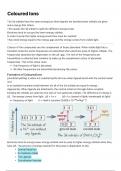
Coloured Ions
The 3d orbitals have the same energy but when ligands are bonded some orbitals are given
more energy that others.
This causes the 3d orbital to split into different energy levels.
Electrons tend to occupy the lower energy orbitals.
In order to jump the higher energy levels they must be 'excited'.
They need energy equal to the energy gap and this energy comes from visible light.
Colours of the compounds are the complement of those absorbed. When visible light hits a
transition metal ion some frequencies are absorbed when electrons jump to higher orbitals. The
frequencies absorbed are dependant on the ΔE gap. The rest of the frequencies are
transmitted or reflected and combine to make up the complement colour of absorbed
frequencies. This is the colour seen.
One frequency of light is absorbed.
All other frequencies are transmitted producing the colour.
Formation of Coloured Ions
[d-orbital splitting is when a d-subshell splits into two when ligands bond with the central metal
ion]
In an isolated transition metal element ion all of the 3d orbitals are equal in energy -
degenerate. When ligands are attached to the central metal ion through dative covalent
bonding the orbitals are split into two sets of non-generate orbitals. The difference in energy is
ΔE. The energy comes from light. ΔE = h x v ΔE= h x (speed of light/ wavelength of light)
v= frequency of light h = Hank's constant (6.626 x 10⁻³⁴m2kgs-1)
Electrons tend to occupy lower energy orbitals and to jump to higher energy orbitals when they
have ΔE. The amount of energy required for this jump is dependant on the:
Central Metal Ion
Its Oxidation State
The Ligands
Coordination Number
The 3d orbitals have the same energy but when ligands are bonded some orbitals are given
more energy that others.
This causes the 3d orbital to split into different energy levels.
Electrons tend to occupy the lower energy orbitals.
In order to jump the higher energy levels they must be 'excited'.
They need energy equal to the energy gap and this energy comes from visible light.
Colours of the compounds are the complement of those absorbed. When visible light hits a
transition metal ion some frequencies are absorbed when electrons jump to higher orbitals. The
frequencies absorbed are dependant on the ΔE gap. The rest of the frequencies are
transmitted or reflected and combine to make up the complement colour of absorbed
frequencies. This is the colour seen.
One frequency of light is absorbed.
All other frequencies are transmitted producing the colour.
Formation of Coloured Ions
[d-orbital splitting is when a d-subshell splits into two when ligands bond with the central metal
ion]
In an isolated transition metal element ion all of the 3d orbitals are equal in energy -
degenerate. When ligands are attached to the central metal ion through dative covalent
bonding the orbitals are split into two sets of non-generate orbitals. The difference in energy is
ΔE. The energy comes from light. ΔE = h x v ΔE= h x (speed of light/ wavelength of light)
v= frequency of light h = Hank's constant (6.626 x 10⁻³⁴m2kgs-1)
Electrons tend to occupy lower energy orbitals and to jump to higher energy orbitals when they
have ΔE. The amount of energy required for this jump is dependant on the:
Central Metal Ion
Its Oxidation State
The Ligands
Coordination Number