BC1B Formal Notes
Lecture 1- organic reactivity- principles
Reaction types: addition, substitution, elimination, isomerisation, oxidation and reduction. Others
include functional group transformations and “name” reactions e.g. aldol.
Hydrocarbon reactions
Alkanes- low polarisation-strong bonds, low reactivity, energetically favourable to form single bonds.
generally, alkenes undergo addition reactions (including redox) e.g. hydrogenation.
The reaction mechanism determines which isomer is formed, reactions can proceed via
intermediates. Alkynes highly reactive as triple bond not as energetically favoured as others. Similar
reactions to alkenes.
Ring strain- when molecules that would otherwise have 180-degree bond angles become cyclic and
are hence more reactive.
Delocalisation of aromatic rings determines reactivity. Aromatics energetically favourable. Don’t
undergo addition only electrophilic substitution.
Lecture 2- oxygen compounds + their reactions
Heteroatom- generally O, S or N added to hydrocarbon. Oxygen is bivalent -forms 2 bonds- 2
hybridisation states.
Alcohols synthesised by hydration of alkenes. R refers to substituent-often alkyl group. Alcohols
readily oxidised e.g. ethanol with alcohol dehydrogenase.
Acid/base behaviour
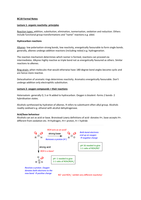
Alcohols can act as acid or base. Bronstead-Lowry definitions of acid- donates H+, base accepts H+.
different from oxidation etc. H=hydrogen, H+= proton, H-= hydride
Lecture 1- organic reactivity- principles
Reaction types: addition, substitution, elimination, isomerisation, oxidation and reduction. Others
include functional group transformations and “name” reactions e.g. aldol.
Hydrocarbon reactions
Alkanes- low polarisation-strong bonds, low reactivity, energetically favourable to form single bonds.
generally, alkenes undergo addition reactions (including redox) e.g. hydrogenation.
The reaction mechanism determines which isomer is formed, reactions can proceed via
intermediates. Alkynes highly reactive as triple bond not as energetically favoured as others. Similar
reactions to alkenes.
Ring strain- when molecules that would otherwise have 180-degree bond angles become cyclic and
are hence more reactive.
Delocalisation of aromatic rings determines reactivity. Aromatics energetically favourable. Don’t
undergo addition only electrophilic substitution.
Lecture 2- oxygen compounds + their reactions
Heteroatom- generally O, S or N added to hydrocarbon. Oxygen is bivalent -forms 2 bonds- 2
hybridisation states.
Alcohols synthesised by hydration of alkenes. R refers to substituent-often alkyl group. Alcohols
readily oxidised e.g. ethanol with alcohol dehydrogenase.
Acid/base behaviour
Alcohols can act as acid or base. Bronstead-Lowry definitions of acid- donates H+, base accepts H+.
different from oxidation etc. H=hydrogen, H+= proton, H-= hydride