○T RANSFORMATION○
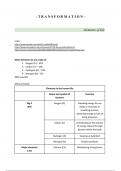
elements of life
Links:
https://www.youtube.com/watch?v=qdoQ9NHLuAQ
https://www.sciencelearn.org.nz/resources/1728-the-essential-elements
https://quizizz.com/join/quiz/614856e38dbbbf001d15bc0c/start?studentShare=true
Main elements we are made of:
1. Oxygen (O) – 65%
2. Carbon (C) – 18%
3. Hydrogen (H) – 10%
4. Nitrogen (N) – 3%
(96% overall)
More precisely:
Elements in the human life
Name and symbol of Function
element
Big 4 Oxygen (O) Providing energy for our
96% body, is necessary in
breathing process,
obtaining energy to fuel all
living processes
Carbon (C) Contributing to the process
of energy release through
glucose within the body
Hydrogen (H) Keeping us hydrated
Nitrogen (N) Protein synthesis
Major elements Calcium (Ca) Maintaining strong bones
3.5%
, Phosphorus (P) Formation of bones and
teeth
Potassium (K) Nerves functioning
Sulfur (S) Building DNA
Sodium (Na) Keeping the body
electrolyte
Chlorine (Cl) Keeping the balance of fluid
inside and outside the body
cells
Magnesium (Mg) Maintaining normal nerve
and muscle function
Trace elements Boron (B)
0.5%
Chromium (Cr)
Cobalt (Co)
Copper (Cu)
Fluorine (F)
Iodine (I)
Iron (Fe)
Manganese (Mn)
Molybdenum (Mo)
Selenium (Se)
Silicon (Si)
Tin (Sn)
Vanadium (V)
Zinc (Zn)
, chemical interactions and bonds
Links:
https://www.youtube.com/watch?v=ttEBGT0CMsQ
https://quizlet.com/403143756/ionic-covalent-and-metallic-bonding-diagram/
https://www.youtube.com/watch?v=RSRiywp9v9w
Atom structure:
Protons have a positive charge and are found in the nucleus.
Neutrons have a neutral charge and are found in the nucleus.
Electrons have a negative charge and are found orbiting the nucleus.
When an atom is missing one or more electrons it will have a positive charge.
When an atom has one or more extra electrons it will have a negative charge.
An atom with a charge is called an ion.
Chemical bonding – attraction between atoms, ions or molecules that enables the formation of
chemical compounds.
Molecule – covalently bonded group of atoms
Types of chemical bondings:
Ionic Bonding Transfer of valence -high boiling and melting Example: NaCl
electrons from metal point
atom to a nonmetal -form as crystals
atom which then both -conduct electricity if
atoms become stable dissolved in water and
exist as ions
-brittle and easily broken
down into small pieces
, Covalent Sharing of valence -mostly liquids and gases Example:
Bonding electrons between -low melting and boiling diatomic
nonmetal atoms to points molecules (as
become stable -does not conduct O2)
electricity
Metallic Metal atoms achieve a -good conductor of Example: Mg
Bonding stable form by sharing electricity
its outer shell electrons -ductility
with other metal -thermal and electrical
atoms. resistivity
-conductivity
Hydrogen bond – an attractive force that can exist between certain molecules.
Hydrogen bonds are weaker than other kinds of bonds because it takes less energy to break them.
Hydrogen bonds are created between water molecules because the electrons in water molecule are
not shared equally (water molecules are polar), as they have a higher probability of being found
closer to the nucleus of oxygen atom, giving that end a slightly negative charge. So, the hydrogen
atoms’ end of molecule will have slightly positive charge. These charged ends weakly attach the
positive end of one water molecule to the negative end of an adjacent water molecule. Hydrogen can
make such bonds with elements like oxygen (obviously), nitrogen and fluorine. When polar and
non-polar substances are mixed they do not create bonds between each other and they keep on
separating.
, Salts
Recall that salts are formed when ions form ionic bonds. In these reactions, one atom gives up one
or more electrons, and thus becomes positively charged, whereas the other accepts one or more
electrons and becomes negatively charged. You can now define a salt as a substance that, when
dissolved in water, dissociates into ions other than H+ or OH–. This fact is important in distinguishing
salts from acids and bases, discussed next.
A typical salt, NaCl, dissociates completely in water (Figure 2.4.2). The positive and negative
regions on the water molecule (the hydrogen and oxygen ends respectively) attract the negative
chloride and positive sodium ions, pulling them away from each other. Again, whereas nonpolar and
polar covalently bonded compounds break apart into molecules in solution, salts dissociate into ions.
These ions are electrolytes; they are capable of conducting an electrical current in solution. This
property is critical to the function of ions in transmitting nerve impulses and prompting muscle
contraction.
Figure 2.4.2 – Dissociation of Sodium Chloride in Water:
Notice that the crystals of sodium chloride dissociate not
into molecules of NaCl, but into Na+ cations and Cl–
anions, each completely surrounded by water molecules.
Many other salts are important in the body. For
example, bile salts produced by the liver help break apart
dietary fats, and calcium phosphate salts form the
mineral portion of teeth and bones.
Acids and Bases
Acids and bases, like salts, dissociate in water into
electrolytes. Acids and bases can very much change the properties of the solutions in which they are
dissolved.
Acids
An acid is a substance that releases hydrogen ions (H+) in solution (Figure 2.4.3a). Because an atom
of hydrogen has just one proton and one electron, a positively charged hydrogen ion is simply a
proton. This solitary proton is highly likely to participate in chemical reactions. Strong acids are
compounds that release all of their H+ in solution; that is, they ionize completely. Hydrochloric acid
(HCl), which is released from cells in the lining of the stomach, is a strong acid because it releases all
of its H+ in the stomach’s watery environment. This strong acid aids in digestion and kills ingested
microbes. Weak acids do not ionize completely; that is, some of their hydrogen ions remain bonded
within a compound in solution. An example of a weak acid is vinegar, or acetic acid; it is called
acetate after it gives up a proton.
elements of life
Links:
https://www.youtube.com/watch?v=qdoQ9NHLuAQ
https://www.sciencelearn.org.nz/resources/1728-the-essential-elements
https://quizizz.com/join/quiz/614856e38dbbbf001d15bc0c/start?studentShare=true
Main elements we are made of:
1. Oxygen (O) – 65%
2. Carbon (C) – 18%
3. Hydrogen (H) – 10%
4. Nitrogen (N) – 3%
(96% overall)
More precisely:
Elements in the human life
Name and symbol of Function
element
Big 4 Oxygen (O) Providing energy for our
96% body, is necessary in
breathing process,
obtaining energy to fuel all
living processes
Carbon (C) Contributing to the process
of energy release through
glucose within the body
Hydrogen (H) Keeping us hydrated
Nitrogen (N) Protein synthesis
Major elements Calcium (Ca) Maintaining strong bones
3.5%
, Phosphorus (P) Formation of bones and
teeth
Potassium (K) Nerves functioning
Sulfur (S) Building DNA
Sodium (Na) Keeping the body
electrolyte
Chlorine (Cl) Keeping the balance of fluid
inside and outside the body
cells
Magnesium (Mg) Maintaining normal nerve
and muscle function
Trace elements Boron (B)
0.5%
Chromium (Cr)
Cobalt (Co)
Copper (Cu)
Fluorine (F)
Iodine (I)
Iron (Fe)
Manganese (Mn)
Molybdenum (Mo)
Selenium (Se)
Silicon (Si)
Tin (Sn)
Vanadium (V)
Zinc (Zn)
, chemical interactions and bonds
Links:
https://www.youtube.com/watch?v=ttEBGT0CMsQ
https://quizlet.com/403143756/ionic-covalent-and-metallic-bonding-diagram/
https://www.youtube.com/watch?v=RSRiywp9v9w
Atom structure:
Protons have a positive charge and are found in the nucleus.
Neutrons have a neutral charge and are found in the nucleus.
Electrons have a negative charge and are found orbiting the nucleus.
When an atom is missing one or more electrons it will have a positive charge.
When an atom has one or more extra electrons it will have a negative charge.
An atom with a charge is called an ion.
Chemical bonding – attraction between atoms, ions or molecules that enables the formation of
chemical compounds.
Molecule – covalently bonded group of atoms
Types of chemical bondings:
Ionic Bonding Transfer of valence -high boiling and melting Example: NaCl
electrons from metal point
atom to a nonmetal -form as crystals
atom which then both -conduct electricity if
atoms become stable dissolved in water and
exist as ions
-brittle and easily broken
down into small pieces
, Covalent Sharing of valence -mostly liquids and gases Example:
Bonding electrons between -low melting and boiling diatomic
nonmetal atoms to points molecules (as
become stable -does not conduct O2)
electricity
Metallic Metal atoms achieve a -good conductor of Example: Mg
Bonding stable form by sharing electricity
its outer shell electrons -ductility
with other metal -thermal and electrical
atoms. resistivity
-conductivity
Hydrogen bond – an attractive force that can exist between certain molecules.
Hydrogen bonds are weaker than other kinds of bonds because it takes less energy to break them.
Hydrogen bonds are created between water molecules because the electrons in water molecule are
not shared equally (water molecules are polar), as they have a higher probability of being found
closer to the nucleus of oxygen atom, giving that end a slightly negative charge. So, the hydrogen
atoms’ end of molecule will have slightly positive charge. These charged ends weakly attach the
positive end of one water molecule to the negative end of an adjacent water molecule. Hydrogen can
make such bonds with elements like oxygen (obviously), nitrogen and fluorine. When polar and
non-polar substances are mixed they do not create bonds between each other and they keep on
separating.
, Salts
Recall that salts are formed when ions form ionic bonds. In these reactions, one atom gives up one
or more electrons, and thus becomes positively charged, whereas the other accepts one or more
electrons and becomes negatively charged. You can now define a salt as a substance that, when
dissolved in water, dissociates into ions other than H+ or OH–. This fact is important in distinguishing
salts from acids and bases, discussed next.
A typical salt, NaCl, dissociates completely in water (Figure 2.4.2). The positive and negative
regions on the water molecule (the hydrogen and oxygen ends respectively) attract the negative
chloride and positive sodium ions, pulling them away from each other. Again, whereas nonpolar and
polar covalently bonded compounds break apart into molecules in solution, salts dissociate into ions.
These ions are electrolytes; they are capable of conducting an electrical current in solution. This
property is critical to the function of ions in transmitting nerve impulses and prompting muscle
contraction.
Figure 2.4.2 – Dissociation of Sodium Chloride in Water:
Notice that the crystals of sodium chloride dissociate not
into molecules of NaCl, but into Na+ cations and Cl–
anions, each completely surrounded by water molecules.
Many other salts are important in the body. For
example, bile salts produced by the liver help break apart
dietary fats, and calcium phosphate salts form the
mineral portion of teeth and bones.
Acids and Bases
Acids and bases, like salts, dissociate in water into
electrolytes. Acids and bases can very much change the properties of the solutions in which they are
dissolved.
Acids
An acid is a substance that releases hydrogen ions (H+) in solution (Figure 2.4.3a). Because an atom
of hydrogen has just one proton and one electron, a positively charged hydrogen ion is simply a
proton. This solitary proton is highly likely to participate in chemical reactions. Strong acids are
compounds that release all of their H+ in solution; that is, they ionize completely. Hydrochloric acid
(HCl), which is released from cells in the lining of the stomach, is a strong acid because it releases all
of its H+ in the stomach’s watery environment. This strong acid aids in digestion and kills ingested
microbes. Weak acids do not ionize completely; that is, some of their hydrogen ions remain bonded
within a compound in solution. An example of a weak acid is vinegar, or acetic acid; it is called
acetate after it gives up a proton.