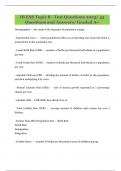
IB ESS Topic 8 - Test Questions 2023/ 45
Questions and Answers/ Graded A+
Demographics - -the study of the dynamics of population change
-Exponential curve- - -when populations follow an accelerating rate of growth which is
proportional to the population size
-Crude Birth Rate (CBR) - -number of births per thousand individuals in a population
per year
-Crude Death Rate (CDR) - -number of deaths per thousand individuals in a population
per year
-calculate CDR and CBR - -dividing the amount of deaths or births by the population,
and then multiplying it by 1000.
-Natural Increase Rate (NIR) - -rate of human growth expressed as a percentage
change per year.
-calculate NIR - -CDR-BDR, then divide it by 10.
-Total Fertility Rate (TFR)- - -average amount of children each woman has over a
lifetime.
-Factors That Affect Population Size - -Birth Rate
Death Rate
Immigration
Emigration
-Fertility Rates- - -number of births per thousand women of childbearing age.
, -Differences between Birth Rate and Fertility - -Birth Rate expressed in percentage
forms, births per thousand of total population (male, female, child, old)
Fertility represents only women
-Human Development Index (HDI)- - -measurement of "well-being" for a country.
(wealth, life expectancy, gross domestic product, education)
-GDP - -Gross Domestic Product- the total market value of all final goods and services
produced annually in an economy
-Countries Considered to be a NIC - -China, India, South Africa, Thailand, Turkey,
Mexico, Brazil
-Demography- - -statistical study of which includes human population, total size, age
and sex composition, change over time w/ variation in births and death rates.
-Factors That Affect Our Resources And Impact on The Environment - -Size of the
population
Wealth of the population
Resource needs and desires
-Malthusian Theory - -Expressed views on the danger of overpopulation and claimed
that food supply was the main limit to overpopulation
-explains the human population grow geometrically (2, 4, 8, 16, 32)
Explained food supply only grew arithmetically (2, 4, 6, 8, 10, 12)- was limited by the
lack of land
Questions and Answers/ Graded A+
Demographics - -the study of the dynamics of population change
-Exponential curve- - -when populations follow an accelerating rate of growth which is
proportional to the population size
-Crude Birth Rate (CBR) - -number of births per thousand individuals in a population
per year
-Crude Death Rate (CDR) - -number of deaths per thousand individuals in a population
per year
-calculate CDR and CBR - -dividing the amount of deaths or births by the population,
and then multiplying it by 1000.
-Natural Increase Rate (NIR) - -rate of human growth expressed as a percentage
change per year.
-calculate NIR - -CDR-BDR, then divide it by 10.
-Total Fertility Rate (TFR)- - -average amount of children each woman has over a
lifetime.
-Factors That Affect Population Size - -Birth Rate
Death Rate
Immigration
Emigration
-Fertility Rates- - -number of births per thousand women of childbearing age.
, -Differences between Birth Rate and Fertility - -Birth Rate expressed in percentage
forms, births per thousand of total population (male, female, child, old)
Fertility represents only women
-Human Development Index (HDI)- - -measurement of "well-being" for a country.
(wealth, life expectancy, gross domestic product, education)
-GDP - -Gross Domestic Product- the total market value of all final goods and services
produced annually in an economy
-Countries Considered to be a NIC - -China, India, South Africa, Thailand, Turkey,
Mexico, Brazil
-Demography- - -statistical study of which includes human population, total size, age
and sex composition, change over time w/ variation in births and death rates.
-Factors That Affect Our Resources And Impact on The Environment - -Size of the
population
Wealth of the population
Resource needs and desires
-Malthusian Theory - -Expressed views on the danger of overpopulation and claimed
that food supply was the main limit to overpopulation
-explains the human population grow geometrically (2, 4, 8, 16, 32)
Explained food supply only grew arithmetically (2, 4, 6, 8, 10, 12)- was limited by the
lack of land